Two Lawsuits Are Trying to Rewrite CS2 Cases — What's Actually at Stake
Two Lawsuits Are Trying to Rewrite CS2 Cases — What's Actually at Stake
Late on a Monday night in May, Valve's lawyers filed 42 pages with the Supreme Court of the State of New York asking a judge to throw out a lawsuit that could, if it succeeds, change what a CS2 case is allowed to be. The filing is not a technicality. It is a straight argument that opening a case is the same kind of act as buying a pack of baseball cards — and that if New York wins, half the retail shelf becomes a crime scene.
Justice Nancy Bannon is presiding. Valve is represented by Milbank LLP. The case is People of the State of New York v. Valve Corporation, index number 450952/2026, filed February 25. And whatever happens in that courtroom, the thing being litigated is the exact mechanic every CS2 skin site — including this one — is built on.
Two complaints, two different theories
The New York action came first. Attorney General Letitia James filed on February 25, alleging that Valve "has made billions of dollars luring its users, many of whom are teenagers or younger, to engage in gambling in the hopes of winning expensive virtual items that they can cash in on." The complaint calls loot boxes "quintessential gambling" and argues they violate both the state constitution and its penal law.
What James is asking for is not a slap on the wrist. Three things, in escalating order of severity: a permanent injunction stopping Valve from promoting gambling features in its games, disgorgement of what the state calls ill-gotten gains, and fines equal to three times Valve's alleged illegal profits. The complaint also seeks restitution for players.
Two weeks later, on March 9, a second front opened on the other side of the country. Law firm Hagens Berman filed a proposed nationwide class action in the U.S. District Court for the Western District of Washington, on behalf of two named plaintiffs and everyone in the US who bought a key and lost money opening it. That complaint targets the same system across Counter-Strike 2, Dota 2, and Team Fortress 2, and it seeks treble damages plus restitution plus an order forcing Valve to stop.
The Washington theory is narrower and, in some ways, more dangerous for Valve. It does not need to prove Valve advertised anything misleading. It only needs to establish that paying $2.49 for a key to receive a randomised item of variable resale value satisfies the state's three-part gambling test: consideration, chance, and prize.
Valve's defence is stranger than it looks
Valve's motion to dismiss does not dispute that cases are randomised, that keys cost money, or that the items hold resale value. It disputes the third leg: that anything is being staked.
The argument, in Valve's own words: "There is no 'stake' or 'risk.'" Every opening returns exactly one skin, the company says, so the player receives precisely what they paid for — a randomised cosmetic. Skins are "designed for entertainment and have subjective and aesthetic value." Neither Valve nor the Steam Community Market converts them to cash directly, which Valve uses to argue they are not "something of value" under the statute.
Then comes the part that reads less like a legal brief and more like a warning shot. Valve listed every transaction that would become chargeable under the Attorney General's interpretation: baseball card packs, Labubu blind boxes, cereal box toys, comic book grab bags, Happy Meal toys, and arcade games at Chuck E. Cheese where you trade tickets for prizes. "Can a child reach into a cereal box and grab a surprise toy?" the filing asks. The company also notes that the legislature has repeatedly considered and declined to regulate mystery boxes, meaning Valve had no reason to believe it was breaking a law that nobody had written.
Valve's public statement struck the same note, with less theatre: "We don't believe that they do, and were disappointed to see the NYAG make that claim after working to educate them about our virtual items and mystery boxes since they first reached out to us in early 2023." It closed by conceding the obvious — "Ultimately, a court will decide whose position—ours or NYAG's—is correct."
The legal consensus is not unanimous, but it leans Valve's way on the motion. Lawyer and analyst "Legal Mindset" told Dexerto that Valve is "likely to find solid basis to fight this under existing caselaw, where they have already won," and can additionally assert a First Amendment right in creating game systems.
The number that decides it isn't in either filing
Both sides are arguing about categories — is a skin a prize, is a case a lottery. The number that will actually move a judge is the distribution inside the box, and it is public.
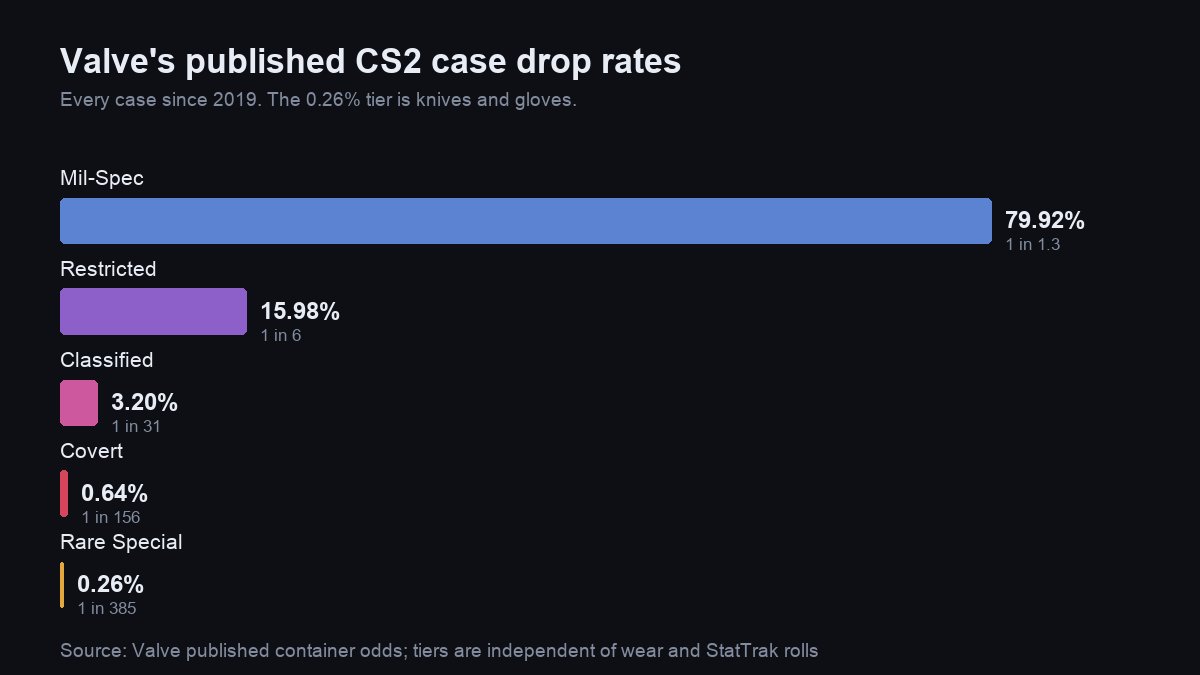
79.92% of openings return a Mil-Spec (blue) item. Another 15.98% return Restricted (purple). Classified is 3.20%, Covert is 0.64%, and the Rare Special tier — knives and gloves — is 0.26%, roughly one in 385 openings.
That shape is Valve's strongest fact and its weakest at the same time. Strong, because it supports "you always get something." Weak, because the Attorney General's office does not need every opening to be a loss — it only needs the typical opening to be one, and it is. On a case costing roughly $3 all-in, the median opening returns a fraction of the spend. The complaint's framing that many items "are worth pennies" is, arithmetically, correct.
Which is why the market consequence of a Valve loss would not arrive through a fine. It would arrive through the injunction. A ruling that cases constitute illegal gambling in New York would bar Valve from selling them to New York residents at all — and once one state sets that precedent, the compliance question stops being "how much do we owe" and becomes "which states are next."
The Germany precedent nobody talks about
There is already a working template, and it is not a ban. In March 2026, Valve announced that players in Germany would only be able to open in-game containers through the X-ray Scanner — a mechanic that lets you see the contents before you commit — in order to comply with German law on games of chance.
That is the most likely shape of any US settlement or adverse ruling short of a full prohibition: not the removal of cases, but the removal of the surprise. An X-ray-first case is a different product. It keeps the container, keeps the key, keeps the marketplace, and deletes the gambling mechanic that the entire case-opening economy is priced on.
It is worth being precise about what that would do to prices. A case's premium over its contents comes from the option value of the unknown roll. Strip the unknown and a case becomes a bundle — priced at or below the sum of its parts, because why would anyone pay a markup for a random pick of items they can see. The Fever Case crossing under its own redemption cost this October is a preview of where that ends up.
What this means if you own cases or skins
Three honest reads, none of them apocalyptic.
First: the near-term odds favour Valve. Courts have been reluctant to extend gambling statutes to mystery boxes without a legislature acting first, and Valve has already won on this ground before. A dismissal with prejudice is a real possibility, not a fantasy.
Second: the risk is regulatory drift, not a single verdict. Germany's X-ray Scanner was not a court loss — it was Valve choosing compliance over a fight. If New York signals the same direction, Valve may well settle into a scanner-style compromise rather than risk a treble-damages judgment, and every case price in the world reprices when that happens.
Third: sealed-case holders should be watching the calendar, not the headlines. Cases are the part of this market most exposed to a mechanics change, because their entire premium is the option on the roll. Skins that people actually equip have a floor — use value — that a legal ruling does not touch. That asymmetry is the single most useful thing to take out of both filings.
The market has already been repricing this risk without saying so out loud. Total cap sits near $6.52 billion after six consecutive weekly declines, with player counts down seven months running. Some of that is the trade-up update. Some of it is players leaving. Some of it, whether traders admit it or not, is a legal question that has been open since February and is still waiting on a judge.
If you want to open a case with the published odds in front of you rather than buried in a footnote, Golden Decree is live on SkinVS — every tier listed, 0.26% gold included, no asterisks.