Inside the Week CS2's Bot Farms Went Quiet
Inside the Week CS2's Bot Farms Went Quiet
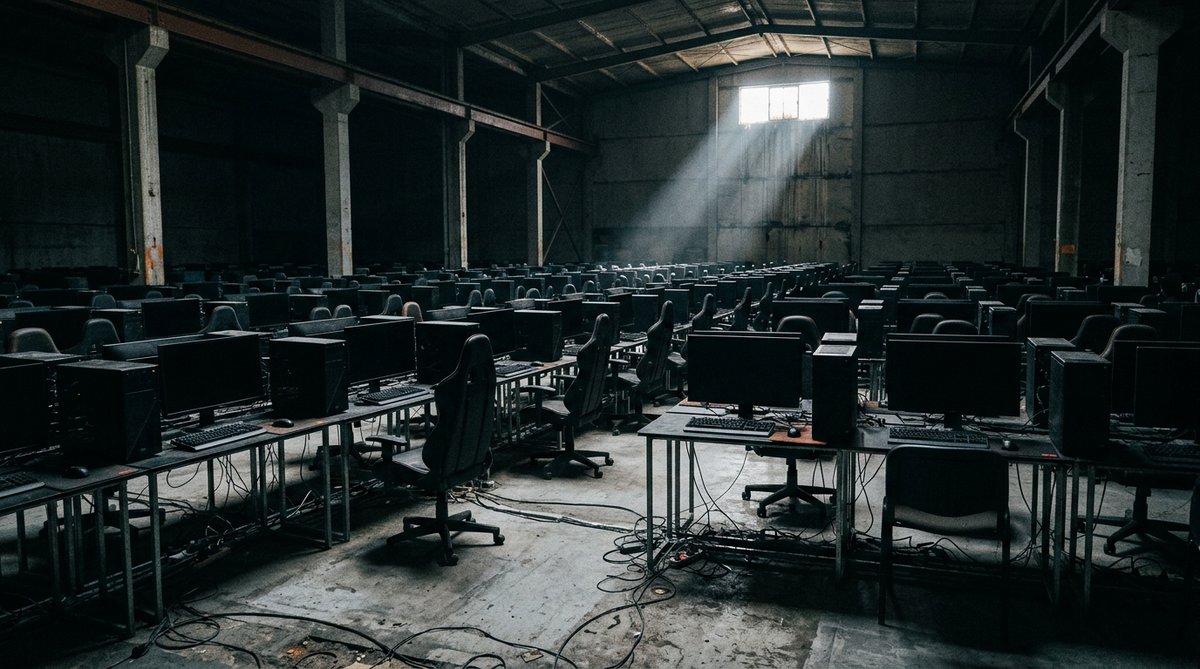
The reports came out of the item market this time, not the forums. In early September, operators who had been running thousands of automated Counter-Strike 2 accounts started powering their rigs down. They were not selling the hardware. They were switching it off and waiting to see whether farming weekly drops would ever pay again.
That detail is the whole story. When a business with real money sunk into it stops running instead of liquidating, it means the operators expect the rules to change back. Right now, nobody knows whether they will.
What the Operators Are Actually Waiting For
According to reports circulating through the item market, several owners of large Chinese farming operations suspended work rather than shut down permanently. The reason given is VACnet, Valve's machine-learning anti-cheat layer, and the new review system built around it. Operators are watching to see if farming weekly drops and Armory items becomes profitable again under the new detection regime.
What spooked them is that there is no safe room left. Farming accounts used to hide in the modes nobody scrutinized: Deathmatch, Casual, rigged competitive lobbies, Retakes. Those are exactly the modes now under review. When your entire business model depends on blending into a crowd, and the crowd is being audited, the rational move is to stop.
The numbers behind that decision are not vague. They are public, and they are brutal.
The Three Numbers That Explain the Panic
960,000. That is how many farming accounts Valve banned on March 26, 2026 in a single day. CS2 project lead Ido Magal confirmed the figure himself on Reddit, calling it the result of an extended investigation that leaned on community reports. Previous waves had peaked in the tens of thousands. This was an order of magnitude beyond anything before it.
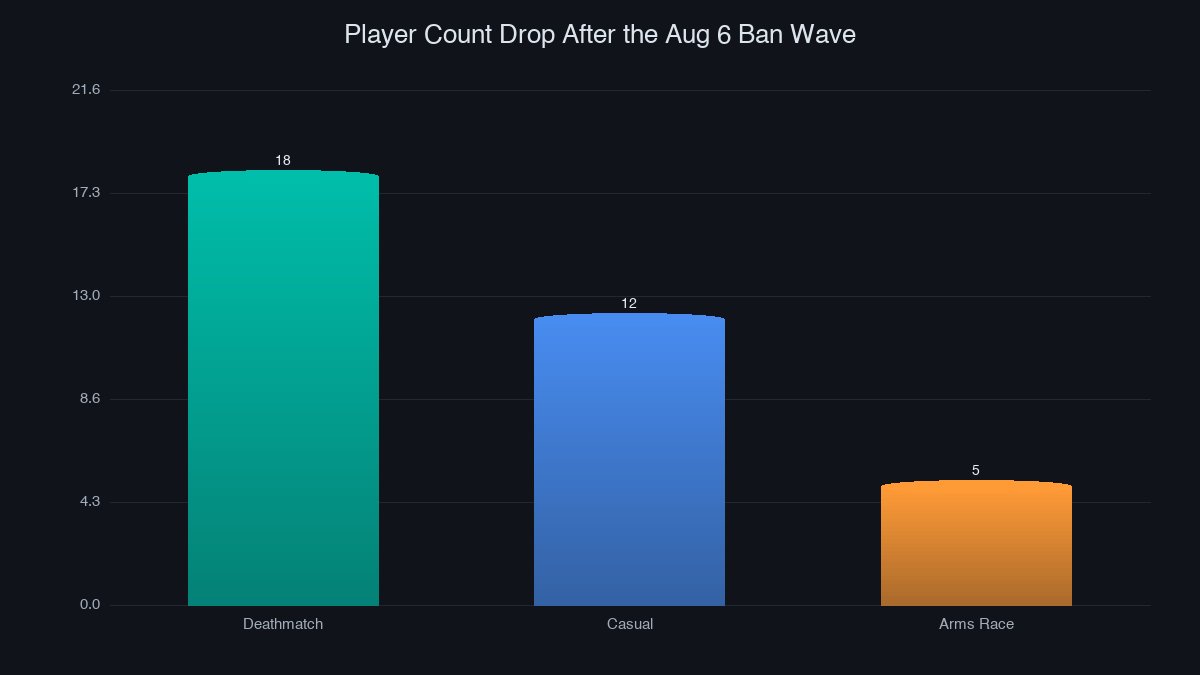
Roughly 7,700. That is how many accounts went down in a single day on August 6, 2026, according to third-party trackers. The visible side effect was a measurable drop in the modes bots had colonized: Casual player counts fell by around 12,000 that week, Deathmatch by about 18,000, and Arms Race by roughly 5,000. Those are not normal weekly swings, and they are the clearest evidence yet that the accounts were concentrated in exactly those lobbies.
Five. That is how many items remain in the active weekly drop pool as of 2026: the Dead Hand Terminal, the Sealed Genesis Terminal, the Kilowatt Case, the Revolution Case, and the Dreams & Nightmares Case. Back on December 17, 2025, Valve set the entire rare drop pool to zero, pushing more than 35 older cases out of regular circulation.
Put those together and you get a supply chain with a very narrow neck, guarded by a system that is actively being tightened.
What makes the crackdown unusual is that it targets economics rather than cheating. These accounts were not aimbotting or wallhacking. They were sitting still, or looping scripted movements, to survive basic AFK checks while the drop timer ticked down. That is a much harder pattern to detect at scale, because the behavior of a farming bot looks a lot like the behavior of a bored human.
Why Anyone Bothered Farming in the First Place
To understand the stakes, you have to follow the money into the weekly care package. A Prime player levels up, gets a package, and picks rewards. Inside can be a case, and inside that case sits a 0.26% chance at a rare special item, meaning a knife or a pair of gloves. That works out to roughly one gold item per 385 openings, and every opening needs a $2.49 key.
No single account makes meaningful money from that. But run a thousand accounts through Deathmatch on a loop, week after week, and the arithmetic flips. Cases and cheap skins trickle in, get sold, and the revenue scales with the rig count. The same logic applied to Armory stars, which convert into collections, charms, stickers, and cases.
The crucial constraint is that rewards only drop in Valve's own matchmaking. There is nothing to farm on community servers, which is why the bot problem never touched private matches and why the crackdown had to happen inside official modes.
By July 2026, Valve's Armory-related revenue had reached at least $878 million, according to reporting on the format shift. That number is a reminder that the farming economy was never stealing from an empty room. It was skimming off a river of real money.
It is also why the fight has dragged on so long. The automation software behind these operations is commercially maintained, updated regularly to dodge detection, and distributed through channels that are not simple to shut down. Operators who lost a thousand accounts in March still had the tooling and the know-how. What they no longer have is a comfortable assumption that the next thousand will survive.
What This Does to Skin Prices
Here is the part that matters for your inventory. Farming bots were a supply pipeline. They were a persistent, low-cost source of the cheapest items in the game: weekly cases, Armory drops, budget skins. When that pipeline goes dark, the cheapest end of the market tightens first, because that is where the farmed volume lived.
This is happening against an economy that is still healing. The October 2025 trade-up change, which let players exchange five Covert skins for a knife or gloves, wiped roughly $2 billion off the market in about 30 hours. By mid-August 2026, the total estimated value had climbed back to around $7 billion, above its previous record. A thinner farmed supply on top of an already narrow drop pool points in one direction for budget items: fewer cheap listings, slower restocks, and more pressure on the floor.
That does not mean everything goes up. It means the items that were cheap because bots kept feeding them in are the ones most exposed to a squeeze. If you have been waiting for a budget case or a low-tier skin to get cheaper, the window may be closing from the supply side, not the demand side.
If you want to see where the floor actually sits right now, the fastest way is to check live listings rather than forum guesses. A case like the Phantom Cache gives you a clean read on what the current pool is actually worth, and whether the thin supply is already showing up in prices.
What to Watch From Here
Three signals will tell you whether the farms stay dark or come back. First, ban counts: if daily ban spikes keep appearing on public trackers, the review system is still biting and operators will stay cautious. Second, the drop pool: another rotation would squeeze the faucet further and make farmed supply even less replaceable. Third, Armory participation, because that is where the operators' attention will shift if weekly drops become unprofitable.
The quiet is not peace. It is a pause while both sides figure out the new rules. The one thing you can count on is that the supply of cheap items is no longer being manufactured by a thousand silent accounts sitting in Deathmatch, and markets eventually price that in.