Five CS2 Items Moved 400% Last Week. Four of Them Are Noise.

Five CS2 Items Moved 400% Last Week. Four of Them Are Noise.
On November 2, the seven-day median sale price of a Desert Eagle | Heat Treated (Well-Worn) on Skinport was $5.14. A week earlier it was $1.01. That is a 408.9% gain, and on a leaderboard it looks like the best trade in Counter-Strike 2.
It also involved 12 sales. Twelve. Across 243 listings.
Every week the CS2 market produces a handful of numbers like this, and every week someone screenshots them into a Discord as proof that a forgotten skin is about to run. This week's data gives us a clean chance to separate the moves that mean something from the ones that are just a thin order book, a patient seller, and one buyer who did not check the price.
How a "Move" Gets Counted
The weekly snapshot from CounterStrikeGO tracks 907 liquid items, where liquid means at least 10 listings and at least 10 sales in the week. Prices are seven-day medians on Skinport, in US dollars, taken November 2 at 3:52 p.m. UTC.
Of those 907 items, 384 rose by 0.5% or more and 394 fell by the same margin. The overall index dropped from 94.18 to 92.8, a loss of 1.5% on the week. The index is set to 100 on September 27, 2026, so this is not a long decline being measured — it is six weeks of grinding lower.
The four groups diverged sharply. Knives and gloves lost just 0.3%. Covert and Classified skins lost 0.4%. Cases fell 3.7%. Stickers and capsules fell 4.2%.
That split is the actual story of the week: the expensive stuff is holding, and the cheap consumable stuff is bleeding. Everything below should be read against that backdrop.
#5: MP9 | Slide (Minimal Wear), +2,750%
From $0.02 to $0.57, on two sales, against 302 listings.
This is the purest example of what the report itself labels a warning rather than a trend. Two buyers paid a listing that had been sitting above the real market for weeks. The other 300 sellers are still asking cents. Nothing about the supply of an MP9 | Slide changed, so nothing about its value changed. If you own one, you cannot sell it for $0.57 — you can list it at $0.57 and wait.
#4: Desert Eagle | Heat Treated (Well-Worn), +408.9%
From $1.01 to $5.14, on 12 sales, with 243 listings.
This one is more interesting because 12 sales clears the liquidity bar, and a Desert Eagle is a weapon people actually use. But look at the ratio: 12 sales against 243 listings means roughly 5% of the available supply changed hands in a week. That is not demand absorbing supply, it is demand poking a hole in it.
There is a plausible reason for a five-dollar floor on a Well-Worn Desert Eagle — the Heat Treated finish has pattern variation, and buyers do pay for specific blue coverage. But a pattern premium on 12 sales is a collector's market, not a signal you can trade on. The next Well-Worn listing that wants to sell will clear near $1.50, and the median will fall as fast as it rose.
#3: Tec-9 | Banana Leaf (Factory New), +320%
From $0.15 to $0.63, on 11 sales and 109 listings.
Same structure as the Desert Eagle with even less to support it: a cheap skin, a small pool of buyers, and a 10% sell-through rate. There is no case change, no collection change and no Valve update behind this. The Tec-9 is one of the least-used pistols in CS2 at the professional level and one of the most common drops at the low end. A 320% move here describes one week of listings, not a repricing.
#2: M4A4 | Naval Shred Camo (Factory New), +163.6%
From $0.22 to $0.58, on 20 sales and 146 listings.
This is the best-supported riser of the cheap group: 20 sales is double the Desert Eagle's count, and an M4A4 skin has a wider buyer pool than a Tec-9. Still, the absolute move is 36 cents. Any skin under a dollar moves in large percentages because the denominator is tiny — a single buyer stepping up from $0.22 to $0.58 is a rounding error in dollars and a headline in percent.
#1: Paris 2023 Challengers Sticker Capsule, +100%
From $0.15 to $0.30, on 15 sales and 11,634 listings.
This is the only riser in the top five I would call real, and the reason is the listing base. Eleven thousand listings is not an order book you can accidentally move. Doubling the median of an item with that much supply requires enough buyers to clear through a deep stack of sellers, which is what a doubling actually means here.
It also runs against its own category. Stickers and capsules as a group fell 4.2% for the week, the worst of the four groups. When a capsule rises while the capsule index falls, that is a rotation inside a category: buyers leaving newer, more expensive capsules for the cheapest sealed product on the shelf. That is a real behaviour, and it is the kind of move that tends to persist for a few weeks rather than a few hours.
The Side That Actually Moved
The fallers tell the opposite story, and their sales counts are 10 to 20 times higher.
- Negev | Sour Grapes (Factory New): $0.94 to $0.54, -42.6%, 14 sales, 68 listings
- G3SG1 | Green Apple (Factory New): $0.21 to $0.13, -38.1%, 13 sales, 234 listings
- StatTrak FAMAS | Mecha Industries (Field-Tested): $22.34 to $15.55, -30.4%, 11 sales, 17 listings
- Shanghai 2024 Legends Sticker Capsule: $0.65 to $0.46, -29.2%, 21 sales, 596 listings
- Revolution Case: $0.28 to $0.21, -25%, 226 sales, 18,222 listings
The Revolution Case is the one that matters. Two hundred and twenty-six sales in a week against 18,222 listings is a functioning market moving down in an orderly way. It lost a quarter of its value and it did so on volume, which means sellers were meeting buyers and both sides accepted the new level. Compare that to the Desert Eagle: 12 sales, no meeting of minds, just a thin stack.
The StatTrak FAMAS | Mecha Industries is the mirror image of a phantom pump. A $22 item fell 30% on 11 sales and 17 listings — and that is a believable decline, because when only 17 copies are listed, one motivated seller sets the price for everyone. Thin liquidity cuts both ways. It creates fake rallies and real crashes.
What the Volume Actually Looked Like
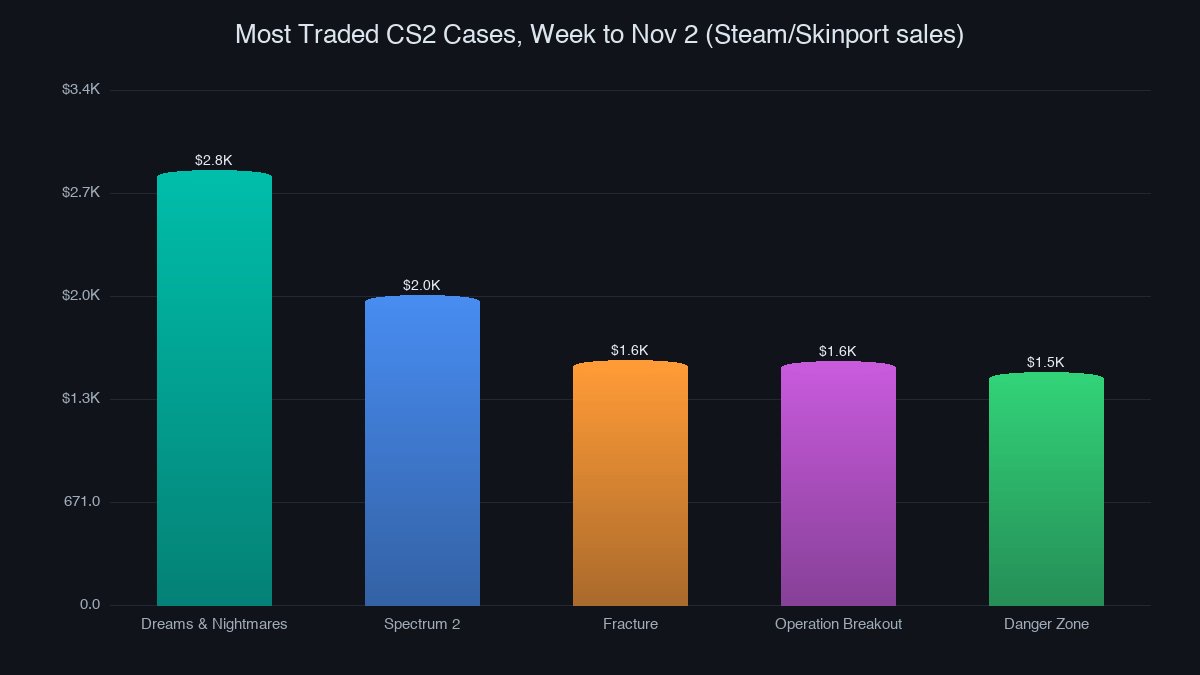
The five most traded items of the week were all cases, which is the normal shape of this market — cases are the cheapest way to participate.
- Dreams & Nightmares Case: 2,796 sales, $0.96 median
- Spectrum 2 Case: 1,984 sales, $2.55 median
- Fracture Case: 1,558 sales, $0.38 median
- Operation Breakout Weapon Case: 1,552 sales, $6.79 median
- Danger Zone Case: 1,480 sales, $0.87 median
Here is the detail worth carrying forward: in the week to October 19, the Dreams & Nightmares Case moved 3,000 units at a $1.13 median. By November 2 it moved 2,796 units at $0.96. Volume held within 7% while the price fell 15%. That is the signature of supply growing faster than demand — the same number of buyers, more cases to sell to them.
What to Take From a Week Like This
Three habits separate reading this data from being fooled by it.
Check sales before percentages. A 400% move on 12 sales and a 25% move on 226 sales are not the same event, and only one of them is information. If the number of sales is lower than the number of listings by a factor of ten, you are looking at a listing change, not a price change.
Read the category, not the item. Cases down 3.7% and capsules down 4.2% while knives lose 0.3% is a statement about where supply is being added. A single skin rising inside a falling category is usually rotation; a single skin falling inside a falling category is usually the trend arriving.
Do not chase a median. Seven-day medians describe the middle of completed trades, not the price you can get today. On a thin item the median and the ask can be 400% apart, in either direction.
If you want to act on the part of this market that is actually liquid, the cheap end of the case market is where the volume is — and the Phantom Cache and Small Arms cases on SkinVS give you the same volume-driven pricing without the 12-sale distortion, and the SkinVS shop lets you price a specific float and wear instead of buying blind at a median. Check the sales count on anything that looks like a steal before you pay for it. Most weeks, the steal is a listing.