Capsules vs Tokens: How Cologne 2026 Broke the Sticker Market
Capsules vs Tokens: How Cologne 2026 Broke the Sticker Market
In late August, a Falcons Gold sticker from the Cologne 2026 Major was selling for $1,468. By the time Valve's fixed-price Ranked Series landed, the same sticker was quoted at $52. That is a 96% collapse — not on a knife, not on a case, but on a tournament sticker, the most predictable asset class this market has ever had.
The cause is not a scam, a ban, or a market crash. It is a design decision. Cologne 2026 was the first Counter-Strike Major in history to ship without sticker capsules. Instead, Valve built an in-client token shop with dynamic pricing, then watched it fail loudly enough that it had to go back and patch the economy mid-event. Here is the comparison that matters, round by round.
Round 1: Supply — Blind Capsules vs an Open Shop
Under the old model, you bought a Team or Autograph Capsule for a fixed price and unboxed a random sticker from a defined group. Supply was effectively unlimited during the event but cheap and easy to absorb, and Valve ran deep discounts late in the cycle. Paris 2023 generated more than $110 million for teams and players, with a large share of that revenue arriving during five months of 75%-off capsule sales.
Cologne 2026 replaced that with event tokens — roughly $1.00 for 100 tokens — exchanged directly for the exact team or player sticker you wanted, including Holo and Gold tiers. Sticker token prices floated with demand instead of being fixed. Valve added a small safety net: if a sticker's token cost drops by 25 tokens or more within 24 hours of your purchase, the difference is refunded to your balance.
The supply consequence is the part traders missed. While the Major Shop stays open, supply is not scarce at all — it is limited only by how many people are willing to pay the current price. There is no capsule inventory to run dry, no post-event supply cliff to anticipate. Scarcity, in this model, is something that only begins the moment the shop closes.
Round 2: Prices — $1,500 Holos and Dead Weight
Dynamic pricing did what dynamic pricing does when demand is uneven. Popular players and top orgs pushed stickers past $1,000 in the official store, and some exceeded the Steam wallet limits entirely — meaning they could not be purchased in a single transaction inside the game. At the other end, the majority of stickers tied to smaller organizations and lesser-known players had almost no value at all.
Valve eventually said it out loud: the original dynamic pricing system "didn't produce reasonable prices." The fix was a second sticker series, Ranked Series, sold at fixed prices with 50% of royalties going to teams, players, and the tournament organizer. Valve also published an end date for the entire Cologne shop — September 29, 2026 — roughly two months after launch.
Put the two supply models side by side and the gap is obvious. A capsule-era sticker's population was decided by how many capsules players chose to open, and almost every one of them entered circulation permanently. A token-era sticker's population is decided by how many people were willing to pay a floating price inside a two-month window — which means nobody, including Valve, can state the final number until months after that window shuts.
The market's verdict on that fix was brutal and fast. Long-term sticker holders watched premiums evaporate, community threads filled up with "rip investors" and "disaster recovery," and the headline number was that Falcons Gold slide from $1,468 to $52. What actually happened is simpler than the outrage: a fixed-price restock appeared in a market where supply had been artificially thin, and the thin-supply premium died.
Round 3: Team Revenue — Where the Damage Really Landed
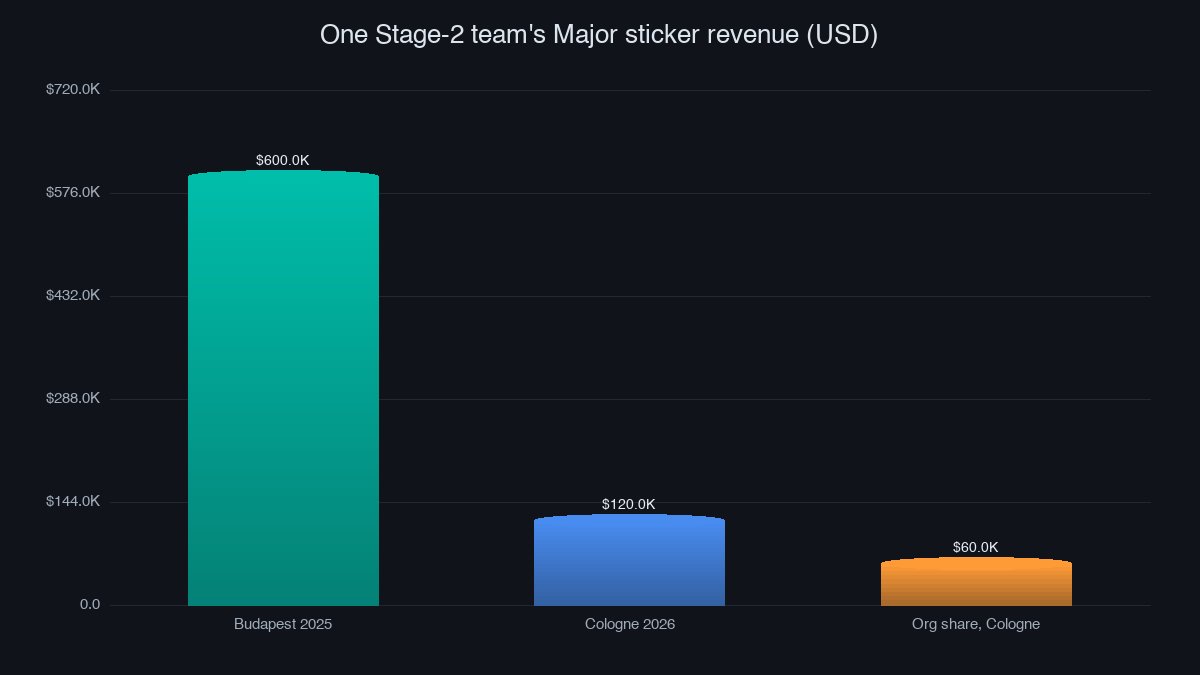
Sticker prices are a spectator sport. Team revenue is the actual scoreboard, and that is where Cologne 2026 did real harm. HLTV reported that one Stage 2 team saw sticker revenue fall from $600,000 at the Budapest Major to $120,000 at Cologne before splitting with players — leaving roughly $60,000 for the organization. One Stage 1 team was reportedly earning about $100 a day as sales slowed in late July.
Those numbers are not just about pricing. Valve tied payout percentages to ranking, so teams that qualified and lost early collected very little. Under the new split, the winning team receives 2.85% of the total revenue pool, tournament organizers receive 5% for the first time, and each player gets 10% of the team's share directly from Valve rather than through the org — a change that has already triggered contract disputes inside some rosters.
Read the two ends of this together. A casual fan who would happily pay $1 for a capsule and a lottery ticket is not going to pay $800 for one gold sticker, and a team that finishes 31st or 32nd collects 0.72%. The old system spread money through volume. The new one concentrates it at the top and replaces impulse buying with a considered purchase most players skip.
What This Means If You're Holding Stickers

First, separate the eras. Legacy stickers from the capsule years — think Katowice 2014 Holos, where a single Titan Holo sits listed around $69,690 — have a supply that is fixed forever and no connection to what Valve does in 2026. Cologne-era stickers are the opposite: their final supply is not yet known, and will not be known until the shop's closing date has fully worked through the secondary market.
Second, treat store prices as a tax on impatience rather than a valuation. While the Major Shop is open, secondary listings have repeatedly sat several times below in-client prices. Anyone who bought at store price during a spike is already deep underwater on paper, and the Ranked Series restock proved how quickly a fixed price can reset a floating one.
Third, look at demand-side changes rather than headline prices. The September 22, 2026 patch quietly let players apply stickers to the C4, which creates a brand new consumption path: every sticker welded to a bomb is permanently removed from trade. It is a small sink, but it is the first new one for stickers in years, and sticker sinks are exactly what made old Holos behave differently from old gun skins.
The Verdict
Capsules lose on transparency and win on volume. The token shop wins on legality and player choice — buying the exact sticker you want is a better experience than gambling a capsule, and it sidesteps the loot-box restrictions that already apply in markets like Belgium and the Netherlands. It loses on everything else: price discovery, team funding, and the impulse demand that made Major stickers a mass-market product.
Valve's own mid-event fix tells you which way this is heading. Ranked Series stickers with fixed prices and 50% royalties are a step back toward the capsule model, and the two-month shop window mirrors the length of a classic Major sticker sale. Expect the hybrid to stay: capped prices, transparent purchases, permanently unknown final supply.
Practically, that means the smart window to look at Cologne 2026 stickers is now — after the shop has closed, once real supply is visible and the panic selling has washed out. Compare listings against the shop's final prices on the SkinVS shop, and if you would rather hold something with a supply that can never be reprinted, the Phantom Cache and the rest of the case pool do not have a closing date at all.