CS2's Newest Cosmetic Is Its Worst Performer: Charms Are Down 75%
CS2's Newest Cosmetic Is Its Worst Performer: Charms Are Down 75%
Valve launched charms in October 2024 as the first genuinely new cosmetic category in Counter-Strike in years. Small 3D trinkets that clip to a weapon, swing on their own ragdoll physics, and can be pulled off and reattached without being destroyed. Two years later, the index that tracks all 78 of them sits at 245.6 against a starting level of 1,000. That is a 75% decline from launch, and it is the worst two-year performance of any category in the game.
The obvious explanation is that everything is down. That explanation does not survive contact with the data. Over the 27 days captured in the most recent full market snapshot, knives fell a median 3.3%, gloves 4.3%, weapon skins 2.4%, stickers 2.3% and cases 2.6%. Charms fell 14%. So the question worth answering is not why cosmetics are soft. It is why this one specific category is falling five times faster than everything around it.
The Category Nobody Can Grade
Every other item in CS2 has a quality ladder that traders can price against. Weapon skins have float and wear tiers. Knives have patterns and phases. Stickers have position and wear. Charms have none of it.
A charm is either the one you pulled or it is not. There is no Factory New charm, no 0.003 float chase, no rare phase. SteamDB's own catalogue notes that charm value is driven almost entirely by which figure you pulled, "not by wear or float, since charms have no exterior condition."
That sounds like simplicity. In practice it removes the single most reliable source of price support in the entire CS2 economy: the grading premium. When a skin has five wear tiers, there are five different buyer pools at five different budgets, and the top tier acts as an anchor that drags the rest up with it. A charm is one buyer pool at one price, and if that buyer does not want a specific model, the charm is worth whatever the next cheapest seller will accept.
The price floor across the category is $0.08. The cheapest charm on the market is Backsplash at eight cents, and the average of all 78 charms is $5.38. That is not a collectible market. That is a keychain rack.
No Contract, No Bid
The second structural problem is that charms are not inputs to anything. You cannot feed five charms into a contract to roll a knife. You cannot trade them up. They are not part of a case pool, they come from dedicated charm capsules, and they do not drop from weapon cases at all.
Compare that to Covert skins. Since October 2025, five Covert skins feed a contract that outputs a knife or a pair of gloves. That single mechanic puts a hard, computable bid under every Covert skin in the game, which is why Covert prices moved violently when the trade-up system launched and why they have held a floor since. Charms have no such bid. Nothing consumes them. Nothing converts them into anything else.
What they do have is continuous supply. As long as the capsule or Armory pool containing a charm is live, new copies keep arriving into a market that already has 581,924 listings across 78 items. That is roughly 7,460 listings per charm model, competing for buyers who, in aggregate, spend about $78,144 a week on the entire category.
Run that arithmetic out loud. $78,144 divided by seven days, divided by 78 items, is about $143 of trading per charm per day across every venue that reports volume. The category turns over less in a day, per item, than a single mid-tier AK skin does in an hour.
Why a Capsule Rotation Won't Save It
The standard bull case for charms runs like this: every charm sits in a pool that Valve rotates, and when a pool closes, supply stops. Closed taps do not guarantee a price rise, they only stop the flood, and in this category the flood has already happened.
The numbers make that argument worse, not better. 581,924 listings accumulated against 78 models while the pools were open. Rotating a tap on a market holding 7,460 listings per model does not create scarcity, it just stops adding to a pile that nobody is clearing. You can watch the same physics play out in cases: the Revolution Case lost 25% in a single week earlier this month, and cases at least have a reason to be consumed. Someone opens them. Nobody opens a charm.
The only mechanism that has ever re-priced a dead CS2 category is a change in what the item can be converted into. Trade-ups did exactly that for Covert skins in October 2025, and the effect was measurable within 24 hours across the entire Covert tier. Nothing in Valve's roadmap proposes a use for charms beyond hanging them on a gun. Until something consumes them, the supply side has no counterweight.
What the Tape Actually Looks Like
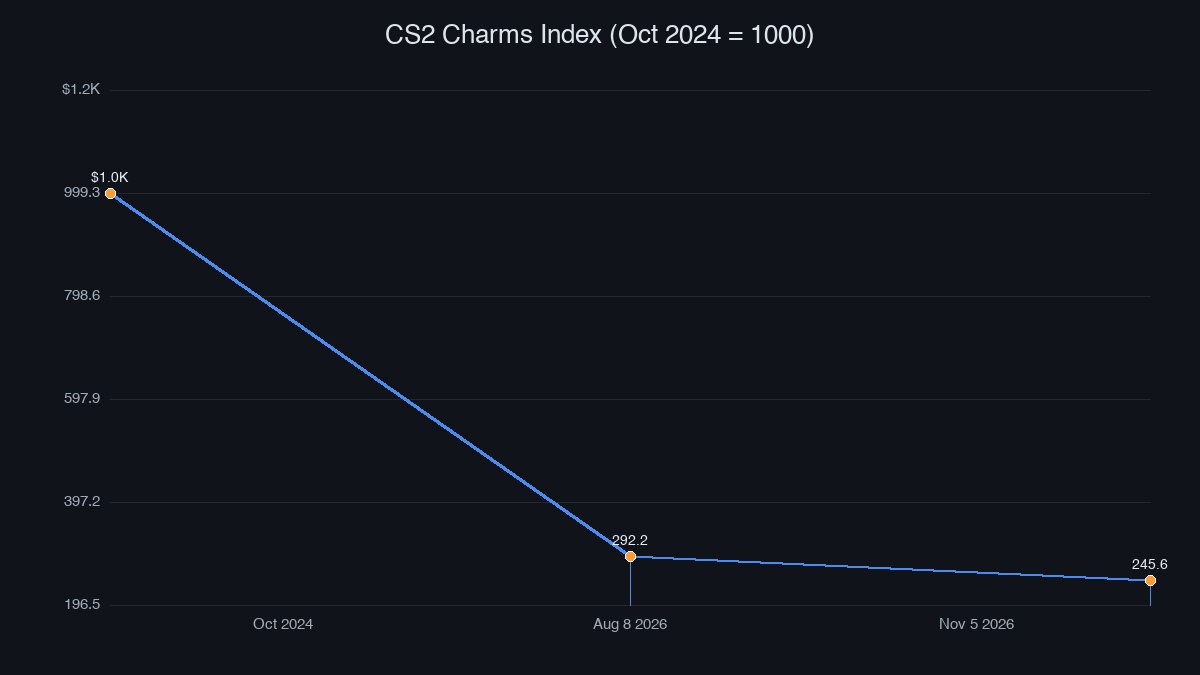
The shape of the decline is what tells you this is structural rather than an event. There was no single crash day to point at. The index did not gap down on a lawsuit, a policy change or a Valve announcement. It ground from 1,000 to 292.2 by August 2026, then lost another 16% over the following three months.
The losses are also broad, not concentrated in a few unloved models. Of 255 charm listings with enough market coverage to compare, 170 fell, 69 rose and 16 were flat over the same 27-day window that saw knives fall 3.3%. In a healthy category you would expect the top-end chase items to hold while the commons rot. Here the top end is falling with everything else: Hot Wurst lost 26% in 30 days, Lil' Monster 26%, Diamond Dog 25%, Baby Karat T 22%.
That is the signature of a market where the buyers stopped believing the story, not one where a few items went out of fashion. And the story was always the same one: this is the new thing, get in early. Two years of monthly declines is a long time to hold that position.
Where Charms Actually Work
None of this means charms are bad items. It means they are bad investments, and those are different claims. A charm that clips to your AK and swings when you strafe is a genuinely good piece of cosmetic design, and it is the only cosmetic in the game you can move between weapons freely without destroying it. You buy it once, you keep it, you play with it.
The mistake, and it is an extremely common one, is treating a $5 keychain as a store of value. The category's own numbers argue against it: 7,460 listings per model against $143 of daily turnover is a ratio that guarantees you will be the cheapest seller if you ever need out quickly, and that is how a $5 charm becomes a $3.40 charm after fees.
If you want the charm, buy the charm. Buy the one that looks good on the gun you actually use, in the rarity you can justify, and stop checking the index. If you want exposure to CS2 that has a bid under it, the data points somewhere else entirely: the items with grading tiers, contract demand, and enough daily volume that a sale is a transaction rather than an event.
The full charm catalogue sits alongside the rest of the inventory on the SkinVS marketplace, where you can sort by price and see exactly how many listings are stacked behind any model before you commit. And if you want to understand why the trade-up contract holds up the rest of the market while charms do not, the Phantom Cache on our case page shows the same mechanic from the other side, where five Covert skins carry a computable floor that a keychain never will.
Data in this article comes from the CS2 Charms Index (cs2.sh, November 5, 2026), SteamDB's cross-marketplace snapshot of October 14 to November 10, 2026, CSSkinLab's charm index (November 3, 2026) and SteamAnalyst's charm pricing table.