10,514 CS2 Cases, 25 Sites, Zero Break-Evens: The Real House Edge
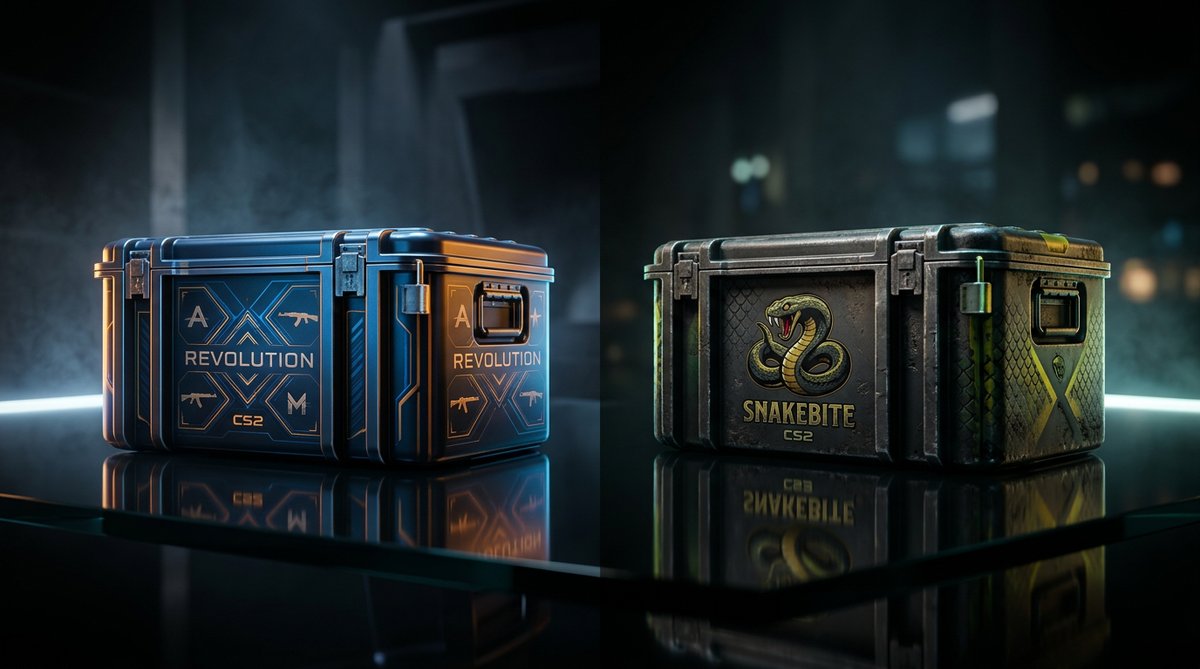
10,514 CS2 Cases, 25 Sites, Zero Break-Evens: The Real House Edge
Across 10,514 cases sold by 25 case-opening sites, the average return to the player was 89.06%. The median was 89.99%. And the number of cases whose contents were worth more than the case plus the key was, quite precisely, zero.
That comes from CaseLab's operator-case dataset, compiled on 27 September 2026. It covers 10,514 case records and 267,415 item-pool entries — the actual drop tables behind every case, with each site's own listed prices and odds. It is the largest public accounting yet of what case-opening sites hand back.
If you have ever clicked "open" and felt the maths was not on your side, this is the arithmetic behind that feeling.
What 10,514 Cases Actually Return
RTP, or return to player, is the expected value of a case's drops divided by its opening price. House edge is 100% minus RTP. Each case is counted once, equally, no matter what it costs or how many people play it.
The distribution is uncomfortably tight. 9,559 of the 10,514 cases — 90.92% — landed in an 85–95% RTP band. Only 3.10% cleared 95%, and 3.12% fell below 80%. Standard deviation across the whole set was 3.52 percentage points.
The best product in the dataset, Plunder's fatal-strike, returned 99.48% — a house edge of 0.52%, which is about as fair as this genre gets. The worst, CSGOWin's YOLO case, returned 50.33%. That is a 49.15-point spread between the best and worst product in the same industry.
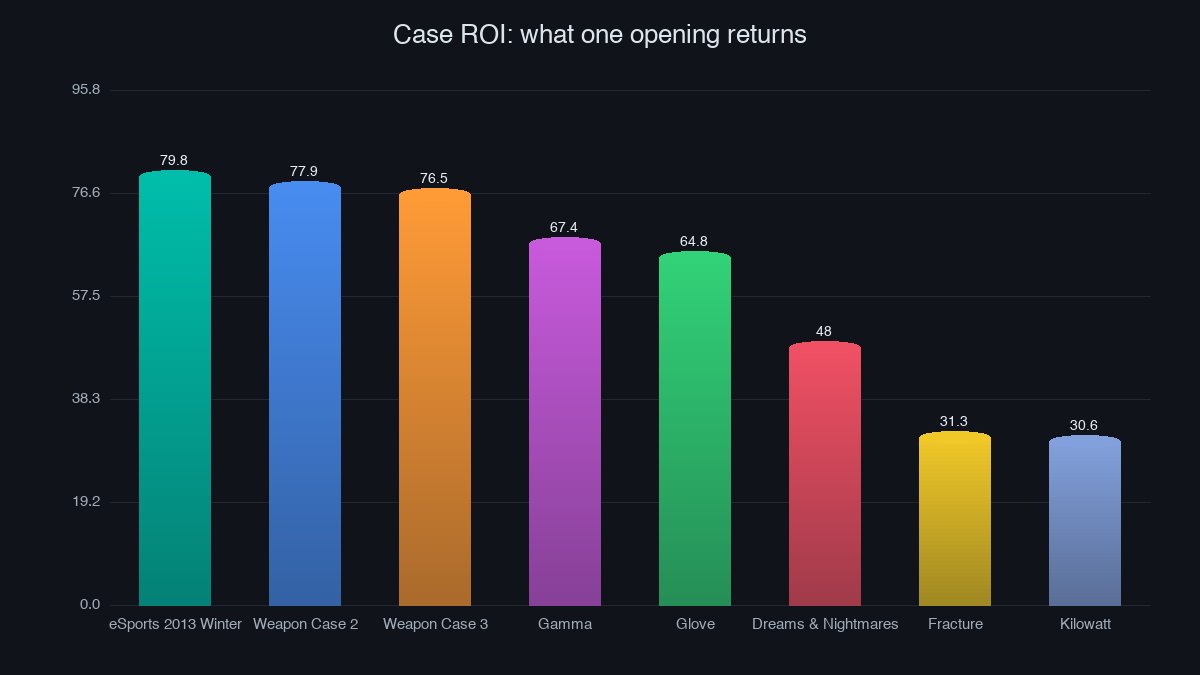
The Outliers Are The Whole Story
Two numbers explain almost everything about that chart. Site averages ran from 92.20% at the top (SkinRave) down to 73.37% at the bottom (CSGO.net) — an 18.83-point gap between the friendliest and harshest operators in the study.
Now look at where the good cases live. Of the 326 cases in the entire dataset that reached 95% RTP or better, 324 were listed by SkinRave. The remaining two were Plunder's fatal-strike and Hellcase's Glove case. In other words, "high-return cases" are not a market-wide feature — they are one operator's pricing strategy.
The reverse is equally concentrated. 319 of the 328 cases below 80% RTP belonged to CSGO.net, out of a catalogue of 327. The bottom of the industry is not spread thin across many sites. It is one site.
Price matters less than people assume. Cases under $1 averaged 86.59% RTP; cases at $500 and above averaged 89.52%. Strip out CSGO.net — whose cheap cases drag the low end down hard — and the gap between the cheapest and most expensive bands collapses to 0.49 percentage points. A big-ticket case is not a fairer case. It is just a bigger bet.
Valve's Own Cases Are Worse
It is easy to assume the grey-market sites are the shady end of this trade and that Valve's official cases sit somewhere above them. The published research says the opposite.
Valve's rarity odds were disclosed by Perfect World, the game's Chinese operator, back in 2017 and have not moved: Mil-Spec 79.923%, Restricted 15.985%, Classified 3.197%, Covert 0.639%, knife or gloves 0.256%, with one drop in ten upgraded to StatTrak. Independent EV modelling puts a typical Valve case at an estimated 40% to 65% RTP once you include the $2.49–$2.71 key.
A worked example from 10 October 2026 makes it concrete. A Fracture Case plus key cost $2.84; its drops were worth $0.78 on average. That is an ROI of minus 73%. The Dreams & Nightmares Case cost $3.38 for $1.55 back — minus 54%. Even after the maths is run favourably, with an 8% selling fee applied, a $3.49 opening returns $1.02. You are down $2.47 before you have finished the animation.
What The 0.26% Actually Costs You
Almost every "best case to open" table you will read is really a table about one drop. At the published 0.256% rate, knife or glove outcomes arrive roughly once in 385 cases. In the models, that single tier contributes about half of a case's entire expected value — $0.52 of a $1.11 EV in one worked example — because the top knives and gloves are worth hundreds or thousands.
Which means the headline RTP number is a number almost nobody experiences. To have a 50% chance of seeing any knife at all takes about 266 openings — around $1,507 at a median $5.67 per open. A 90% chance takes 885 openings, roughly $5,014. A 99% chance takes about 1,765 openings, close to $9,999.
For under $1,600 you could simply buy the knife you were hoping for. That is the trade the maths is offering, and it is not a subtle one.
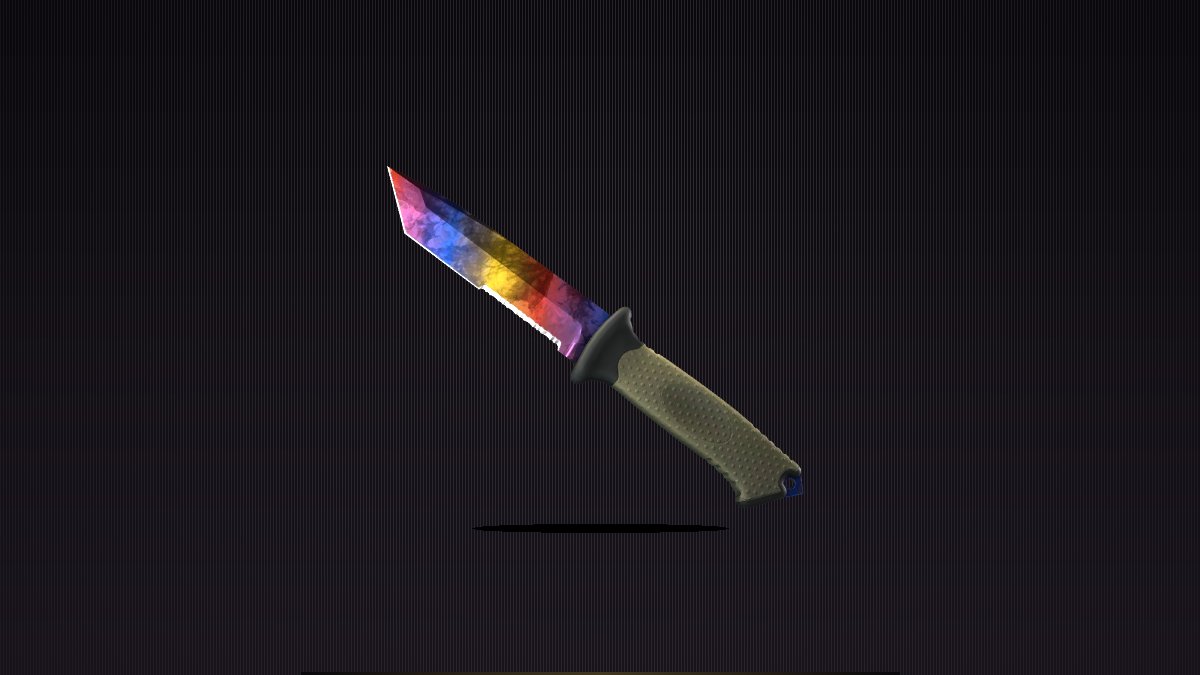
Take a knife like the Ursus Knife | Marble Fade (Factory New). It is exactly the kind of outcome those 385-to-1 rolls are chasing, and it is sitting on a marketplace right now with a price tag and a buy button instead of a probability.
Two Levers That Actually Move Your Number
If you are going to open cases regardless — and plenty of people are, because the reveal is half the appeal — the research does point at two things worth doing.
- Feed the drop into a contract instead of selling it. One 42-case study found that valuing each outcome at the better of "sell now" or "feed into a trade-up" adds up to 3.9 percentage points of ROI, and up to 4.7 points on Armory Pass sets. Chroma 2 Case went from 60.2% to 64.0%. That is a free gain, because the option costs you nothing to consider.
- Buy the case somewhere other than Steam. Third-party venues list the same cases 31% to 53% cheaper, and since the key price is fixed, the case price is the only part of your opening cost you control. On a cheap case the key is almost the entire cost — for the Kilowatt Case at $0.11, the key is about 96% of the total.
Note what is not on that list: waiting for a lucky streak, opening at a particular hour, or switching sites hoping for better odds. Drop rates are fixed server-side. Every opening is independent. The RTP bands above show how little the site you choose moves your expected result — and how much your own behaviour does.
What This Means Going Forward
The case-opening trade has matured into something with published odds, third-party audits and 10,000-case datasets. That transparency is good news. It also makes the conclusion impossible to dodge: the house edge in this genre sits between 8% and 11% in most places, and closer to 35–60% on Valve's own cases.
Treat opening as entertainment with a fixed budget, priced the way you would price any other night out. If what you actually want is a specific skin — an Ursus Marble Fade, an AK-47, a pair of gloves — then the cheapest route has always been to buy it outright, and the data now says so with 10,514 receipts.
When you are ready to do that, the SkinVS marketplace lists skins with live prices across venues so you can see what the item really costs before you commit. And if you still want the thrill, our Phantom Cache is open — go in knowing the number, not guessing it.