The Same CS2 Skin Costs 18.7% More on One Marketplace Than Another
The Same CS2 Skin Costs 18.7% More on One Marketplace Than Another
Pick a CS2 skin. Any skin, any wear, as long as it is listed on at least four marketplaces that pay out real money. Now find its cheapest listing and its most expensive one. The middle of that spread, across 4,626 skins measured on November 3, was 18.7%.
Not 18.7% on a rare outlier. 18.7% as the median — which means half the skins in the sample had a gap wider than that. A quarter sat above 26.1%, and the top decile above 38.3%.
This is the least discussed number in CS2 trading. Everyone watches the index. Almost nobody watches the spread, even though the spread is the part a buyer can actually act on. Here is how to use it without getting burned.
Step 1: Learn What "Normal" Looks Like
A gap only means something against a baseline. Veriloot recalculated its price-gap index on November 3, 2026 at 00:03 UTC, across 4,626 skins out of the 20,096 in its database, each listed on at least four cash marketplaces, across 12 counted venues.
The distribution matters more than the average:
- 1st quartile: 14.1% — a quarter of skins are tighter than this
- Median: 18.7%
- 3rd quartile: 26.1%
- 9th decile: 38.3%
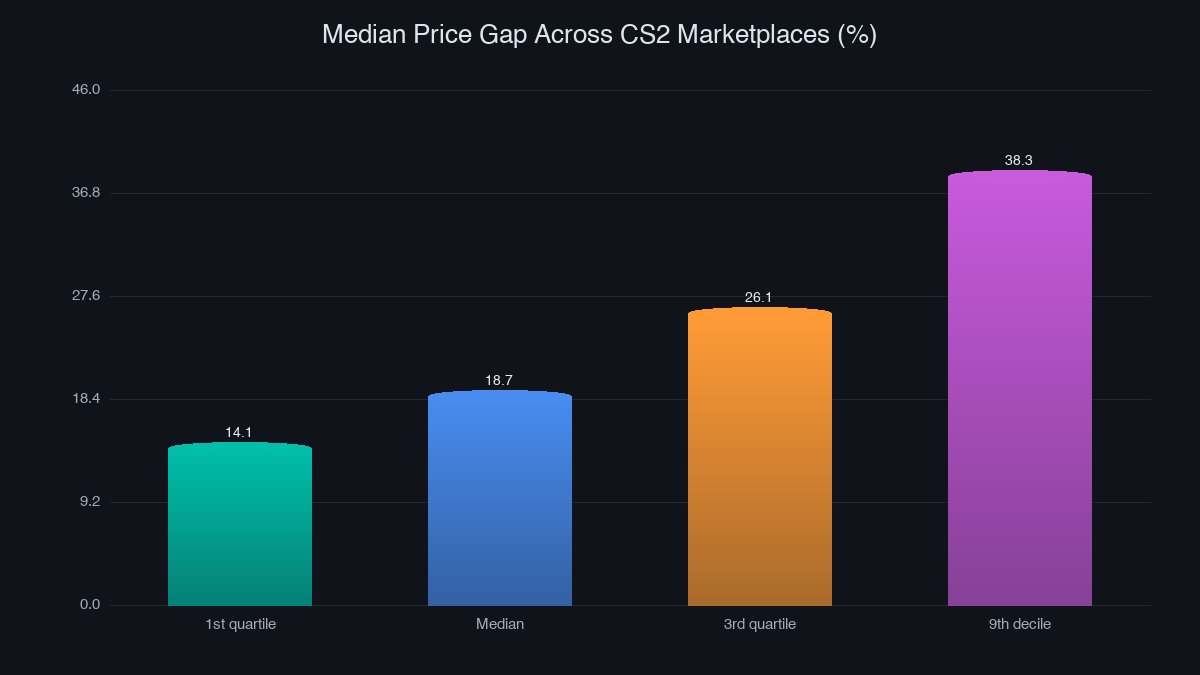
Read it this way: if you find a skin listed 12% apart across two venues, you found a tight market and there is not much to win. If you find 30%, you are in the third of the market where shopping around genuinely pays. If you find 45%, either you found the top decile or one of those listings is not what it claims to be.
That single baseline turns "is this a good price?" from a feeling into a test.
Step 2: Stop Treating Steam as the Reference Price
This is the expensive habit. Steam is where most players look first, and it is systematically the most expensive place to buy.
Comparing the Steam price, fees included, against the cheapest cash-marketplace listing of the same skin, the median premium was +38.0%. Steam was dearer in 99.6% of the 4,214 skins compared.
The quartiles are just as blunt: a quarter of skins cost at least 48.9% more on Steam, and even the cheapest quarter carried a 29.9% premium.
There is a structural reason, and it is not greed. Steam pays sellers in wallet credit that cannot be withdrawn. Buying there means paying for the convenience of an instantly liquid, platform-backed balance — and paying roughly a third more for it. If your goal is to own a skin, Steam is a reference point for what it is worth on Steam, not a price to beat.
Step 3: Know Which Venues Actually Win
Across the sample, the cheapest listing was found on the same two venues more than six times out of ten.
- CSFloat: 35.7% of skins (1,652.5)
- CS.MONEY: 28.6% (1,323.8)
- HaloSkins: 9.5% (441.5)
- Buff.market: 8.6% (396.8)
- Skinport: 5.8% (266)
- DMarket: 4.6% (214.5)
- SkinBaron: 2.2%, White.Market 1.9%, Waxpeer 1.3%, Dupe 1.0%, market.csgo 0.5%, Tradeit 0.2%
Two warnings before you treat this as a shopping list. First, the shares depend on which venues were present and how fresh their quotes were at calculation time — the ranking moves more than the median does. Second, "cheapest somewhere in this table" is not "cheapest at this venue for the skin you want." It is a prior, not an answer.
The useful conclusion is narrower and safer: two venues account for the majority of cheapest listings, so a comparison that skips them is not a comparison.
Step 4: Filter Out the Fakes Before You Celebrate
A wide gap is often not an opportunity. It is a measurement artifact, and the people who build these indexes know it — which is why the methodology excludes so much.
Three exclusions you should copy into your own shopping:
- Pattern-dependent finishes are not comparable. Case Hardened, Doppler and Fade are excluded from the index entirely, because every marketplace lists a different pattern, phase or blue-percentage. Two "same" knives in those finishes can differ by hundreds of dollars legitimately. Never compare them on name alone.
- Isolated listings are noise. The index drops any skin whose end price sits more than 35% away from its neighbour — one abandoned or fat-fingered listing does not get to define a market.
- Thin listings do not count. A skin qualifies only if at least four cash marketplaces list it, each with at least five listings, and its lowest price reaches $11.17. Below that, a "gap" is usually one seller with one item.
Apply the same logic by hand. Before you call something a 40% deal, check that the cheap listing is a real, sellable item in the wear you actually want — not a different float, not a different phase, not a stale quote from three weeks ago.
Step 5: Do the Fee Math on What You Keep
Here is where most spread-chasing falls apart. A gap is a difference in listing prices. It is not a profit.
Fees, trade holds and float are all uncounted in the 18.7% figure. If you buy the cheap listing on one venue and sell on another, you pay the seller fee on the way out, you wait out the trade hold, and you carry the risk that the item does not move at the price you saw. A 20% gap can vanish entirely once a marketplace takes its cut.
So the honest version of the strategy is smaller than the headline suggests. The spread is reliably useful for one thing: paying less for something you intend to keep. It is a much weaker tool for flipping, because the fee and hold structure eats exactly the margin the gap appears to offer.
What the Index Cannot Tell You
Three limits worth saying out loud, because they decide whether any of this works for you.
First, these are listing prices, not completed sales. A listing at a low price is an offer, not a transaction — it can sit there for weeks or vanish when the seller changes their mind. Second, Steam publishes no listing count, so the five-listing rule cannot be applied to it; Steam's numbers are computed on a different footing than the cash venues. Third, the whole calculation converts to euros at the ECB reference rate of October 30, 2026 ($1 = €0.895095), so currency drift adds a small amount of noise on top.
What survives all three caveats is the shape of the market, and the shape is consistent: the median skin has an 18.7% spread across venues, Steam is dearer in 99.6% of comparisons, and a thin top decile carries gaps above 38%.
That is enough to change one habit. Before you buy anything, look at the same item somewhere else. Most players never do, and that is precisely why the spread exists. You can start by browsing what is actually listed on the SkinVS marketplace and pricing the exact wear you want — then check the number against a second venue before you commit.
An 18.7% median is not a secret worth guarding. It is a gap sitting in plain sight, in a market where two thirds of items just lost value in a month. The buyers who close it are not smarter than the ones who don't. They just looked twice.