Why CS2 Skin Prices Are Down 41% — What the Data Actually Says

Why CS2 Skin Prices Are Down 41% — What the Data Actually Says
Forty-one percent. That is the median price change across 1,185 CS2 skins measured between March 2 and November 2, 2026. Not a bad week, not a bad case — the middle of the entire comparable catalogue, eight months apart.
If you own skins, you already felt it. What is harder to answer is whether this is a correction, a collapse, or something more boring. The data says all three, depending on which number you look at.
The Number Everyone Is Quoting
The 41.1 percent figure comes from a fixed-baseline comparison: a snapshot taken March 2, 2026, held against a snapshot taken November 2, 2026. The method is deliberately strict. A skin only counts if at least three of its wear conditions could be priced in both snapshots, and anything under $1 at baseline is dropped so a single stray listing cannot distort the result.
What that produces is lopsided in a way that is hard to argue with. Of 1,185 comparable skins, 1,174 lost more than 1 percent. Ten gained more than 1 percent. That works out to roughly 99 percent of the comparable catalogue declining.
A market where 99 percent of items fall is not a rotation out of one category into another. Rotations leave winners behind. This looks more like demand stepping back across the board while supply keeps arriving.
Category by Category, the Damage Is Even
The spread between categories is small, which is the most important thing about it. There was no safe corner to hide in.
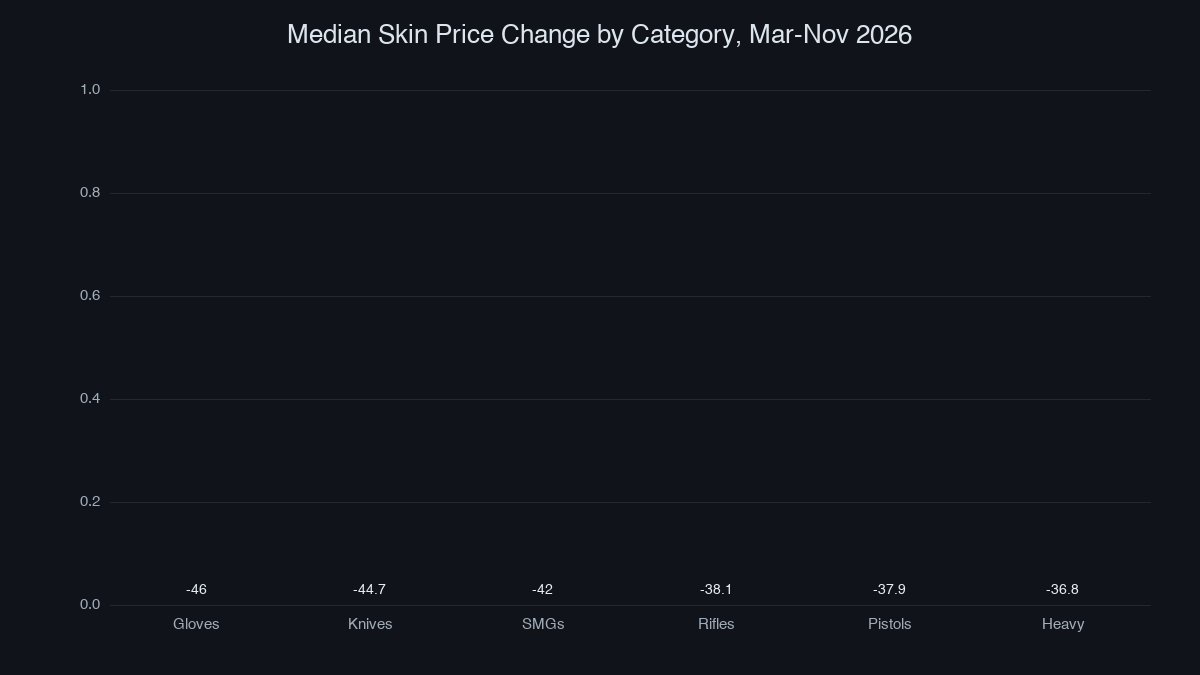
Gloves fell hardest at a median -46.0 percent across 72 comparable skins. Knives were close behind at -44.7 percent across 306. SMGs came in at -42.0 percent, rifles -38.1 percent across 312 skins, pistols -37.9 percent across 247, and heavy weapons -36.8 percent across 103.
The gap between the worst category and the best is under 10 percentage points. When gloves and heavy weapons move together — two things bought by completely different players for completely different reasons — you are not watching a preference shift. You are watching the funding behind the whole market shrink.
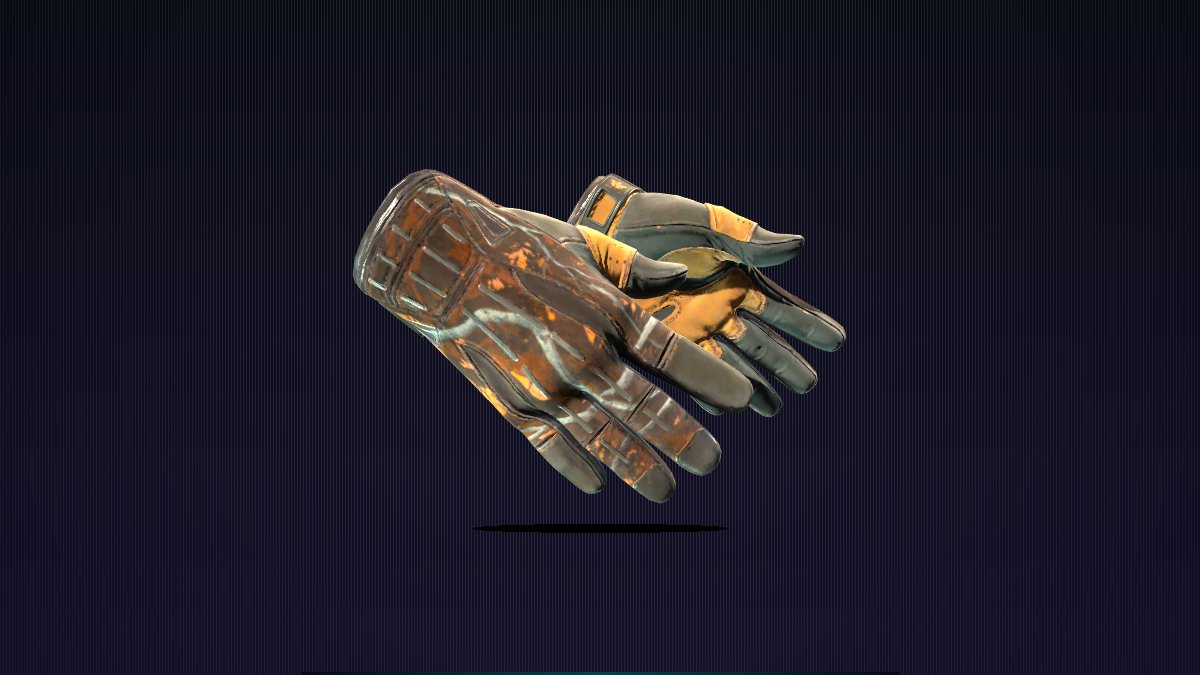
Gloves are the clearest illustration of why percentage declines mislead. A glove finish that traded at $200 in March can sit at $108 today and still be the same object, in the same wear, with the same float. Nothing about it got worse. The bid underneath it got thinner, and thin bids on illiquid items produce violent percentage moves in both directions.
The Index Tells a Softer Story
Here is where the numbers start disagreeing, and the disagreement is informative.
Across the full catalogue of 50,530 tracked items in 131 collections, total market value still sits around $4.3 billion. The broad market index reads 624.8 against a base of 1,000 set in January 2024, and it is down only 1.0 percent over seven days.
A second tracker puts the picture in the same shape. Its scanned-inventory market cap is about $193 million, down 1.01 percent over a week and 8.79 percent over 30 days, with 52 percent of tracked skins lower on the week.
So the eight-month view says -41 percent, and the one-week view says -1 percent. Both are true. The market took its damage in a long slide, not a crash, and the last few weeks have been close to flat.
The count that lands hardest is breadth: on November 3, among items priced $5 and up with real trading, 1,633 fell and 1,022 rose. More things going down than up, but not the near-total wipeout the eight-month median implies. That is what a bottom looks like — not a bounce, just fewer sellers in a hurry.
Volume backs that up. Roughly 196,000 confirmed sales cleared in seven days across the two largest venues, about 121,000 on Steam and 75,000 on CSFloat. A market with no buyers does not print numbers like that. What it lacks is urgency on the buy side, and urgency is what sets prices.
Cases Fell Harder Than Anything Else
One category beat the rest to the downside on the shorter window: cases. Over the past 30 days, a hundred-item index of the most traded CS2 items fell 11.7 percent, and cases dropped 13.6 percent — the worst of all six item types. Across 83 collection indices, none rose.
That fits the supply story better than any narrative about players losing interest. Terminals now deliver new community finishes on a weekly rhythm rather than a case every few months. More supply, arriving on a schedule, into a market where the marginal buyer has already spent. Case prices are the most supply-sensitive thing on the board, so they break first.
The mechanics have not changed on the demand side either. A rare special item still drops at 0.26 percent, the same odds that have priced knives and gloves for years. When the odds are fixed and supply only grows, the only variable left is how many people want to take the bet. Fewer openers means less demand for the case itself, which is exactly the 13.6 percent you see in the index.
Where the Money Still Sits
Not everything deflated. The top of the market is still expensive, and it is still concentrated.
- The most expensive commonly traded item remains the AK-47 | Wild Lotus (Factory New), listed from $12,707.
- By total market value, the leaders are the M4A4 | Buzz Kill at roughly $54.4 million, the SSG 08 | Dragonfire at $50.2 million, and the ★ Butterfly Knife | Gamma Doppler Phase 4 at $48.5 million.
- The ten most valuable items together account for about $424 million of the $4.3 billion total.
The bottom of the market is a different planet. The Industrial Grade index sits at 288.3 as of November 1 — 71 percent below its January 2024 starting point of 1,000. Cheap skins have given back nearly three quarters of their index value while the top ten items still hold hundreds of millions. That is not a market repricing. That is a market splitting in two.
Daily moves still happen in both directions. On November 3, the Glock-18 | Pink DDPAT (Well-Worn) rose 22 percent to $26 and a ★ Falchion Knife | Crimson Web (Battle-Scarred) fell 27 percent to $107. Sticker spikes were steeper still, with a Katowice 2019 Team Spirit paper up 57 percent. Volatility has not gone anywhere. Liquidity has.
What a Buyer Should Take From This
The useful conclusion is not "wait for the bottom" — nobody calling a bottom in a 99 percent-declining market has a track record worth trusting. It is that the shape of the market changed.
Breadth is thin, which means the same skin can move 20 percent on a handful of sales in either direction. That cuts in your favor when you are buying and against you when you are selling, and it means the spread between what a listing asks and what a buyer will actually pay has widened. Buying the item you want directly, at a price you can see, beats chasing a chart.
It also means the cheap end is where the damage lives. A $3 rifle at 71 percent off its index is not a bargain; it is an item with almost no floor because supply keeps arriving. The relative safety is in finishes people actually want to look at, in wear conditions that stay liquid.
If you want to buy into this market rather than watch it, start where the pricing is transparent. The SkinVS marketplace lists real asks you can compare side by side, and if you would rather pay a fixed price for a chance at something better than the median, Phantom Cache is the shortest route from a small budget to a finish worth keeping. Just size the position like the market is down 41 percent, because it is.