CS2 Knives: The $54 Sells Faster Than the $626
CS2 Knives: The $54 Sells Faster Than the $626
Two knives. On paper the choice looks obvious — one costs $53.58, the other costs $626.04, and the expensive one looks like it should be the better asset. Then you try to sell them.
The cheap knife clears in hours almost any week of the year. The expensive one sits, and the price it finally fetches can land well below where you thought you bought it. That gap is not luck and it is not hype. It falls straight out of liquidity data, and if you have never looked at it before buying a knife, this is the part of the market that decides whether your purchase was an asset or a trap.
The Two Knives, Side By Side
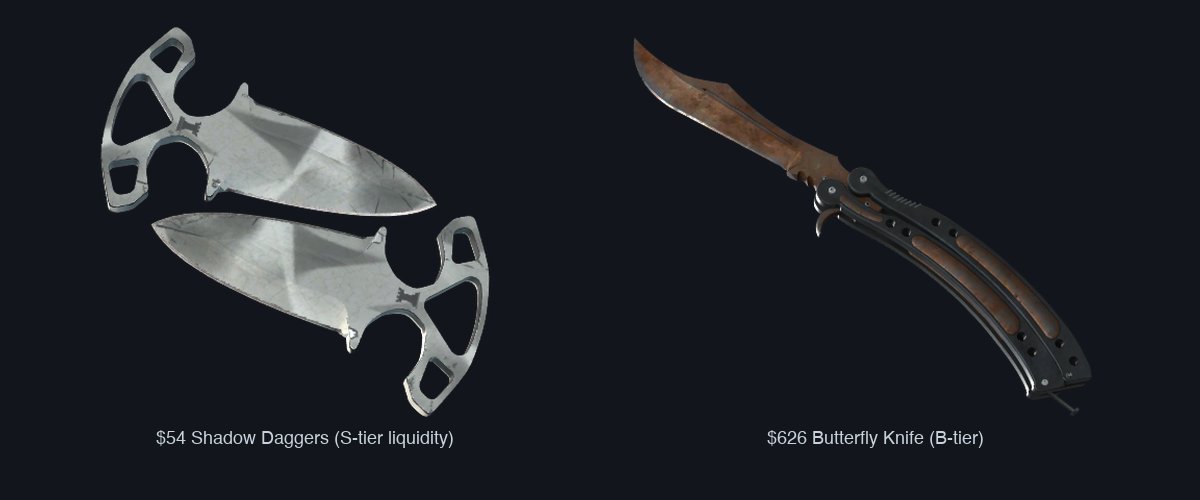
Both knives below are priced from live SkinVS listings, so the numbers are what it actually costs to buy one right now rather than a historical average.
- ★ Shadow Daggers | Urban Masked (Field-Tested) — $53.58
- ★ Butterfly Knife | Rust Coat (Battle-Scarred) — $626.04
An 11.7x price difference for two items that occupy the same category, share the same Covert rarity tag, and do exactly the same thing in a match. The difference is entirely about who wants them, how often, and how easy they are to move — which is the only subject that matters when you are buying a knife as an asset rather than as a toy.
Now put the liquidity index next to them, because this is where the story flips. SteamDB's CS2 knife index grades every knife model on a formula weighted 40% market liquidity, 40% daily sales volume and 20% 30-day price stability. On that scale Shadow Daggers sits in the top tier. Butterfly Knife sits in B tier. The $54 knife is the more liquid instrument.
Round 1: How Fast It Sells
Daily sales volume is the single most honest number in the CS2 knife market. It counts how many copies moved in a day across the tracked markets, and nothing else — no asking prices, no optimistic listings, just completed movement.
Shadow Daggers: roughly 9,300 sales per day.
Butterfly Knife: roughly 3,300 sales per day.
That is a 2.8x gap in throughput. In practical terms, a Shadow Daggers listing at or near the current floor is competing with a shallow queue of identical items. A Butterfly Knife listing is competing with far fewer buyers spread across a much thinner flow, and the shape of that flow is unfriendly: the price band it trades in is wide enough that a patient buyer can simply wait for someone more motivated than you.
Put the scale of the whole category next to that. The CS2 knife market spans about 20 knife models and roughly 15,800 tracked items across dozens of marketplaces. Nine thousand sales a day is a real market with real depth. Three thousand is a market where a single seller decides the day's price.
Falchion Knife and Huntsman Knife, for comparison, both sit in the same top liquidity tier as Shadow Daggers, moving around 7,300 and 6,100 units a day. There is nothing glamorous about that tier. There is also nothing stuck in it.
Round 2: How Much the Price Moves
Volume tells you whether you can sell. Volatility tells you whether the sale will hurt.
The index measures a model's 30-day price movement as the median absolute change across all of its priced finishes. Shadow Daggers sits at roughly ±4.4%. Butterfly Knife sits at roughly ±9.4%.
Read those as the range of normal, not the range of disaster. A knife that drifts 4% a month lets you plan a purchase and a sale around a stable number. A knife that drifts 9% a month means the item you bought at $626 can reasonably be a $570 knife thirty days later without anything unusual happening — and can just as easily be a $690 knife. You are not holding an asset at that point, you are holding a position.
The price ceiling tells the same story. Shadow Daggers' most expensive finish sits around $126.91. Butterfly Knife's most expensive finish, the top-tier pattern, is quoted near $1,838.02, with a median finish around $371.95. The premium knife compresses an enormous amount of value into a tiny number of daily transactions, which is exactly the structural setup that produces violent moves.
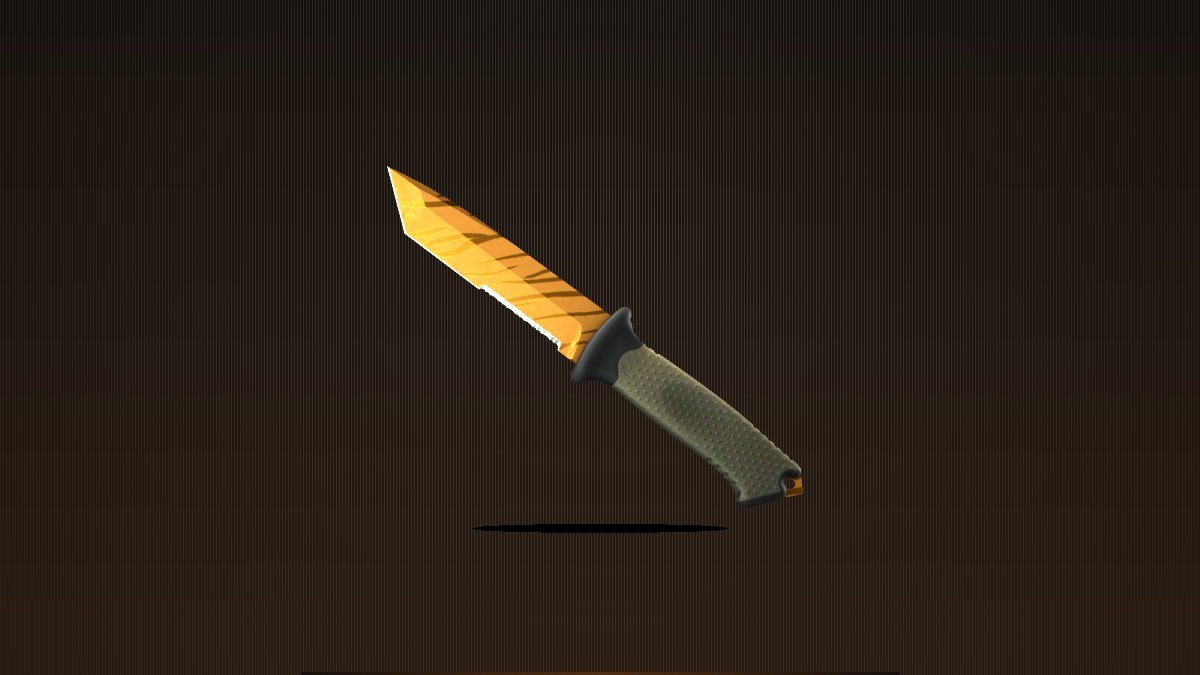
That middle band is worth naming, because it is where most buyers should actually be shopping. A ★ Ursus Knife | Tiger Tooth (Factory New) sits around $155.77 — comfortably above the budget floor, well below the premium bracket, and priced in a zone where volume is still healthy enough to sell without a wait. The SkinVS marketplace lists these with float and pattern data attached, which is what you need to compare two copies of the same finish rather than two different finishes.
Round 3: What the Exit Actually Costs You
Here is the number nobody puts in a tier list. Your real cost is the price you paid minus the price you can realistically exit at, minus the time you spent waiting.
On the budget knife, the exit is fast and the spread is tight. You buy at $53.58, the market tolerates a couple of percent of slippage, and the item is gone. Total friction: small, and measured in hours.
On the premium knife, the maths change twice. First, slippage: a 9.4% monthly movement range means a realistic exit can land several percent below your entry even in a flat market, and considerably worse if you are in a hurry. Second, and more importantly, the wait itself has a cost — a week of holding an item you cannot sell on is a week you are not rotating capital into the next opportunity.
Then layer the platform mechanics on top. Items bought from the Steam Community Market or in-game store carry a 7-day retrade lock, and anything received in a trade is flagged Trade Protected for 7 days, during which it cannot be re-listed, traded onward, or even moved into a Storage Unit. Your premium knife does not become sellable the moment you buy it. On a fast-moving budget knife that delay is boring. On a knife whose price moves 9% a month, a seven-day lock is a live risk.
One more structural fact worth holding onto: the median finish of the entire Butterfly model sits around $371, yet the model's headline price is $1,838. Most of the money in the premium tiers lives in a handful of well-known patterns. If you are paying premium prices for an ordinary finish, you are paying for the model's reputation rather than for the specific item in front of you.
The Verdict: Buy the Market, Not the Aesthetic
If the goal is a knife you enjoy and can also sell without drama, the data points at the liquid middle. Shadow Daggers-grade volume at a $50–$160 price point gets you a knife that moves about three times faster than a premium blade and swings less than half as hard. That is not a compromise on looks — Urban Masked, Gamma Doppler and Tiger Tooth finishes all live in that bracket — it is a decision about how much uncertainty you want to buy into.
If the goal is the premium bracket, buy it the way you would buy any volatile position. Go in knowing the 9.4% monthly range is normal, treat the seven-day settling period as part of the cost, and buy the specific finish you researched rather than the model's reputation. Frost Vault and the other active cases are where most of these knives enter the market in the first place, which is why case supply quietly sets the floor under every knife tier above it.
Neither knife is wrong. One is a product and one is a position. Know which one you are buying before you click accept.