Capsules Are Gone: What Singapore Major Stickers Will Really Cost
Capsules Are Gone: What Singapore Major Stickers Will Really Cost
The last sticker capsule Valve ever sold for a Major is now worth 12 cents. The Budapest 2025 Legends capsule sits at $0.12 while a single Team Spirit gold sticker from Cologne 2026 costs $364.55. That gap is not a market glitch. It is what happens when a company replaces a lottery with a shop, and it is the model the Singapore Major will inherit on November 24.
PGL Major Singapore runs through December 13 with a $1,250,000 prize pool, 32 teams across three stages and an eight-team playoff at the 12,000-capacity Singapore Indoor Stadium. It is the first Counter-Strike Major held in Southeast Asia. For anyone planning to spend money on stickers, the interesting question is not who wins. It is which system Valve runs, and the Cologne experiment already answered most of it.
What Cologne Actually Did
The IEM Cologne Major, June 2 to 21, was the first Major without capsules. Instead of buying a sealed container and hoping, players bought the exact sticker they wanted from an in-game Major Shop. Purchases used tokens, sold in bundles starting at 100 tokens for $0.99.
Three mechanics came with it. Prices moved with demand, so popular stickers got more expensive and unpopular ones got cheaper. If a sticker's price fell by 25 tokens or more within 24 hours of your purchase, you got the difference back in tokens. And the Viewer Pass came with a Challenge Coin, where each Pick'Em upgrade paid out 300 tokens.
Valve later layered a Ranked Series line on top after the original shop pushed some autographs past $1,500. The shop closed for good on September 29. Whether PGL and Valve bring back capsules, keep the token shop, or ship something else for Singapore has not been announced.
Round 1: Supply
Under the capsule model, supply was fixed by a deadline. Valve sold capsules during a window, then stopped. From that point the only direction was down — every capsule opened removed stickers from circulation permanently, and every sticker applied to a gun removed it too.
That scarcity engine is why old stickers are expensive. The EMS Katowice 2014 Legends capsule is listed at $20,000. The iBUYPOWER Holo from the same event was the cheapest listing at $64,804.47 on October 14.
Under the shop model, supply follows demand. If 40,000 people want a Falcons gold sticker, roughly 40,000 get made at whatever price clears. There is no accidental scarcity, no lucky pull that leaves a popular sticker rare. You pay more for popular items, but you are not competing against a fixed pool.
The trade is straightforward: capsules gave buyers a chance at scarcity and charged them a lottery ticket for it. The shop gives buyers certainty and takes the scarcity away.
Round 2: Price Discovery
The Cologne numbers show what the shop does to the shape of the market. As of October 14, the cheapest listings looked like this: Team Spirit gold at $364.55, Falcons gold at $268.70, Falcons holo at $55.80, and a plain paper Falcons sticker at $1.08.
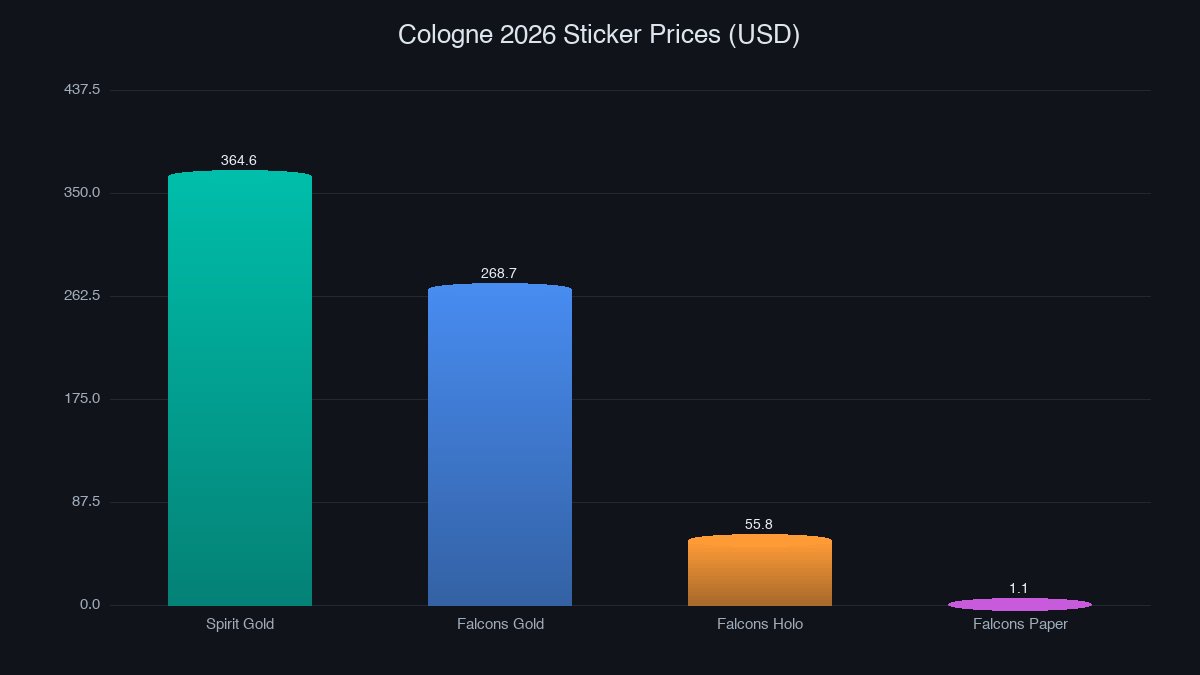
That is a 337x spread between the paper and the gold of the same team, at the same event, on the same day. Under capsules, that spread existed too, but it was set by pull rates nobody could see. Under the shop, the spread is set by demand and the token price, and it is visible in real time.
For a buyer, visible is better. For a speculator, visible is worse — the arbitrage between what a sticker should cost and what it does cost shrinks when everyone can see the same price list.
Round 3: The Ceiling
Here is the part that gets oversold. Every sticker investment pitch starts with Katowice 2014 and stops there. The broader universe is 16,990 stickers with an average price of $80.71, a floor of one cent and a ceiling of $221,336.84 for the Howling Dawn.
Those extremes are survivorship, not a strategy. Most Major stickers never go anywhere, and 2026 changed the mechanism that produced the old winners. Fixed supply plus slow destruction plus growing demand pushed 2014 holos up for a decade. Remove the fixed supply and you remove the engine.
That does not make new stickers worthless. A gold sticker for a team that wins a Major still has real demand, and applied stickers still reduce supply. It just means the upside case is now "this team is popular and this finish is rare within a demand-priced system," not "this capsule will run out forever."
The Souvenir Side Changed Too
Capsules were only half the old system. Souvenir packages used to arrive by drop count — you watched a match, you got a package, and total supply was decided by how many people tuned in.
At Cologne, souvenir supply depended on what players chose to convert, not on how many packages fell out of the broadcast. That is a smaller change on paper and a bigger one in practice. A souvenir package's value always came from two things: which map collection it drew from, and how few of them existed. The first is unchanged. The second is now a function of player behaviour rather than viewer numbers.
For Singapore, that means the Cobblestone-style scarcity plays of the past do not transfer cleanly. If souvenirs are again conversion-driven, the scarce package is the one nobody bothered to claim, and that is a much harder thing to predict three weeks before the event than a drop rate.
Why Capsules Probably Do Not Come Back
The legal argument is stronger than the economic one. In February, the New York Attorney General filed a lawsuit against Valve over loot boxes. Germany, which hosted the Cologne Major, has forced players to open containers only through the X-Ray scanner since March.
Valve's own FAQ for the Cologne shop listed regions where capsules could not be sold at all. Once a company has shipped a system that satisfies regulators in some markets and shut it down cleanly, going back to random-pull capsules for the biggest event of the year is a hard sell to its lawyers.
There is precedent for the direction of travel. The October 2025 knife trade-up change wiped roughly $2 billion off the market capitalization of CS2 skins, taking it from around $6 billion to $3-4 billion. Valve never rolled it back. This is a company that ships economic changes and does not reverse them.
So the working assumption for Singapore should be: a shop, probably with adjustments — a wider refund window, a tweaked pricing formula — rather than a return to the old model. Anyone buying capsules expecting a 2014 replay is buying the previous decade's trade.
What This Means Before November 24
Three practical reads. First, if you want a specific team's sticker for a loadout, the shop model is better for you than any capsule era — you can buy the exact finish instead of opening until you get lucky. Budget in tokens, not in capsules.
Second, the pre-Major window is when team stickers move on qualification news, not on the event itself. All teams for Singapore were confirmed on November 2, with FaZe locking a spot through a third-place finish at Tesla Cup and 100 Thieves qualifying through the FiRe Last Chance. The roster is set, so the "will they make it" premium is already priced.
Third, treat the sticker market as a demand market now. The old playbook was buy sealed, wait, and let supply shrink. The new playbook is buy the finish people actually want, on the team people actually watch, and accept that the price is public information.
For anyone who would rather own the skin than the sticker, the browse live skin prices on SkinVS lists live prices across finishes and wear levels — the same items, priced by the market instead of by a token formula. The Major runs three weeks. The prices do not wait for it.