Why Your CS2 Skin Listing Sits Unsold: The Order-Book Gap, by Price Band

Why Your CS2 Skin Listing Sits Unsold: The Order-Book Gap, by Price Band
Fifty thousand Recoil Cases are sitting on Skinport right now. To be the cheapest seller in that queue you have to list at $0.30. The middle of the book - the median of every live listing - sits at $0.72. You did not misprice your case. You joined a queue that was already 50,000 deep, and the price of cutting to the front is 58%.
That gap between the cheapest ask and the median ask is the most under-discussed number in the CS2 skin economy. It is not a fee. It is not a spread a bot quoted you. It is the discount you must accept to be the next person who actually sells.
On 3 September 2026, CS2-Inventory.com sampled Skinport's entire public catalogue - 25,164 distinct item names and 3.69 million live listings - and measured that gap item by item. The results explain a complaint that shows up on every skin forum: "it's listed under market and nobody is buying it."
The Raw Numbers
The measurement is simple. For each item, take the cheapest live listing and the median of all live listings. The difference, as a share of the median, is how far below the typical seller you must price to sell next.
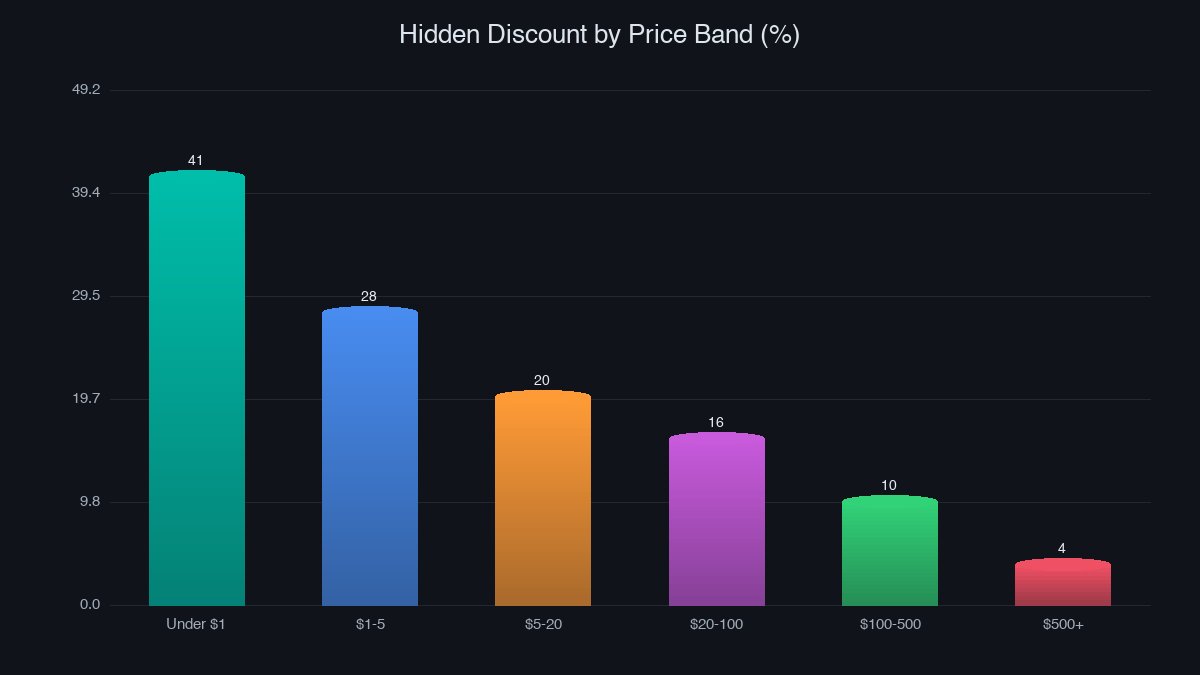
- Under $1: 8,609 items, median 49 live listings, cheapest ask sitting 41% under the book median
- $1 - $5: 6,193 items, median 13 listings, 28% under
- $5 - $20: 3,981 items, median 8 listings, 20% under
- $20 - $100: 3,356 items, median 6 listings, 16% under
- $100 - $500: 2,223 items, median 4 listings, 10% under
- $500 and up: 725 items, median 2 listings, 4% under
Across the entire catalogue, 42.9% of items had a cheapest listing more than 30% below their own book median. Nearly half the market is priced against itself, and the pattern is not random - it scales almost perfectly with how many other people are selling the same thing you are.
The Cheap End Is a Different Market Entirely
Three cases make the point better than any average. Recoil Case: 50,385 live listings, cheapest ask $0.30 against a book median of $0.72. Fever Case: 36,598 listings, $0.69 against $1.45. Kilowatt Case: 12,210 listings, $0.21 against $0.49.
Those are 52% to 58% haircuts. Instant-sell quotes advertise roughly 5% at the fair end of the market - about 10% at Lis Skins and Avan.market. On a sub-dollar case, listing is often the more expensive choice: you wait, you pay the platform's commission, and you still clear less than a quote would have paid you on the spot.
Liquidity does not save you either. On 20 August 2026 a Kilowatt Case printed 103,910 sales in 24 hours. An AK-47 Case Hardened in Field-Tested printed one. An AWP Dragon Lore printed nothing at all - no listing, no sale, no price returned. Volume at the bottom of the market is measured in six figures. Volume at the top is measured in single digits.
What Surprised Us
Two findings run against the standard advice you see repeated in trading threads.
First, the "hidden discount" of listing shrinks as price rises. At $500 and up it is only 4%. So the usual rule - never instant-sell an expensive skin - is correct, but for a bigger reason than most people give. At the top of the market the queue is two sellers deep and joining it costs almost nothing. At the bottom the queue is 49 sellers deep and joining it costs you two fifths of the item.
Second, the round trip is brutal. SteamDB's July 2026 dataset measured the median buy/sell spread across 8,942 items with live data on both sides at 24.9%. Buy at the cheapest ask, instantly sell it straight back at the best bid, and you have already lost a quarter of the value before touching a withdrawal fee.
Where A $6,000 AWP Actually Sits
The top of the book is thin, and it is thin in a way that helps patient sellers. AWP | Dragon Lore (Field-Tested) showed 4 live listings, cheapest $6,238.32 against a book median of $6,711.58. Glock-18 | Fade (Factory New): 18 listings, $1,679.65 against $1,997.45. AK-47 | Case Hardened (Field-Tested): 75 listings, $218.09 against $292.05.
Prices thin out fast as you climb. Somewhere around the $150 mark, daily sales drop into single digits, and past that the endpoints stop returning a lowest ask at all. A $6,000 AWP is not illiquid because nobody wants one - it is illiquid because four people in the world are selling one on that venue today.
The Fees Decide More Than The Method
Seller commissions are anything but uniform: 2% at CSFloat, DMarket and Waxpeer, 5% at Market.CSGO and ShadowPay, 8% at Skinport (6% above $1,000). Instant-sell services bury their margin in the quote instead - roughly 5% at Aim.market, about 10% at Lis Skins and Avan.market, a measured 25-34% at Skinout, and an effective 60% at Skinvault.
Note what that means. The worst instant-sell spread on the market is fifteen times the best one, and most sellers never compare them. The advertised commission of a venue tells you almost nothing about what you keep.
Then there is the wait. CS2 items carry a seven-day hold before they can be traded or listed at all, and that hold has to be paid for by somebody in the transaction. The only somebody is you. It is the reason instant-sell quotes across the board got worse after mid-2025 and never came back.
The Smart Play
The data points to three decisions, and none of them involve guessing where prices go next.
Under about $5, don't list - quote. The queue is 13 to 49 sellers deep and the list-and-wait discount is 28% to 41%. Compare two or three instant-sell quotes instead and take the best number today. The 7-day hold means "today" is worth more on cheap inventory than it is on anything else.
Between $5 and $100, price to the queue, not to the median. The gap here is 16% to 20%. If your listing is at the book median you are not competitive - you are a placeholder that gives other sellers a reference point. Price just under the current cheapest ask, or accept that you are holding for weeks.
Above $500, list and be patient. The queue is two sellers deep and the penalty for joining it is 4%. Cross-venue dispersion is small at this level too - SteamDB measures a median gap of about 4% between the highest and lowest ask across marketplaces - so spending ten minutes comparing venues collects real money on a four-figure item.
And keep the fee stack in view the whole way. A 2% venue against an 8% venue is a six-point difference on every sale, which on a $2,000 knife is $120 that either stays with you or does not. If you want to see how the market is pricing that kind of inventory today, the live listings on the Phantom Cache page show more than 112,000 opens worth of supply flowing through a single case - a useful reality check on what "liquid" actually looks like before you price your own inventory against a median nobody is paying.
The single most useful habit here is cheap: before you list anything, look at how many other people are already selling that exact item. If the answer is two, be patient. If the answer is forty-nine, the queue is the asset - and you are the one paying for the privilege of joining it.