One Year of Gold Trade-Ups: What $4.6 Billion Tells You About CS2 Knife Prices
One Year of Gold Trade-Ups: What $4.6 Billion Tells You About CS2 Knife Prices
On October 24, 2025 — two days after Valve let players feed five Covert skins into a contract and pull out a knife — a Butterfly Knife | Freehand in Well-Worn condition sold for $309. That was its lowest recorded price ever. Today the same knife trades at $493, up 4.3% over the past week and 3.4% over the year.
One item does not prove a market recovered. But it is the cleanest illustration of what twelve months of gold trade-ups actually did: they did not destroy knife prices, they rewrote the rule that set them. And the number most people quote when they talk about this — the one that says the CS2 skin market is down 44% — measures something narrower than it sounds.
The Number Everyone Quotes, and What It Leaves Out
Pricempire put the total CS2 skin market at $5.81 billion on October 30, 2026. The all-time high was $10.41 billion. That is a 44.15% gap, and it is the figure that gets screenshotted into every "the market is dead" thread.
Look at the momentum behind it, though, and the shape changes. The same tracker recorded -0.55% over 24 hours, -2.34% over seven days, -9.84% over 30 days and -21.1% over 90 days. Those are not the numbers of a crash. They are the numbers of a slow bleed — the kind that happens when supply keeps growing and the pool of buyers does not.
Treat the $5.81B as an estimate of what it would cost to rebuild the tracked catalog at current asks, not as cash that vanished. Other trackers land in different places for the same reason: cs2.sh values its 530-item basket at $4.3 billion and CSMarketCap was quoting roughly $5.4 billion in the third week of October. Three methodologies, one direction. The direction is the signal; the absolute number is a modelling choice.
Supply Did Most of the Damage
The mechanics changed on October 22, 2025. Five regular Covert items could now be exchanged for one regular knife or one pair of gloves, and five StatTrak Covert items for one StatTrak knife. StatTrak gloves were never added. The output comes from a collection represented among your inputs, so what you feed in decides which pool you draw from.
Before that patch, the only route to a knife was the 0.26% rare special slot — roughly one hit per 385 case openings. A trade-up replaced a lottery ticket with a repeatable input cost. Traders watching CSFloat registrations clocked the effect: knives and gloves on the platform went from about 5.5 million to 8.8 million, a 60% increase, against a standing pool of roughly 20 million red skins. Not all of that came from contracts — cases kept paying out too — but the slope changed.
The soft ceiling follows directly. If five Coverts cost less than the knife they can produce, people craft, and the gap closes. Right now that arithmetic is brutal: an AK-47 | Inheritance in Field-Tested sits near $42.56, so five of them is about $212.80 for one random draw from the represented collections. Scroll any knife list and you will find dozens of models priced under that.
The aggregate shows it. cs2.sh tracks 576 knife skins with a combined market value of $280.1 million, ranging from $36 for a bare Navaja to $1,801 for a Butterfly Knife | Fade in Factory New. The knife index closed at 904.3 points on October 30 — 9.6% below its January 2024 base of 1,000, and down 4.8% over 30 days.
Where the Floor Actually Sits Now
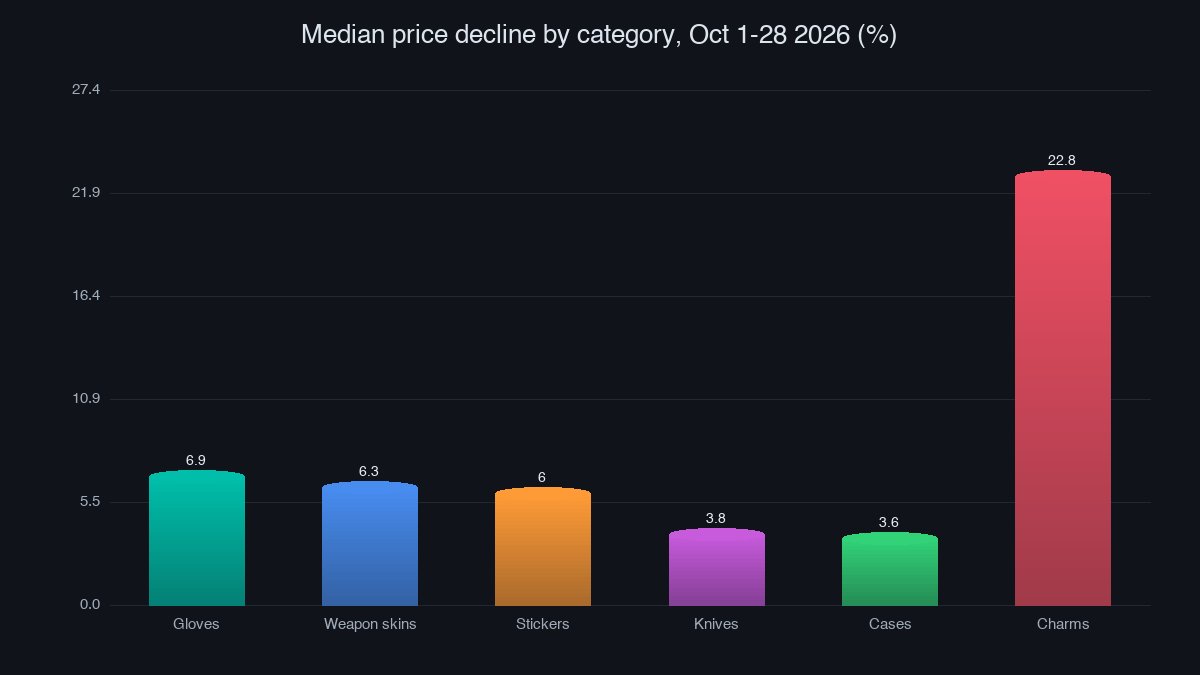
The most useful window is not the annual one. cs2.io compared 18,235 listing variants priced on both October 1 and October 28, 2026 and found 12,529 down, 4,263 up and 1,443 flat. Median moves by category: gloves -6.9%, weapon skins -6.3%, stickers -6.0%, knives -3.8%, cases -3.6%, charms -22.8%.
Read that list carefully. In the most recent 27-day window, knives fell less than weapon skins and less than gloves. That is the opposite of the 2025 story, when knives were the epicentre. The knife correction already happened; what is happening now is a broad, category-wide drift that hits items the trade-up patch never touched.
Charms at -22.8% are the outlier worth flagging. They are the newest cosmetic category in the game, they carry no trade-up utility, and they were the least liquid thing on the board. New categories with thin order books do not fall gracefully.
The Bifurcation: What a Contract Still Cannot Aim At
Here is the part that gets lost in the "knives are cheap now" headline. A contract hands you a random result from the collection's pool. It cannot be aimed at a specific finish, a specific float, or a specific pattern. Everything the contract cannot target is still priced on rarity, and that is exactly where the premium survived.
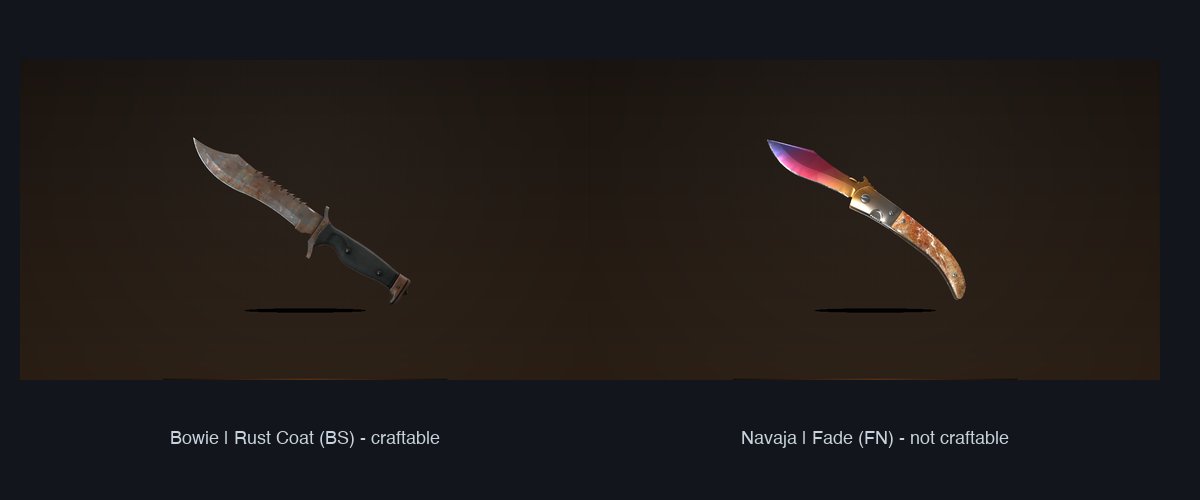
Put a commodity knife next to a finish-driven one and the split is obvious. A Bowie Knife | Rust Coat in Battle-Scarred is the archetype of a knife that became craftable in spirit — cheap, plentiful, and defined by the fact that five reds can roughly approximate it. A Navaja Knife | Fade in Factory New is not: Fade percentage is a pattern outcome no contract can select for. Same weapon class, same Covert rarity, completely different price behaviour.
The same logic explains the top of the market. A Butterfly Knife | Doppler Phase 2 in Factory New traded between $3,674.96 and $5,614.50 during 2026 and currently sits about 29% below that high — a real decline, but a decline, not a collapse, on an item the market still quotes near $3,560 on the cheapest venue.
StatTrak tells the same story in one number. The median StatTrak premium across 3,122 matched skin pairs widened to 31.15% this week, up 1.52 percentage points. Buyers are paying more, not less, for the attribute a contract strips out.
What the Next Twelve Months Look Like
Three things are worth watching, and none of them are knife prices in isolation.
First, sticker supply. After acknowledging that dynamic pricing was producing unreasonable numbers, Valve shipped fixed-price Ranked Series stickers on July 29 at roughly a tenth of previous pricing. That resets an entire sub-market the way gold trade-ups reset knives, and it is the closest precedent we have for how Valve now handles an economy it considers broken.
Second, the Major cycle. The Singapore Major begins November 25, with new stickers expected in-game around November 18–19. Major stickers are the one category where a scheduled event reliably moves prices, and after a year of broad declines, a lot of inventory is sitting on the sidelines waiting for a reason to trade.
Third, the structural problem nobody has solved. The supply increase from gold trade-ups does not reverse. Knives do not leave the economy; they only accumulate, and the audience buying them is not growing at 60%. That means the long-run direction for anything craftable is flat-to-down, and the long-run direction for anything the contract cannot target is whatever its own scarcity says.
In practice, that is a simpler rule than most trading advice makes it sound: if what you want is a model — a Falchion, a Bowie, a Huntsman in a mid-tier finish — the market has probably already over-supplied it, and waiting has cost you nothing. If what you want is a finish, a float or a pattern, you are not competing with five red skins, you are competing with everyone else who wants the same specific thing.
You can see that split play out in real time if you watch how premium cases get opened. Cases like Golden Decree keep drawing players precisely because the pool is what people actually chase, rather than what a contract can approximate — and the SkinVS marketplace is where you can check what the exact finish you want costs before you spend on either route. Buying the knife you want beats crafting a random one; the data has been pointing at that all year.
Twelve months in, the honest summary is that Valve did not crash the knife market. It replaced a luck-based price with a cost-based one. The knives that got cheap were always the ones nobody specifically wanted.