The 8 CS2 Cases Moving the Most Money Every Week
The 8 CS2 Cases Moving the Most Money Every Week
One case moved 793,300 units in seven days. It is not the case you would guess, and it is not the newest one either. When we pulled the latest weekly snapshot of the CS2 case market — 28,107 tracked items, captured September 27, 2026 — the ranking that fell out was almost the exact inverse of what most players assume about this economy.
The cheapest cases on the board are not the quiet ones. They are the busiest. And the gap between "most units sold" and "most money moved" is where the real story of the case market lives right now.
How This Ranking Works
Two numbers matter for every case: units sold, which counts how many copies changed hands in seven days, and turnover, which multiplies those units by the price. A case can dominate one and lose the other, and that split tells you exactly who is buying.
The full tracked catalog was worth an estimated $22.62 million in that snapshot, down 0.35% week over week. Cases made up only 12.13% of that value. Knives, at 44.83%, still carry the weight of this market, with weapon skins at 31.94%.
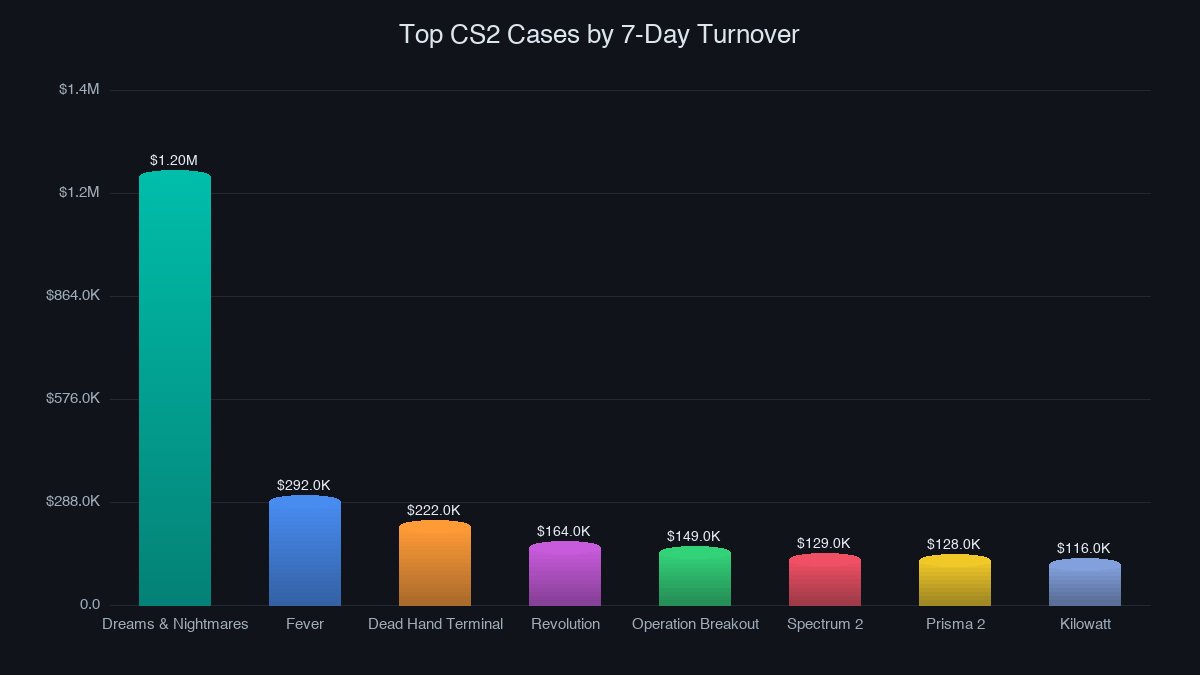
Here is the top eight by turnover, ranked from the bottom up.
#8 — Kilowatt Case
653,200 units sold at $0.18 each, for $116,000 in turnover.
Kilowatt finished second in the entire market for raw units sold and dead last in this ranking for money moved. That is not a contradiction, it is a description. This case sits in the active drop pool, it still drops every day, and its price has been compressed to eighteen cents because supply never stops arriving. Between April 12 and June 29 of this year its price fell from $0.28 to $0.18, a 35.3% slide — the hardest drop of any major case we track. Volume without scarcity is a treadmill.
#7 — Prisma 2 Case
77,000 units sold at $1.67 each, for $128,000 in turnover.
Prisma 2 is the quiet middle of the market. It has rotated out of the active pool, so new supply has slowed to a trickle, and that is the only reason it still holds a price above a dollar. Its turnover is modest because its volume is modest. Whether that price holds depends entirely on patience: retired cases historically climb as old stock thins out, but "historically" is doing a lot of work in that sentence.
#6 — Spectrum 2 Case
31,000 units sold at $4.16 each, for $129,000 in turnover.
Now the shape of the list changes. Spectrum 2 moves less than a tenth of Kilowatt's volume and still beats it on money, simply because each copy is worth twenty-three times more. This is the first entry where price, not volume, is doing the work — and it is the pattern that holds all the way to the top.
#5 — Operation Breakout Weapon Case
13,600 units sold at $10.90 each, for $149,000 in turnover.
Operation Breakout is the extreme version of that idea. It sold the fewest units of anything on this list — roughly 2% of Kilowatt's volume — and still out-earned six other cases. At $10.90 a copy, every single sale is a serious transaction. Cases like this have been out of the drop pool long enough that the market runs entirely on old stock, and old stock does not restock.
#4 — Revolution Case
605,700 units sold at $0.27 each, for $164,000 in turnover.
Revolution is Kilowatt's twin: enormous volume, tiny price, and a price that has been sliding for months. It dropped from $0.34 to $0.26 between April and June, a 23.1% decline. The interesting question with a case like this is not whether it will recover, because it probably will not while it keeps dropping, but how cheap it has to get before the trade-up math starts to look different.
#3 — Sealed Dead Hand Terminal
404,100 units sold at $0.55 each, for $222,000 in turnover.
The Terminals are the odd branch of this market. They arrive as sealed collectibles rather than a classic weapon case, and they trade at sub-dollar prices with genuinely heavy volume. Dead Hand Terminal is the busier of the two, moving more than 400,000 copies in a week. Treat it as packaging people are speculating on rather than a case people are opening for the contents.
#2 — Fever Case
328,200 units sold at $0.89 each, for $292,000 in turnover.
Fever Case is the best all-rounder on the board: sub-dollar price, solid volume, and enough turnover to clear a quarter of a million dollars in a week. Its own price line is telling — it slipped 15.3% from $0.70 to $0.59 between April and June, then traded back up toward the dollar by late September. Of everything on this list, Fever is the one showing a pulse instead of a trend line.
#1 — Dreams & Nightmares Case
793,300 units sold at $1.52 each, for $1,200,000 in turnover.
Nothing else is close. Dreams & Nightmares moved more than four times the money of the second-place case and more units than any other case in the market, and it did both at a price above a dollar. That combination — top volume and a real price — is what separates a genuine market leader from a case that is just cheap enough to be everywhere.
Its price line also shows the market's texture. The case fell 17.0% from $1.47 to $1.22 between April 12 and June 29, then recovered to $1.52 by late September. It is one of the few mainstream containers that has moved the other way this year.
What the Split Actually Tells You
Line the eight cases up and one rule falls out immediately: volume is a symptom, not a strength. The two highest-volume cases in the entire market — Kilowatt and Revolution — finished last and fourth-from-last on money. The two smallest — Operation Breakout and Spectrum 2 — both beat them comfortably.
The reason is scarcity, and it is the same force that has reshaped the wider skin economy. A case in the active drop pool grows its own supply every single day, and nothing about that changes until Valve retires it. Once a case leaves the pool, openings start to consume the remaining stock faster than the rare drops replace it, and the price finally gets room to move. That is why a case that has been out of rotation for a decade — like the CS:GO Weapon Case, still trading at $127.64 after a 21.5% drop of its own — sits in a completely different world from a $0.18 Kilowatt.
It also explains why supply should never be confused with the odds. The rare special slot in a weapon case fires at roughly 0.26%, about one opening in 385, and the same odds apply whether the case costs eighteen cents or eleven dollars. Buying the expensive retired case does not buy better luck. It buys a case that other people are not opening by the thousand every day.
Volume is a useful signal for exactly one thing: telling you how much of the market is being churned rather than held. The churn lives at the bottom of the price ladder, and that is where the money quietly disagrees with the crowd.
If you want to see the split for yourself, the fastest route is to open a case on the live board — the Phantom Cache gives you a fresh look at current drop pools and real payout odds side by side, without having to open thirty tabs of price history first. Compare what a case costs against what it actually returns, and the ranking above stops being a curiosity and starts being a filter.