890,000 Dreams & Nightmares Cases in Seven Days: Reading the Real Case Economy

890,000 Dreams & Nightmares Cases in Seven Days: Reading the Real Case Economy
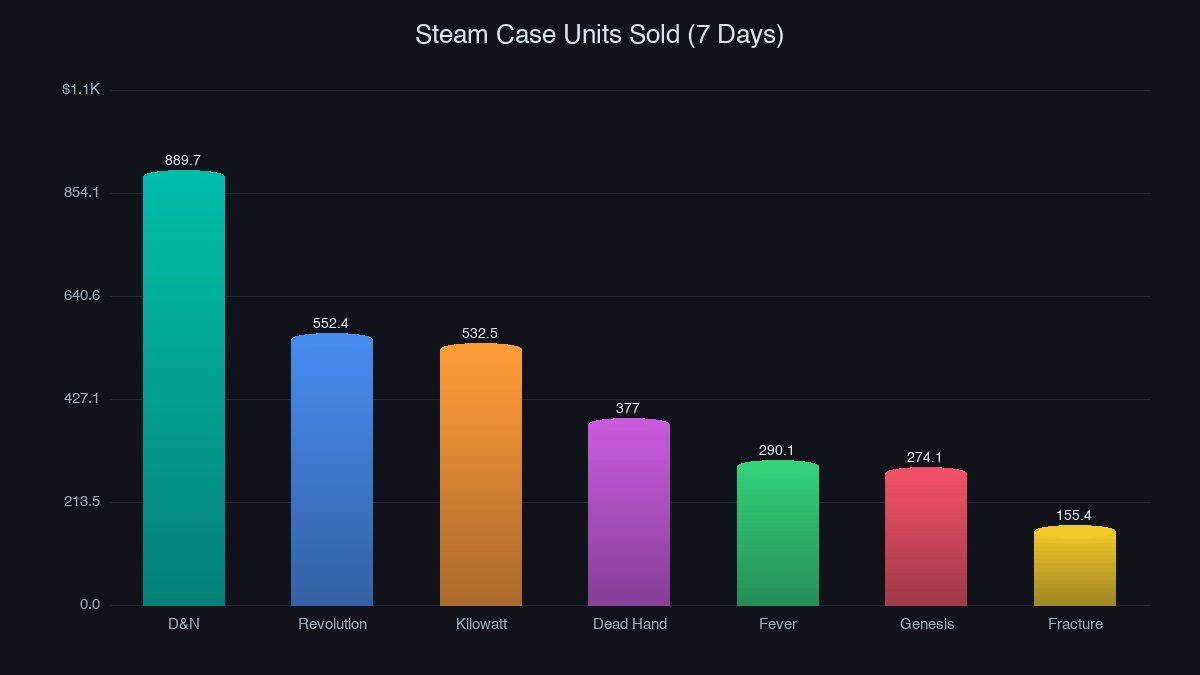
889,700 copies of the Dreams & Nightmares Case changed hands on the Steam Community Market in seven days. Not 889,700 openings — 889,700 case sales, at an average of $1.43, turning over roughly $1.28 million in a single week on a case released four years ago.
That one line tells you more about how CS2's economy actually works than any market cap figure. This is a game where the most-traded item is not a knife or a Covert rifle — it is a $1.43 cardboard box that people buy in industrial quantities because the alternative is paying $2.50 for a key and a dream.
Here is the full week's data, what it hides, and where the numbers point next.
The Raw Numbers
These are seven-day unit counts and turnover for the week of 19–25 October 2026, as tracked by TradeUp Academy's week 43 report:
- Dreams & Nightmares Case — 889.7k sold at $1.43 → $1.28M turnover
- Revolution Case — 552.4k sold at $0.20 → $112k
- Kilowatt Case — 532.5k sold at $0.12 → $63k
- Sealed Dead Hand Terminal — 377.0k sold at $0.35 → $132k
- Fever Case — 290.1k sold at $0.77 → $223k
- Sealed Genesis Terminal — 274.1k sold at $0.07 → $20k
- Fracture Case — 155.4k sold at $0.49 → $76k
- Recoil Case — 138.7k sold at $0.26 → $37k
Eight cases, 3.2 million units, and a combined turnover a bit north of $1.94 million. For context, the entire tracked catalog of 28,107 items was valued at $22.66M that same week, up 2.03% week over week. Cases make up 11.57% of that catalog value — the single largest slice after knives at 45.18% and weapon skins at 30.37%.
What Unit Counts Hide
Rank by units and you get one story. Rank by turnover and you get a different one, because units multiply by price and cheap items multiply by a lot.
The Kilowatt Case moved 532,500 units and generated $63,000. The Fever Case moved 290,100 units — 45% fewer — and generated $223,000. One case is doing three and a half times the money on less than half the volume, purely because it costs $0.77 instead of $0.12.
Then the old cases appear, and the whole picture inverts. Operation Breakout Weapon Case: 15,600 units at $9.74, for $152,000 in turnover. Glove Case: 10,000 units at $12.11, for $122,000. Spectrum 2: 30,400 units at $3.73, for $113,000. Chroma 2: 17,900 units at $5.06, for $90,000.
Read those four lines together and the case economy separates into two markets that barely interact. There is a volume market — sub-$1.50 cases trading in the hundreds of thousands, where almost every buyer is opening. And there is a supply market — $5 to $12 cases that no longer drop, trading in the tens of thousands, where buyers are mostly storing them.
Why the Cheap Cases Win the Volume Race
Opening a case is a two-part purchase: the case plus a key. When the case costs $0.12, the key is the entire expense and the case is a rounding error. When the case costs $1.43 — Dreams & Nightmares — the container itself has become a meaningful part of the bet, which is exactly why its volume is so large and its price is so stable. It is the default "I want to open something" case: available, cheap enough to repeat, expensive enough that sellers still list it.
The price distribution explains the rest. 35.54% of all tracked items trade under $1, and another 30% sit between $1 and $10. Sixty-five percent of the catalog is essentially disposable. Cases live in that band by design, which is what makes them the most liquid thing in the game — you can buy 500 of them without thinking, and the market absorbs it without moving.
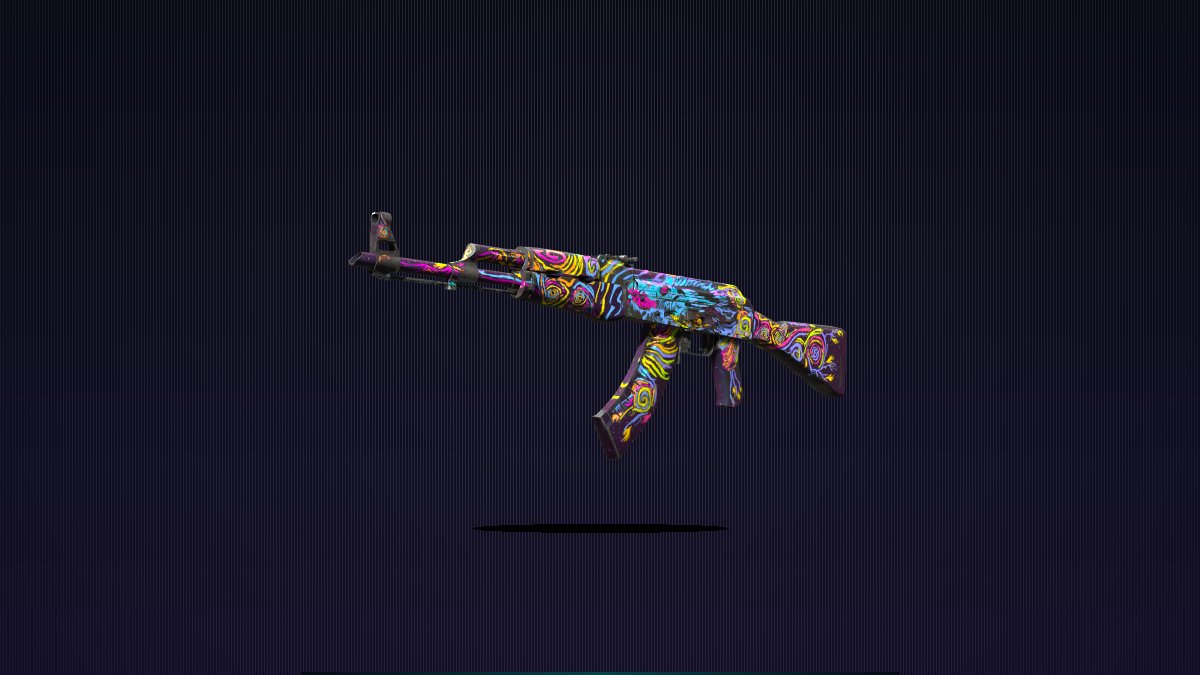
Worth naming what is actually inside the most-traded case. Dreams & Nightmares tops out at the AK-47 | Nightwish, listed at $75.59 in Field-Tested this week — roughly 53 cases at $1.43 each for a single copy of the case's best realistic outcome, before the key cost enters the math. The case's real economics are not $1.43 against a $75 rifle; they are $1.43 plus a key against a distribution where the overwhelming majority of results are worth less than the key.
That is the number players actually underweight. A case trading 889,700 units a week is evidence of demand for the gamble, not evidence about the odds.
Supply Has Quietly Stopped Growing
The structural story sits underneath all of this, and it is the part most likely to matter in twelve months.
Valve has not released a traditional key-and-case since the Fever Case on 31 March 2025. The newest container is a different format entirely — the Sealed Dead Hand Terminal, released 11 March 2026, which shows you one offer at a fixed price and lets you accept or reject it. Before that came the Sealed Genesis Terminal in September 2025. Armory collections arrived in July 2026 (Arabesque and Spy Tech, 17 skins each, no key).
Meanwhile the drop pool has been shrinking. Around 30 older cases were removed from the weekly drop pool on 17 December 2025 by one tracker's dating, and the Recoil Case was pulled on 11 March 2026 when Dead Hand arrived. The newest classic case still available as a weekly drop is the Kilowatt Case from February 2024 — the same case trading at $0.12 today.
Put those two facts together. Supply of older cases is capped, and the arrival rate of new classic cases has fallen to roughly zero. That is the mechanism behind a $12 Glove Case and a $9.74 Operation Breakout Case doing six figures of weekly turnover. Scarcity is being manufactured by attrition, not by demand.
What the Week Actually Says
Three conclusions hold up against the numbers. First, the entry-level opening market is healthy and enormous — millions of sub-$1.50 units a week, no sign of the volume collapse that the "market is dying" narrative implies. Second, the money in cases has migrated upward: turnover concentrates in the $1–$12 band where supply is fixed. Third, the format itself is changing, with Terminals and Armory collections replacing the classic case as Valve's preferred release vehicle.
There is a fourth signal in the data worth flagging, because it cuts against the first three. The eight cases above generated roughly $1.94 million in combined turnover for the week — a meaningful sum, but a small fraction of a catalog valued at $22.66M where knives alone account for 45.18% of value. Cases are the most traded thing in CS2 and nowhere near the most valuable thing. Volume and value have fully separated.
The practical implication for anyone holding cases is simple: the ones still dropping in the weekly pool are the ones with uncapped supply, and the ones that stopped dropping are the ones with a reason to be worth $12. Buying the cheap ones is buying volume. Buying the retired ones is buying scarcity — and the market is currently paying $223,000 a week for that distinction.
If you would rather open than speculate, the Phantom Cache case on SkinVS runs on the same odds as everything in the pool, with the contents listed before you commit a single dollar. That is the honest version of the bet: know what is inside, then decide.