A $15.99 Armory Pass Returns About $11. Here's Where the Rest Goes
A $15.99 Armory Pass Returns About $11. Here's Where the Rest Goes
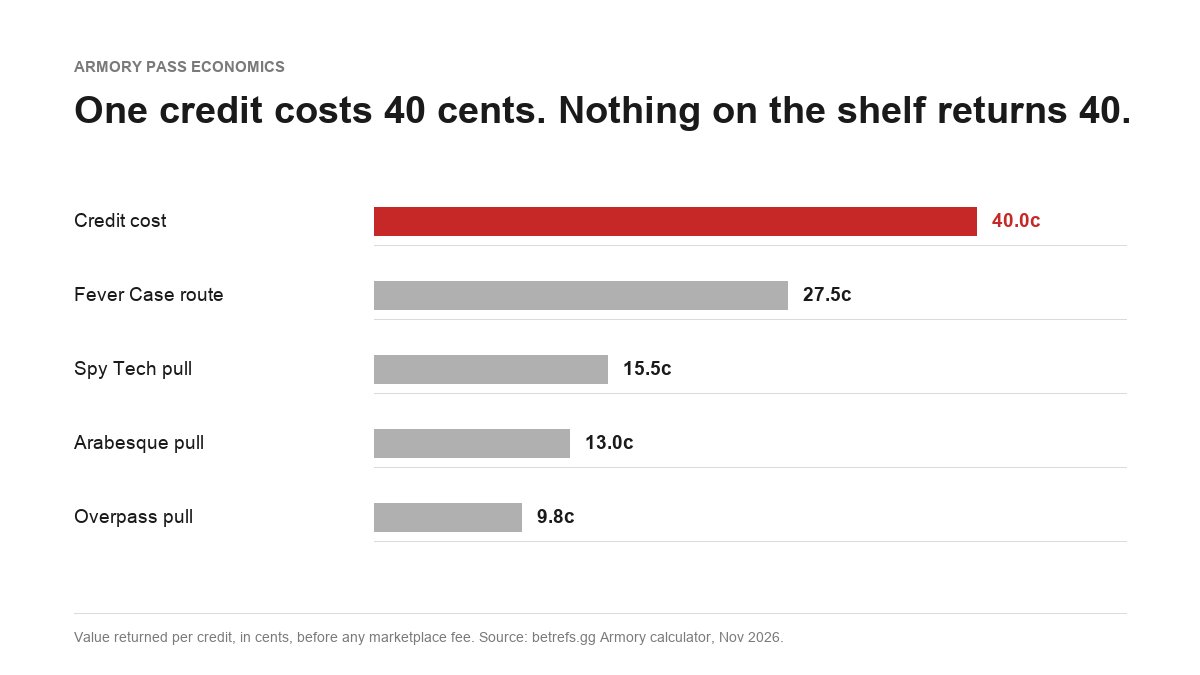
Valve sells you 40 Armory Credits for a reported $15.99. That works out to 39.975 cents per credit, which is the single most useful number in the entire Armory system, and almost nobody quotes it.
Once you have it, every reward in the shop becomes a subtraction. The Fever Case costs 2 credits, so it costs you 80 cents. A random pull from a weapon collection costs 4 credits, so it costs $1.60. The only question left is what each of those things is actually worth when you try to sell it.
We ran that subtraction on all four priced routes, using November 2026 marketplace data and live listings. Three of the four lose more than half your money. One of them loses less than a third. That is the whole review.
The Number That Matters: 40 Cents a Credit
A pass holds 40 credits, and you cannot buy credits separately. You earn them by playing: Valve does not publish the rate, but community testing puts it near 300 XP per credit, so a full pass is roughly 12,000 XP. A Competitive round win pays 30 XP, which makes one credit about ten won rounds and a whole pass about 400.
You can stack up to five passes at once, so every point of XP feeds all of them. That speeds up the grind. It does not change the price of a credit.
The number to hold onto is 40 cents. Every reward below is priced against it, and the gap between what a credit costs and what a credit returns is the entire story.
Route One: Twenty Fever Cases, Minus 31%
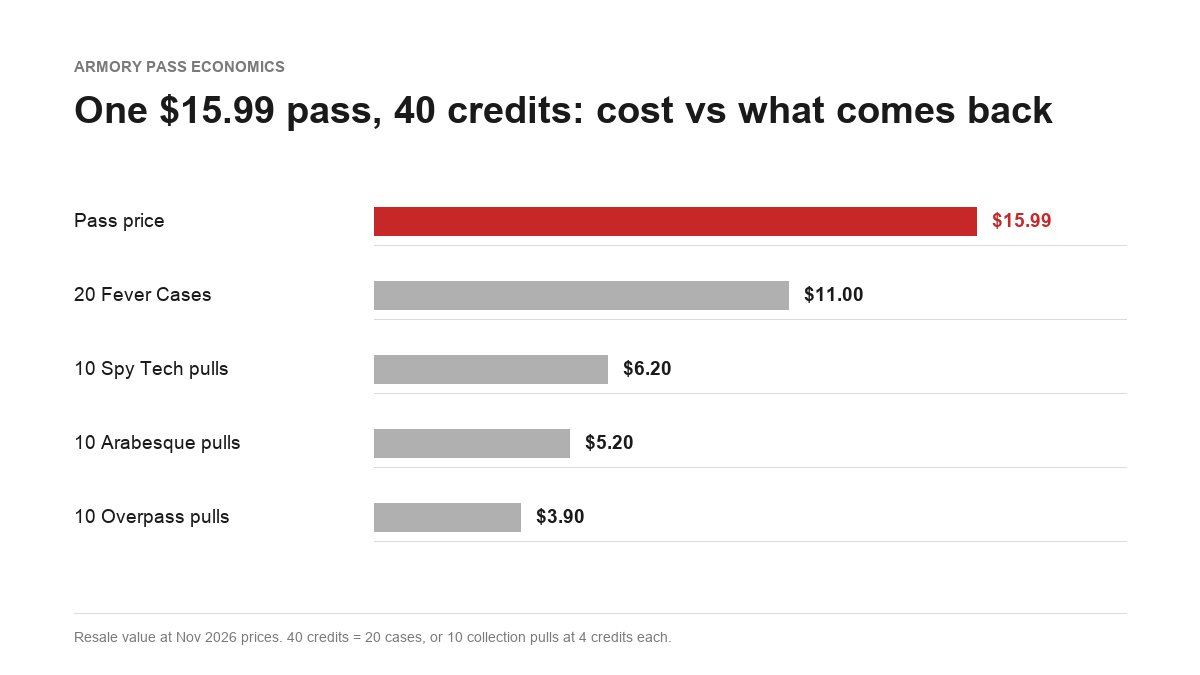
The safest thing you can do with 40 credits is turn them into 20 unopened Fever Cases at 2 credits each. Recent Armory cases sell for roughly $0.55 to $0.76 each, so 20 of them is about $11.00 before fees.
Against $15.99, that is a 31% loss for doing nothing but clicking redeem twenty times. It is the best result on this page and it is still a loss.
And if you open those cases instead of selling them, the arithmetic gets much worse. Twenty keys at $2.49 adds $49.80, so your real outlay becomes $65.79. Average case openings return somewhere between 50% and 85% of cost, so you would be spending $65.79 to receive maybe $28 of items on average, before the marketplace takes its cut.
That is not a knock on the Fever Case specifically. It is how cases work everywhere. The pattern showing up across the market right now is that cases and their keys are getting cheaper faster than the items inside them — the Glove Case has slid to $8.72, and the average Glove Case drop now lands at just 62.1% of the opening price.
Route Two: Four-Credit Collection Pulls, Minus 61% to 76%
Spend your 40 credits on weapon collection pulls at 4 credits each and you get ten random skins at $1.60 apiece. Here is what each collection actually averages, using the middle of the published price ranges:
- Spy Tech — average result $0.62 per pull, against $1.60 paid. Down 61%.
- Arabesque — average result $0.52 per pull. Down 68%.
- Overpass 2024 — average result $0.39 per pull. Down 76%.
Ten Spy Tech pulls return about $6.20. Ten Overpass pulls return about $3.90. Both of those numbers are less than half of what the pass cost, and both assume you sell everything at market price with no fee.
The reason is the rarity ladder. Roughly 79.4% of collection pulls are Industrial skins worth pennies, another 16.5% are Mil-Spec, and only 3.3% reach Restricted. The items that make the collection worth talking about are almost never the items you receive.
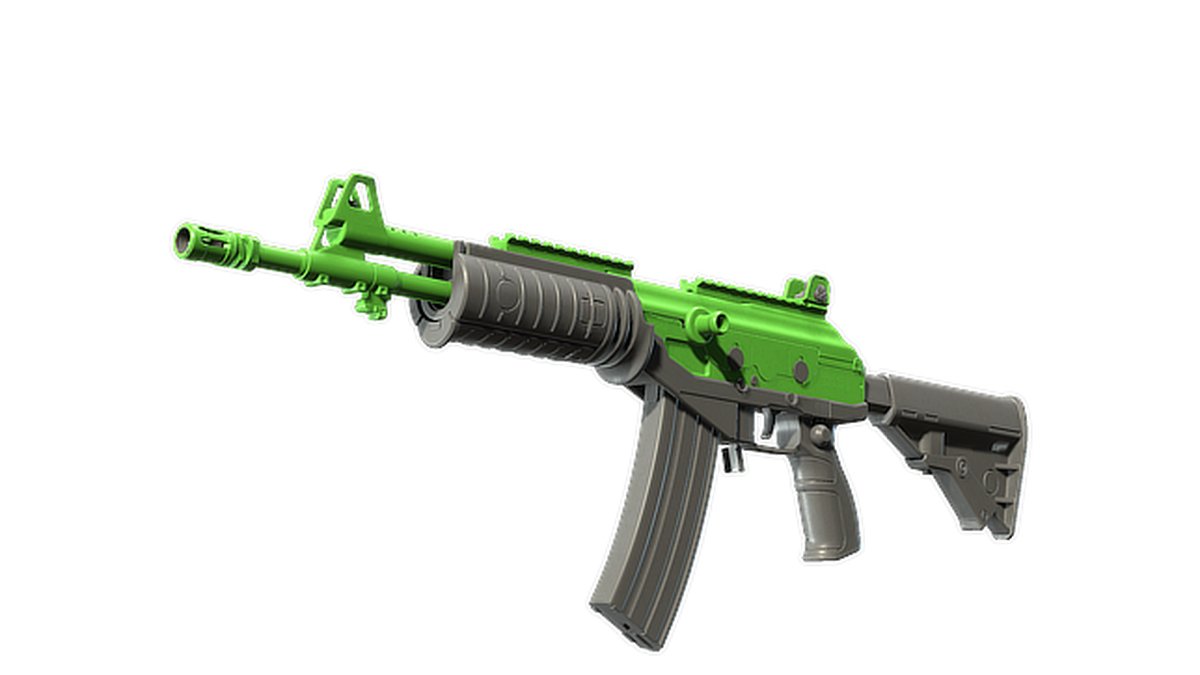
The floor is genuinely bleak. Overpass 2024 has skins listed at $0.03. Arabesque has skins at $0.02. On skinvs right now, a Galil AR | Green Apple in Factory New trades at $0.24 — that is not a typo, and it is the kind of item a low-tier pull hands you.
The Odds Are Half What a Case Gives You
Here is the part that surprised us. A 4-credit collection pull costs $1.60, which is cheaper than a $2.49 case key. So on the surface the Armory looks like better value for chasing a red item.
It is not. Collection Covert odds run at about 0.13%, or 1 in 769. Case Covert odds are 0.64%, or 1 in 156. Normalise both for what you spend and a case key gives you roughly 3.2 times more Covert chance per dollar than an Armory collection pull.
The ceiling is real, which is what keeps people redeeming. Spy Tech's best item is the Glock-18 | Ghost Protocol at $175.05. Arabesque's is the AK-47 | Consequence of the Jinn at $125.03. Overpass 2024's is the AK-47 | B the Monster at $81.18. Every one of those is a real, sellable item that would pay for a dozen passes.
But you are buying a roughly 1-in-769 shot, ten times, for $16. That is a lottery ticket priced at exactly what lottery tickets cost and returning exactly what lottery tickets return.
The Limited Edition Trap
The Armory's flagship items sit outside the credit ladder, and they rotate out without much warning. The range has been wide: the Desert Eagle | Heat Treated launched as the flagship at 25 credits. The AK-47 | Aphrodite went the other way at 125 credits, which is four full passes and about $64.
Aphrodite has since left the Armory. Today it sells for roughly $16 to $20 in Field-Tested and about $30 in Minimal Wear. Live skinvs listings put the Field-Tested copy at $16.10 and Minimal Wear at $27.59.
So the item that cost four passes and a few hundred won rounds to grind can now be bought outright for less than a single pass, in every condition except Factory New, where it still commands a real premium near $370.
That is the cleanest illustration of the whole system. Grinding a flagship is a bet that its post-rotation price holds above the cost of the credits you burned. Most of the time it does not, because the market is flooded with everyone else who ground the same item at the same time.
What This Is Actually For
None of this means the Armory is a scam. It is not priced as an investment and never was. It is a progression track that pays out in cosmetics while you play the game you were going to play anyway, and Valve has reportedly cleared well over $800 million on Armory items, which tells you exactly how the deal is structured.
The mistake is treating the credits as money. If you would have played those 400 rounds regardless, then $11 of cases and $6 of skins are a bonus and the maths does not matter. If you are buying passes specifically to resell the contents, you are paying $15.99 for about $11 and calling it a strategy.
The smarter version of the same money is embarrassingly simple. Take the $15.99, skip the pass, and buy the specific skin you actually wanted. If it is a $16 Field-Tested Aphrodite or a $27 Minimal Wear one, you get the exact item with no dice involved, and you can browse the full marketplace to compare conditions side by side before you commit.
If you want the opening experience instead of the skin, an opening from Phantom Cache costs a fixed price, tells you the odds up front, and does not require 400 won rounds of unpaid labour first. That is a fairer trade than 40 cents a credit, and it is available tonight.