The $19,447 Sticker Set: Inside Valve's Cologne 2026 Dynamic Pricing Fix

The $19,447 Sticker Set: Inside Valve's Cologne 2026 Dynamic Pricing Fix
At one point in June, a full set of Cologne 2026 Major stickers was worth $19,447. That is more than a factory-new Karambit, more than most players' entire inventories, more than a used car. Then Valve quietly admitted that the pricing system behind that number "didn't produce reasonable prices" — and shipped a fix that almost nobody noticed.
The Raw Numbers
Before we get into what changed, here is what the sticker economy around the Cologne 2026 Major actually looked like:
- $19,447 — the reported cost of a complete sticker set under Valve's original dynamic pricing system, according to coverage of the June peak.
- 50% — the share of every Cologne 2026 shop sale that goes to the teams, players, and tournament organizer.
- September 29 — the last day the Cologne 2026 Shop stays open for purchases.
- 2 million+ — live concurrent viewers during the Major, making it the most-watched Counter-Strike tournament in history.
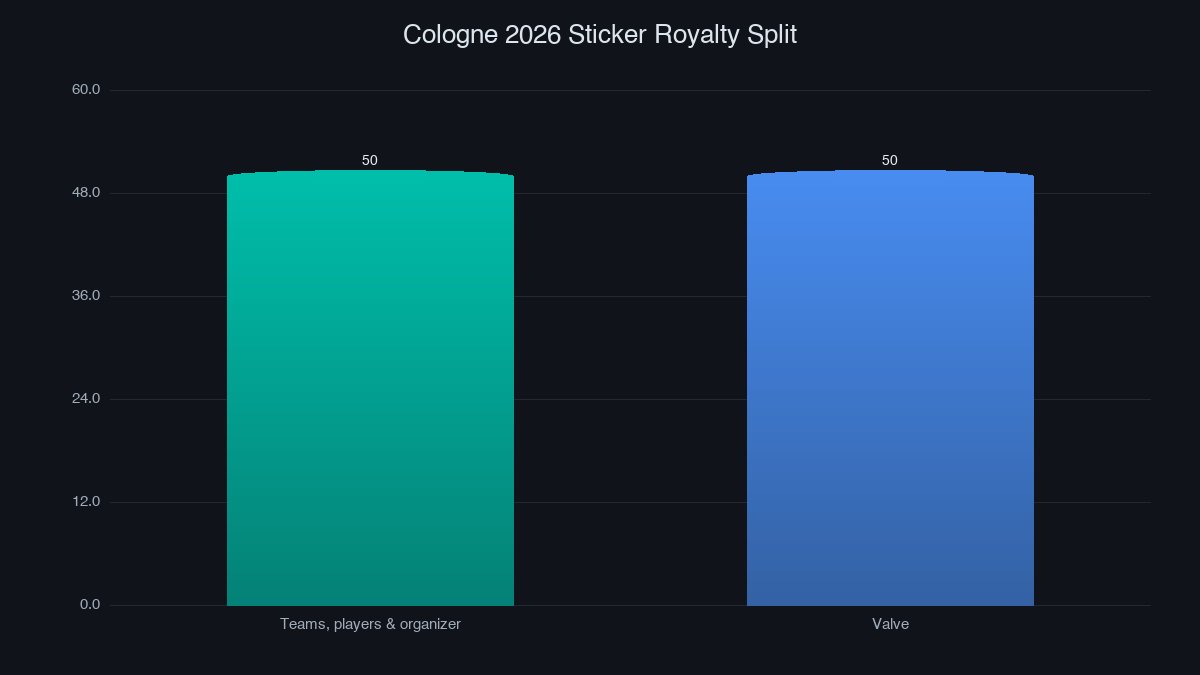
Those numbers add up to something unusual: a cosmetic item market where demand is driven by esports fandom, but prices are set by an algorithm that clearly lost the plot. When a sticker set out-prices almost every knife in the game, something in the pricing model has gone sideways.
What Went Wrong With Dynamic Pricing
The idea behind dynamic pricing was reasonable on paper. Instead of charging one flat price for every sticker, Valve let the price rise and fall with demand. Popular players and teams would cost more; less popular ones would cost less. The market, in theory, would self-correct.
In practice, it produced the opposite of a functioning market. Prices for the most-wanted stickers spiraled upward as fans piled in, and the full set — collecting one of everything, including the rarest holo and foil variants — ballooned to that five-figure total. What started as a way to price stickers fairly turned into a feedback loop: higher prices signaled higher demand, which pushed prices even higher.
Valve's own assessment, posted in the July 29 update, was blunt. The system determined relative interest in players and teams, but "it didn't produce reasonable prices." That is about as close to a public admission of a failed experiment as Valve gets — and it matters because Valve rarely walks back a monetization decision this quickly.
It is also worth remembering how unusual the sticker market is compared to the rest of CS2. Cases have fixed prices and a known drop table; a sticker's price, under dynamic pricing, was essentially a live auction with no ceiling. Once fans of a single breakout player piled in, the sticker for that player could move more in a week than most knives move in a year.
How the Ranked Series Fixes It
The fix shipped as the Ranked Series of Cologne 2026 stickers. These new stickers carry a team's final tournament standing directly in the design — a subtle status marker for anyone who wants to show off where their squad actually finished.
The important part for buyers is the price. Valve reset the Ranked stickers to a lower, fixed price, while keeping the same relative relationship between players and teams as the earlier Event Series. In other words, the hierarchy is still there — a star player's sticker still costs more than a support player's — but the runaway algorithm is gone.
Just as importantly, the 50% royalty split to players, teams, and the tournament organizer remains intact on every purchase. That is the model's saving grace: even with corrected prices, every sale still funnels real money back to the people who make the scene worth watching in the first place.
What This Tells Us About the Sticker Economy
Stickers rarely get the same attention as knives or gloves, but they are quietly one of the most liquid corners of the CS2 market. Team stickers tied to a Major become speculative assets — their value swings on a team's playoff run, a roster change, or a legendary clutch round.
The $19,447 moment is a reminder that Valve is still actively tuning how this economy works. When pricing goes too far in one direction, Valve steps in — just as it has with case drops and the trade-up system in the past. For collectors, that kind of intervention matters: it tells you the ceiling on sticker prices is not purely organic demand, but partly a policy decision made in Seattle.
It also tells you something about scale. The Cologne Major pulled more than 2 million concurrent viewers, and a meaningful slice of that audience converts into sticker buyers. That is a lot of real money moving through a purely cosmetic market — enough that Valve is willing to iterate on the pricing model mid-cycle rather than let it ride.
The Smart Play
If you have been on the fence about Cologne 2026 stickers, the clock is the thing to watch. The shop closes on September 29, and after that the only way to get these stickers is on the secondary market — where the resale premium is anyone's guess.
The Ranked Series gives you the clearest entry point: a lower fixed price, the same royalty support for players and teams, and a design that actually marks a team's finish. For the price of a single mid-tier knife, you could build a meaningful sticker collection instead — and a full sticker set has already proven it can out-price most knives when hype takes hold.
If you are buying to support a favorite player or team, there is no bad time before the deadline. If you are buying as a long-term hold, the lower-priced Ranked Series is the safer bet — you are not chasing an inflated peak, and the September 29 cutoff gives scarcity a chance to do its work after the shop closes.
Stickers and cases scratch different itches, but both feed the same hobby. If opening something with a shot at a knife is more your speed, Frost Vault is a solid place to test your luck — and it is open right now, no September deadline attached.