CS2 Lost 300,000 Players This Year. The Skin Market Only Noticed Five Percent of It.
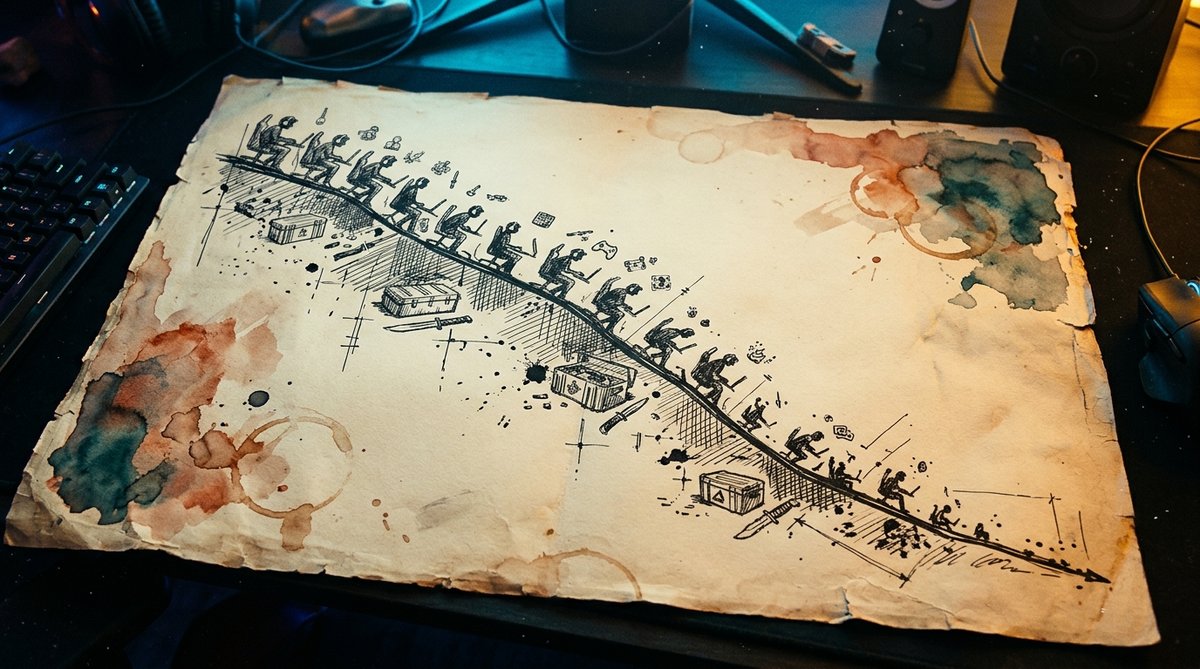
CS2 Lost 300,000 Players This Year. The Skin Market Only Noticed Five Percent of It.
On Sunday 15 November, 850,132 people had Counter-Strike 2 open at the same moment. Two days later, on the Tuesday, that figure was 701,082. Nothing shipped, nothing broke, nobody announced anything. The game simply did what a game does on a weekday.
That 149,000-player gap is the whole story of the 2026 skin market, and almost nobody trading cases talks about it. The number people quote — the monthly average, the peak, the "CS2 is dying" screenshot — is a slow indicator. What actually moves skin prices is the shape of the week.
First, the number everyone is arguing about
SteamAnalyst's monthly series puts October 2026 at an average of 797,324 concurrent players. October 2025 averaged 948,244. That is a 15.9% decline year over year, and it is not a one-month wobble. It is the ninth consecutive month below the one before it.
Run the sequence in order: January 1,070,444. February 1,084,095, the last month that went up. March 1,069,173. April 974,786. May 932,721. June 916,655. July 853,232. August 825,258. September 805,638. October 797,324. November so far, 755,028.
From January's average to November's, CS2 has shed just under 30% of its concurrent audience — roughly 315,000 people at any given moment. Against the March 2025 all-time monthly peak of 1,818,368, the current average sits about 58% lower. The game is still the most-played title on Steam by a wide margin, which is exactly why the decline is easy to wave away in a headline.
One caveat on the source: these are concurrent players, not unique players. A 15.9% drop in people logged in at 20:00 does not mean 15.9% fewer people touched the game this month. It means the crowd standing in the room got smaller.
Meanwhile the market fell 5.2%
SkinStrack's November report, covering the 30 days to 21 November, has the typical CS2 item down 5.2%, with only 22.3% of tracked items rising. Every category fell, and cases fell hardest of all. UnboxedCases' daily index for 22 November reads −0.3% with 323 items up against 817 down — a normal red day, not a crash.
Put the two numbers side by side and something looks wrong. Players down 15.9%. Prices down 5.2%. If skin demand were purely a function of how many people log in, the market should be down three times as much as it is.
It isn't. And that gap is the most useful thing in the data, because it tells you the thing holding prices up is not player count.
Why losing players hurt prices less than expected
Three reasons, and only one of them is comfortable.
The people who left were the least likely to open cases. A returning player who plays four hours a week and never buys a key contributes exactly nothing to skin demand. The churn CS2 has absorbed since March 2025 looks a lot like that profile: a wave that arrived with an update cycle and drifted off, without ever converting into buyers. The players still logging 700,000 concurrent on a Tuesday are the ones who already own inventories.
Supply grew at the same time. Since 22 October 2025, five Covert skins can be traded up into a knife or a pair of gloves. Every contract mints an item that did not exist before, and standard knife prices have never recovered. New supply arriving while the buyer pool shrinks is a double hit, and it produces a much deeper price fall per lost player than the raw count suggests.
Cases became the cheap end of the hobby. Sealed cases sitting between $0.14 and $1.16 are the one thing a lapsed player can still buy on a whim. That floor absorbed a lot of the demand shock that would otherwise have landed on finished skins, and it is why the case category can fall hardest in percentage terms while the rest of the market stays near flat.
The four-hour window that actually sets the price
Here is the part that changes how you read every "CS2 player count" post you will see this week.
On 19 November the hourly count ran from 386,812 at its low to 1,108,331 at its peak. That is a 2.9x swing inside a single day. Across the last thirty days, weekday averages cluster near 700,000 while Saturdays and Sundays run 840,000 to 875,000 — a weekend premium of roughly 20%.
What that means in practice: for a large share of the day, the live audience is less than half of the headline peak. Case openings, market listings and impulse purchases happen in the high band, not at the average. The daily peak is the number that matters for trading activity. The daily trough is mostly people who left the client open overnight.
So watch the weekday trough, not the peak. If the trough stops falling while the peak holds, the audience has stabilised and skin demand follows within about a month. If the trough keeps sliding while the peak holds, you are watching the committed core shrink — and that is the scenario where 5.2% turns into 15%.
There is a second tell in the same data. November's peak of 1,300,237 is higher than September's 1,450,705 only on paper; measured per day, November is the softest month since early 2023. But the peak is still being hit — once a week, briefly. A market driven by weekend spikes can look healthy on a chart and thin in a spreadsheet.
What this does to a buying decision
Practically, the current setup argues for patience on anything priced as a finished skin and against patience on anything priced as an input. Coverts are the fuel for knife contracts, and fuel demand does not care how many people are online. It cares how many contracts are being run. That is why a P90 Asiimov can hold $243 while a plain knife from the same case loses a third of its value.
If you want the other side of the trade — the part where new knives keep arriving and the floor keeps getting tested — that is exactly what a case with a live knife pool gives you. Opening the Phantom Cache is the same mechanic at retail price: you pay for a roll at the gold tier instead of buying five reds to convert. Neither is a good bet on average. The difference is that the case caps your downside at the price of a key, and the trade-up caps it at the price of five Covert skins.
Neither route is a way to beat the 15.9%. Both are ways to stop paying for the thing that is falling.
What would actually change the trend
Player count is a downstream number. It moves when Valve ships something people want to log in for, and it stays moved for about six weeks afterwards. The PGL Singapore Major starts 24 November and runs to 13 December, and majors historically lift both the daily peak and case volume for the length of the event.
That is the test. If the major lifts the weekday trough and not just the weekend peak, the audience is still there and November's 755,028 average is a floor. If the major lifts the peak while the trough stays at 386,000, then the market is running on a smaller group of people who show up for events — and prices for everything except crafting fuel will keep grinding lower.
The 300,000 players who left this year did not take the market with them. They took the least-committed sliver of demand, and 5.2% is an honest measurement of what that sliver was worth. The next leg is not about player counts at all. It is about how many knives the trade-up system keeps minting, and how many buyers are left who want one.