We Compared 1,185 CS2 Skins With March: 97% Of Them Are Cheaper Today

We Compared 1,185 CS2 Skins With March: 97% Of Them Are Cheaper Today
1,148 down. 30 up. That is the scoreboard from the most complete like-for-like comparison of the 2026 CS2 market, and it has been sitting there in plain sight for two weeks.
The comparison comes from tracking site CSDB, which matched skins that had a price in both of two snapshots — March 2 and September 15, 2026 — using the same wear condition, and counting only items that cleared a $1 baseline with at least three wear bands matched. The result is a dataset of 1,185 skins where the only thing that changed is time.
The Raw Numbers
The headline statistics are blunt enough to read without commentary:
- 1,148 skins lost more than 1% of their value between March 2 and September 15
- 30 skins gained more than 1%
- The median change across all comparable skins was -33.4%
- Roughly 97% of the dataset is cheaper now than it was in March
A second, independent snapshot tells the same story in a shorter window. Comparing April 12 and June 29, 2026, and counting only items worth at least a dollar listed on ten or more marketplaces, SteamDB recorded 16,428 qualifying items — of which 12,132 fell and 4,285 rose, for a median move of -9.1%. Different sites, different methodologies, different windows, one direction.
If you have been holding skins and telling yourself the drift is a mid-tier problem, the category breakdown is where that assumption dies.
Where The Damage Concentrated
Median per-skin price change, March 2 to September 15, 2026, grouped by weapon category:
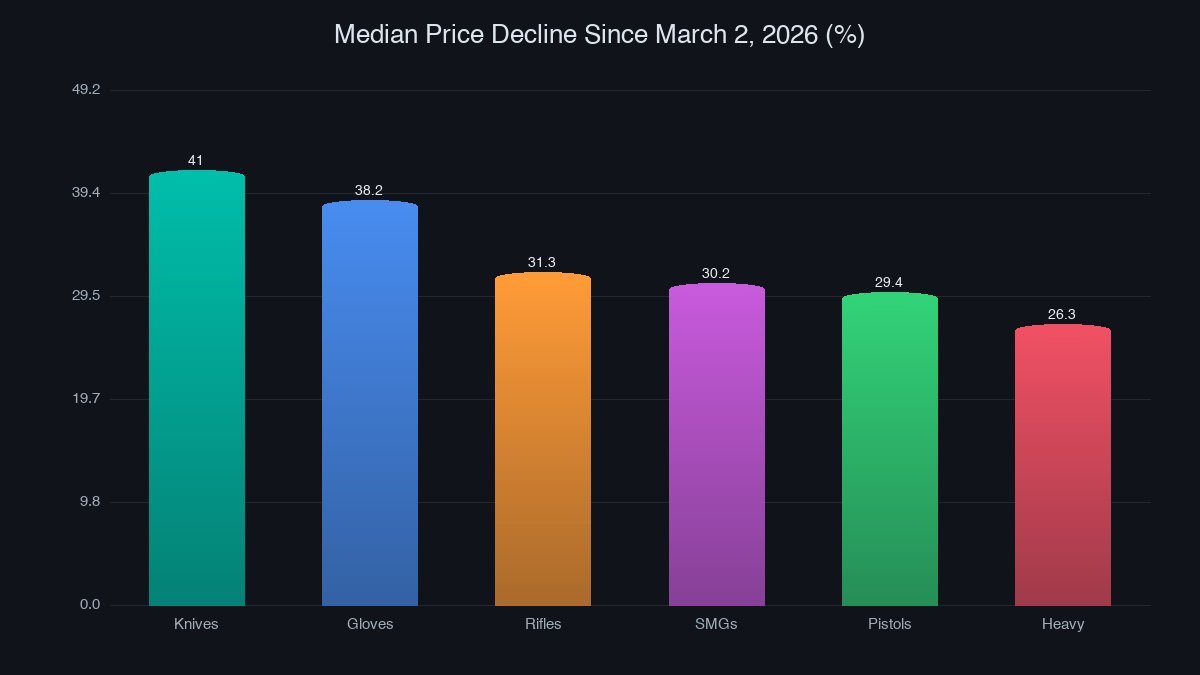
- Knives: -41.0% across 306 compared skins
- Gloves: -38.2% across 72 compared skins
- Rifles: -31.3% across 312 compared skins
- SMGs: -30.2% across 142 compared skins
- Pistols: -29.4% across 247 compared skins
- Heavy: -26.3% across 103 compared skins
Medians are used here deliberately. A median resists the distorting effect of a single $60,000 glove sale, so what you are looking at is roughly what the typical item in each category did — not what the most spectacular one did. And the shape of the table is not random. The two worst categories by a wide margin are the two whose supply mechanics were rewritten in October 2025, when Valve allowed five Covert-rarity skins to be traded up into a guaranteed knife or a pair of gloves. Before that patch, the only routes to a knife or glove were opening a case at roughly a 0.26% special-item rate or buying one outright.
The market's answer was immediate. Tracking site Price Empire logged the total CS2 skin market cap falling from roughly $6 billion to about $4.27 billion in under 24 hours — close to $2 billion of paper value gone in a day, with many previously expensive knives and gloves dropping 40% to 60% almost on contact. Months later, the categories have not recovered their old relationship to the rest of the market. They are still the weakest part of it.
What Actually Went Up
Thirty gainers above 1% is a small number, but the composition of that list is the useful part. The rises cluster in skins from older, discontinued collections — items where no active case or collection produces new copies, so even modest collector demand has nothing new to bid against. That is the one clean supply story in the entire dataset, and the case data confirms it.
Compare the containers in the same SteamDB window:
- Glove Case: $14.04 to $16.10 — up 14.7%
- Operation Bravo Case: $67.57 to $61.58 — down 8.9%
- Dreams & Nightmares Case: $1.47 to $1.22 — down 17.0%
- CS:GO Weapon Case: $162.62 to $127.64 — down 21.5%
Look hard at that last line, because it dismantles a comfortable belief. The CS:GO Weapon Case has been out of the active drop pool for more than a decade. It is about as scarce as an item in this game gets, and it still lost a fifth of its price in eleven weeks. Scarcity is not a floor. Scarcity plus a reason to buy is a floor, and the difference between those two things is the whole 2026 story.
Two Markets In One
The clearest way to understand what is happening is to stop treating CS2 items as one market. Since the trade-up change, there are two.
The first is the craftable tier: knives and gloves that any holder of five Covert skins can now manufacture on demand. Supply in this tier is no longer gated by a 0.26% dice roll, and prices have compressed into something closer to a production cost. The second is the non-craftable tier: rare pattern seeds, float outliers and StatTrak variants. A trade-up contract cannot target a specific Case Hardened pattern or a specific StatTrak designation, so the old scarcity logic still applies at the very top — which is exactly why premium non-craftable items have held while standard versions of the same model bled.
The wear axis
Wear bands in CS2 run from Factory New at 0.00–0.07 up to Battle-Scarred at 0.45–1.00, and every glove in the game has a float range starting at 0.06. That means a Factory New glove has to land in the sliver between 0.06 and 0.07 — roughly one seventy-fourth of the range the item can roll. The result is a price curve far steeper than on guns: across 67 glove finishes with reliable prices in both conditions, the median Factory New premium over Field-Tested is about 5.5×. Knives, on the identical float band, sit nearer 3.2×. Individual finishes go further — the Factory New median for Hand Wraps | Duct Tape runs roughly 30× its Minimal Wear median, while Driver Gloves | Diamondback barely moves across three wears because the texture hides light wear.
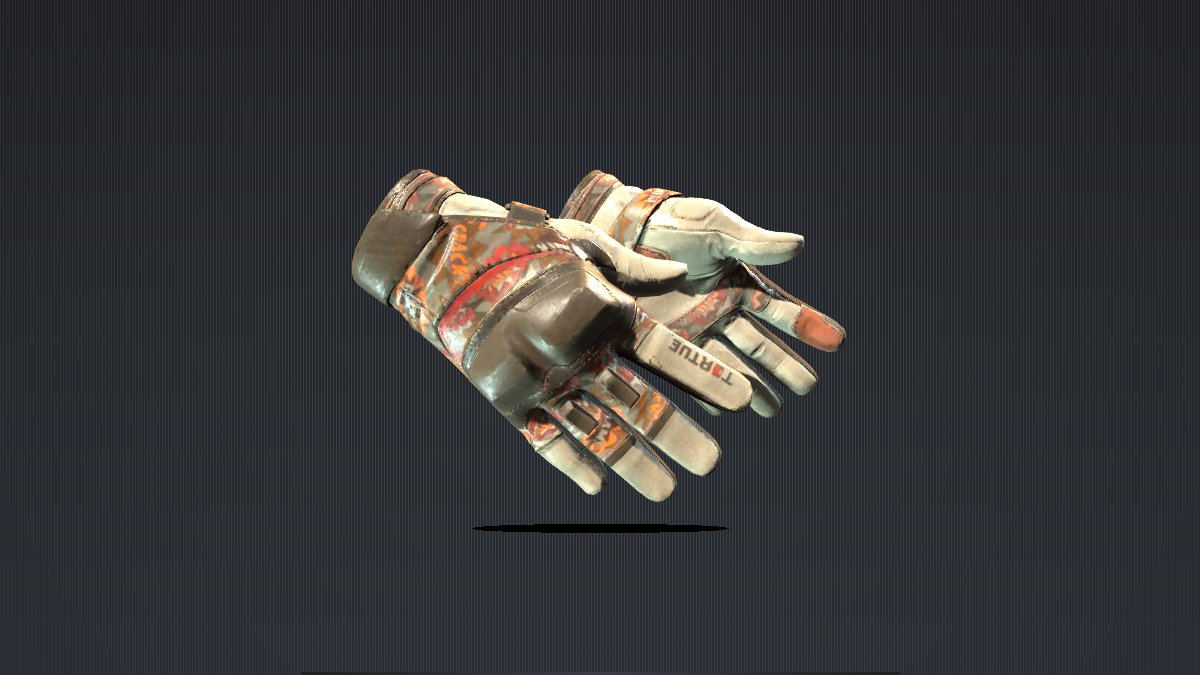
Field-Tested is where the volume lives, and it is where the current floor is. A Moto Gloves | POW! in Field-Tested is trading around $93 right now — an Extraordinary-tier glove for less than a mid-range rifle skin, in a category whose Factory New equivalents run into four figures.
The Smart Play
The single most useful pattern in this dataset is that liquidity dampens swings in both directions. The most-traded mainstream items are the ones that fell the least: AK-47 | Redline in Field-Tested lost only 6.0% ($34.42 to $32.36), AWP | Asiimov in Field-Tested fell 5.9%, AK-47 | Case Hardened in Field-Tested moved -2.4%, and Butterfly Knife | Doppler in Factory New was essentially flat at -1.4%. The steepest declines skew mid-tier and lower, where supply is deepest — cheap items are cheap because there are millions of them.
Exit cost is the part people forget. On June 29, the lowest ask on an AK-47 | Redline (Field-Tested) was $29.23, the best standing buy order was $28.60, and the net after a 2% fee worked out to $28.03 — a 4.1% haircut for wanting out immediately. AWP | Asiimov carried a 4.2% haircut and Karambit | Doppler (Factory New) a 6.2% one. In a market where the median item is down a third, an unplanned exit is an expensive habit.
So the three rules the data supports: buy what a trade-up contract cannot manufacture, size positions so that you can hold through a bad quarter instead of selling into one, and check float before you check finish, because on gloves the wear band is worth more than the paint. On the SkinVS shop the float is visible before you commit, which is the whole game in a market that is repricing itself item by item — and if you would rather chase the other side of the ledger entirely, the Phantom Cache case is where the odds stay fixed at roughly 0.26% no matter what the median does.