CS2 Case Opening in 2026: How to Read the Odds and Stop Burning Money
CS2 Case Opening in 2026: How to Read the Odds and Stop Burning Money
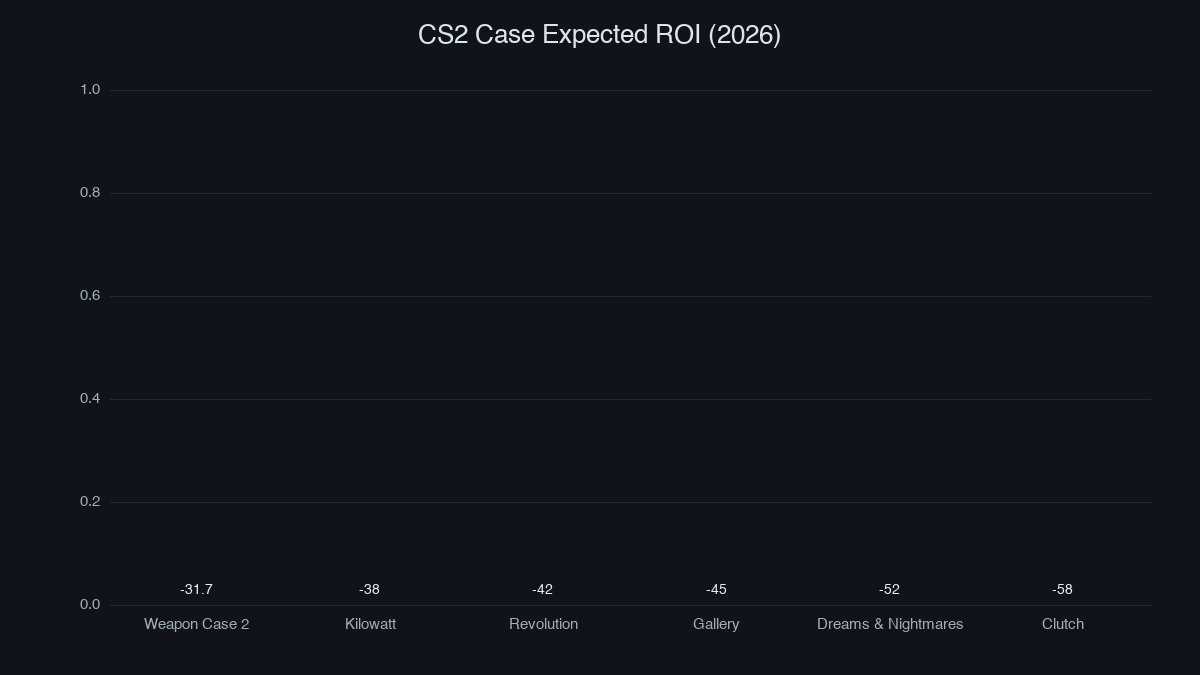
Let's be brutally honest: every CS2 case you open loses money, on average. Not some cases. Not most cases. Every single one. The best-performing case in existence — CS:GO Weapon Case 2 — carries an expected return of -31.7%. That means for every $100 you spend on keys, you're statistically walking away with $68.30 in skins.
But here's what most players don't realize: Valve published official drop rates for every rarity tier. The numbers are public, the math is straightforward, and yet the vast majority of case-openers have never done the calculation. This guide changes that — no spreadsheet required.
Step 1: Know What You're Actually Gambling On
Every CS2 case pull is governed by a fixed probability table. Valve confirmed these numbers, and they haven't changed meaningfully since the CS:GO era. Here's the breakdown:
Mil-Spec (Blue): 79.92% — roughly 4 out of every 5 openings. These skins typically sell for $0.03 to $0.50 on the market. They're not recoveries; they're confirmation that the system works exactly as designed.
Restricted (Purple): 15.98% — about 1 in 6. These can range from $0.50 to a few dollars, but rarely cover the cost of the key.
Classified (Pink): 3.20% — roughly 1 in 31. This is where you might start to break even on a single opening, depending on the case and the specific skin.
Covert (Red): 0.64% — about 1 in 156. These are the big-ticket items that make case opening feel exciting. A $50 to $200 skin can offset a lot of blue drops.
Knife / Gloves (Gold): 0.26% — 1 in 385. This is what everyone is chasing. The odds are worse than getting into a competitive university. But when the knife drops, it pays for hundreds of failed attempts.
Step 2: Understand the Real Cost
A case costs $0.50 to $2.00 on the Steam Market (some rare discontinued cases are much more). The key costs $2.50 directly from Valve, with no discount available. So your minimum buy-in per pull is roughly $3.00 to $4.50.
Now multiply by the odds. With a 79.92% chance of getting a blue skin worth $0.03 to $0.50, your expected loss per opening — across all cases averaged — is around $2 to $3. That's before accounting for the rare but exciting gold drops that swing the average.
The "best" case, CS:GO Weapon Case 2, still loses 31.7% of your money. The worst cases? You're burning 60-70% of every dollar you put in.
Step 3: Pick Your Case Like a Trader, Not a Gambler
Not all cases are created equal. Here's how to evaluate them with a trader's mindset:
Check the active drop pool vs rare pool. Active cases (like Gallery, Kilowatt, Revolution) are still dropping in-game, which means their supply is constantly increasing. Rare cases (like Operation cases from years ago) have fixed supply. Rare doesn't always mean better ROI — but it does mean more predictable pricing.
Calculate the expected value. Take every skin in the case, multiply its market price by its probability, and sum them up. Compare that number to the case + key cost. If the EV is $1.50 and you're spending $3.50, that's a -57% expected return. Sites like TradeUp Academy and Case Calculator do this math live, updated every 15 minutes.
Factor in the StatTrak roll. About 10% of skins come out StatTrak, which roughly doubles their value. This adds roughly 10% to the expected value of any case pull. It's not enough to flip a case from negative to positive, but it softens the blow on the 1-in-10 openings where it triggers.
Step 4: Know When to Stop
The single most expensive mistake case-openers make isn't picking the wrong case — it's opening too many. Each pull is an independent event. Opening 100 cases doesn't make you "due" for a knife; the odds reset to 1-in-385 every single time.
Here's a rule of thumb that will save you hundreds of dollars: set a hard budget before you start. $20 to $50 is a reasonable entertainment budget for an evening of case opening. When it's gone, stop. The knife drop that "might be the next one" is statistically indistinguishable from the one you already didn't get.
If you're genuinely interested in acquiring specific skins, buy them directly on the market. For the price of 50 case openings ($150-$200), you can buy almost any Covert skin in the game outright. The only reason to open cases is for the thrill — and that's a perfectly valid reason, as long as you're treating it as entertainment, not investment.
Still Wondering?
Which case has the best knife odds? All standard cases have the same 0.26% knife probability. Some rare cases have slightly different odds, but the difference is negligible. If someone tells you a specific case has "better knife odds," they're either misinformed or trying to sell you something.
Are souvenir packages different? Yes. Souvenir packages drop from Major tournaments and contain pre-applied stickers. Their odds are similar but the value distribution is different — the stickers can be worth more than the skins.
Should I hold cases instead of opening them? Historically, rare discontinued cases have appreciated 200-500% over 2-3 years. Active pool cases tend to decline as supply grows. If you're patient, holding rare cases is statistically a better bet than opening active ones — but it requires patience measured in years, not weeks.
The CS2 case system is one of the most transparent gambling mechanics in gaming. The odds are public, the math is simple, and your expected loss is predictable. Whether you choose to open cases anyway is a personal decision — but it should be an informed one that accounts for the real cost per pull and the near-certainty that you'll lose money over time. Open a Fan Favorite case and test the odds yourself, or check out the SkinVS market to see what you could buy outright for the same price.