CS2 Case Market July 2026: The Data Behind the Recovery

CS2 Case Market July 2026: The Data Behind the Recovery
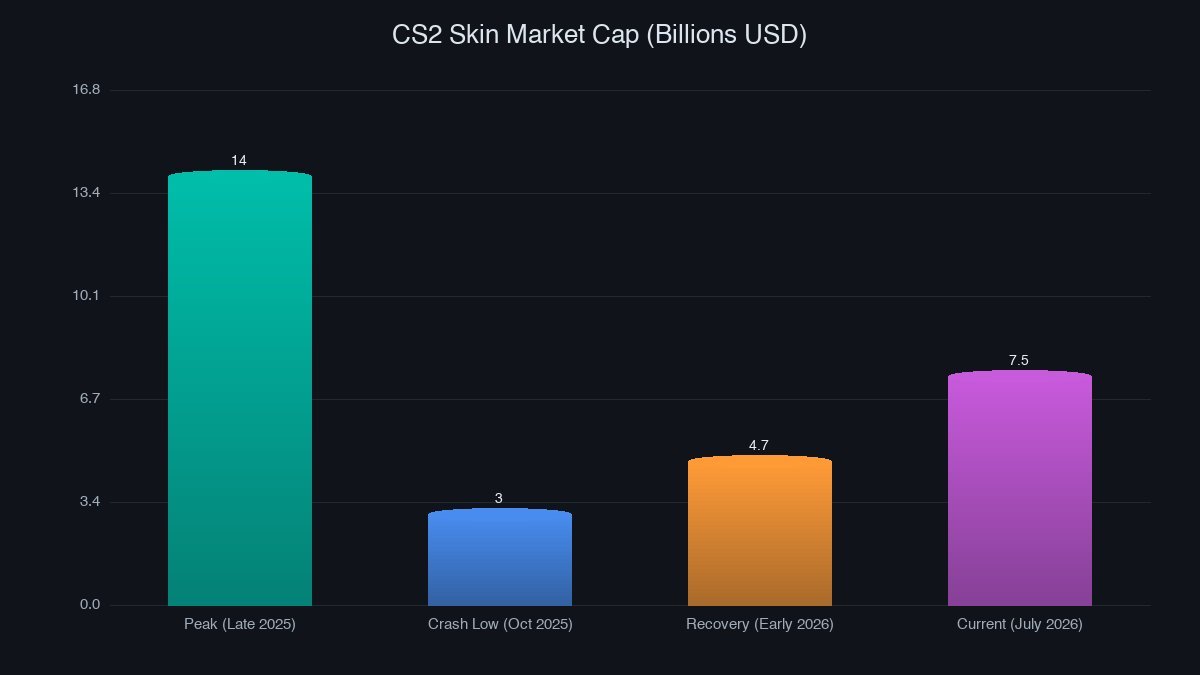
The CS2 skin economy isn't what it was six months ago. Total market capitalization peaked at an estimated $14 billion in late 2025, then cratered. By June 2026, the market had shed nearly 50% of its value. Knife prices dropped double digits. Panic selling swept trading forums. The "CS2 market is dead" narrative took over.
But markets don't move in straight lines forever. Let's look at the actual data — not Reddit sentiment — and figure out where cases and skins are heading in the second half of 2026.
The Numbers: From $14 Billion to Recovery
The CS2 skin market's trajectory over the past 12 months tells a story of boom, bust, and tentative recovery. At the October 2025 bottom, market capitalization had collapsed to roughly $3 billion — a staggering 79% drawdown from peak. The recovery was swift but incomplete: within days, prices rebounded 47%, pushing the market back to $4.7 billion, then continued rising above $5 billion into early 2026.
But that recovery stalled. As of July 2026, the market hovers in the $7-8 billion range — roughly half its all-time high. The May 2026 data from skin.club confirmed the trend: "the drop from peak values has already reached as much as 50% in some stretches." This isn't speculation; it's observable in the live pricing data that platforms like SteamAnalyst track across 28,989 unique items.
The silver lining? The rate of decline has slowed significantly. Q2 2026 saw less dramatic week-over-week drops than Q1. Pre-2020 skins from discontinued cases — Bravo, Huntsman, original Chroma collections — have actually shown annual appreciation, according to CSBoard's market analysis. The supply contraction on these legacy items is a real counterforce to the broader market sell-off.
For context: the Bravo Case, discontinued in 2014, now trades at several times its original market price simply because the supply is fixed and shrinking. Every Bravo case opened removes one from circulation permanently. With fewer than 10,000 Bravo cases estimated to remain in active inventories, scarcity dynamics create a floor that doesn't exist for active-drop cases. The Huntsman and Chroma collections follow the same trajectory, just on a lagged timeline. If you're looking for downside protection in a volatile market, discontinued cases historically outperform everything else.
The live data from SteamAnalyst confirms another trend: high-tier knife skins are recovering faster than mid-tier rifle skins. Items like the Butterfly Knife and Karambit — the "blue chip" assets of the CS2 economy — saw less severe drawdowns and recovered more quickly than the broader market. This flight-to-quality behavior mirrors traditional financial markets during downturns.
What the Smart Money Is Opening Right Now
With approximately 40 cases available in CS2 as of July 2026, not all are created equal. The ROI data from Steamify's case analysis paints a clear picture of where value lives:
The Kilowatt Case leads the pack with a 122.3% ROI and 13.28% profit margin. It's a recent addition to the pool and still benefits from fresh-drop pricing on its contents. Close behind, the Fever Case and CS:GO Weapon Case 2 also deliver positive expected value — rare in a market where most cases are net-negative propositions.
What these top performers share: they contain skins that are still climbing in value rather than declining. The Kilowatt Case's contents benefit from being relatively scarce compared to older cases that have been opened millions of times. This supply-demand mismatch creates pockets of profitability even in a bear market.
Skinflow's July 2026 guide to the best cases emphasizes that opening strategy matters as much as case selection. Chasing Covert drops is a losing game statistically — the expected number of cases to hit a Covert is 391 openings at the standard 0.26% drop rate. Smart openers target cases where the Mil-Spec and Restricted tiers carry enough value to offset losses, treating any Covert hit as a bonus rather than the goal.
What Surprised Us: The Community Map Wildcard
One development that caught market analysts off guard in July 2026: the surge of official Workshop map updates. Fachwerk, Boulder, Shelter, and El Dorado all received production-quality passes from Valve within a two-week window. The July 14 update specifically tightened security around script execution and improved Workshop diagnostics.
This matters for the case market because community Workshop engagement is the upstream pipeline for future skin content. The same creators building maps also design weapon finishes, sticker collections, and glove patterns. When Valve invests in Workshop infrastructure — better submission tools, faster iteration cycles, tighter security — they're lowering the barrier for the next generation of skin designers.
Historically, Valve's biggest content drops follow periods of technical investment. The Armory overhaul came after months of engine stability patches. If the pattern holds, the current "boring patch" phase is setting up a significant Q3 content release — which would be the strongest catalyst for case prices and skin values since the October 2025 recovery rally.
The counter-narrative is worth considering too. Some analysts argue that Valve's Workshop focus reflects a longer-term strategy of reducing dependency on in-house content production. If community creators become the primary source of new skins, release cadence could actually increase — but with smaller, more frequent drops rather than the blockbuster Armory-style updates. That would change the case-opening meta entirely: instead of hoarding for a single quarterly event, traders would need to track a rolling pipeline of community releases.
The Smart Play: Where Cases Go From Here
So what does the data actually suggest for the rest of 2026?
Case prices are near a floor, not a cliff. The 50% drawdown from peak has already happened. Discontinued cases — especially Bravo, Huntsman, and Chroma originals — are showing supply-driven appreciation that insulates their floors. Newer cases like Kilowatt and Fever still offer positive ROI for disciplined openers.
The content catalyst is approaching. Valve's July patch cadence is a leading indicator: 4 patches in 3 weeks, all focused on infrastructure. This pattern preceded every major content release in CS2's history. The community rumor mill points to August as the likely window.
Discipline beats speculation. The traders who survived the 50% crash didn't do it by chasing hype. They targeted cases with positive expected value, built positions during the quiet weeks, and let content drops do the heavy lifting. The Phantom Cache and Silent Form cases are currently in the rotation — and quiet weeks are exactly when the best entries appear.