Why CS2 Case Opening Almost Always Loses You Money

Why CS2 Case Opening Almost Always Loses You Money
Every single week, millions of players click that familiar button and watch a weapon case spin toward a blue skin worth under twenty cents. They know the odds are bad. But very few of them can tell you exactly how bad — or what a 0.26% knife chance really costs once you run the math all the way to the end.
Here's the uncomfortable truth: the numbers behind CS2 cases have not changed since 2017, and they were never built to be in your favor. Almost 80% of every open ends in a skin worth less than a dollar, while the result everyone actually wants sits at a fraction of one percent. Let's pull the whole thing apart, one layer at a time, so you know precisely what you're paying for.
The Numbers Don't Lie
Every standard weapon case in Counter-Strike 2 uses the same rarity table. Valve disclosed these figures back in 2017, when China's Ministry of Culture required loot-box games to publish their drop rates. The probabilities have stayed frozen ever since — from CS:GO straight through to CS2 today.
Here is the full breakdown, from the most common result to the one everyone is chasing:
- Mil-Spec (blue) — 79.92%, roughly 4 out of every 5 opens
- Restricted (purple) — 15.98%, about 1 in 6
- Classified (pink) — 3.20%, about 1 in 31
- Covert (red) — 0.64%, about 1 in 156
- Rare Special Item (knife or gloves) — 0.26%, about 1 in 385
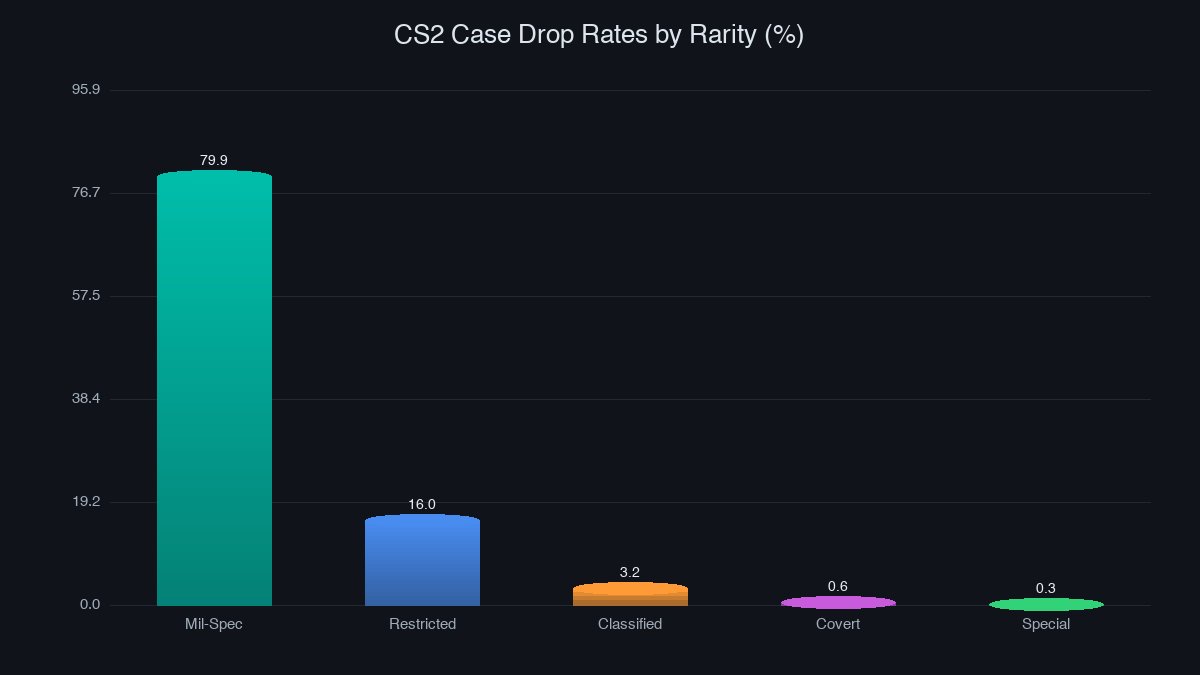
Read that top line again: nearly 80% of every case you open ends in a Mil-Spec blue. On the Steam Market, a blue from a typical case sells for somewhere between $0.05 and $0.30. That is the median outcome of your unboxing — a skin worth a fraction of the $2.49 you paid for the key.
The gold tier is a different universe entirely. At 0.26%, you need to open roughly 385 cases before the math says you should statistically see one knife or pair of gloves. And that single percentage point sits at the center of every "just one more case" decision you've ever made.
What a "One in 385" Actually Feels Like
A percentage on a screen doesn't communicate what a 0.26% chance feels like across a real session. So let's turn it into money. At $2.49 per key, opening 385 cases costs roughly $958 in keys alone — before you spend a single cent on the cases themselves, which add anywhere from a few cents to a few dollars each on top.
That $958 is an average, not a guarantee. Randomness does not care about your streak. This is the part most players get wrong:
- Open 50 cases and your chance of seeing at least one gold is only about 12%
- Open 100 cases and you're still only at roughly 23%
- You don't cross a 50% chance of a gold until around 267 cases
- Even after 500 opens, there is still close to a 29% chance you walk away with zero gold items
There is no pity timer. No bad-luck protection. Every single open is an independent roll at exactly 0.26%, which means opening 384 cases gives you zero statistical advantage on case number 385. A long dry streak never makes you "due" for a knife — the dice simply reset every time.
The Second Roll Nobody Tells You About
Hitting the gold tier is only the first hurdle. What most people overlook is that there's a second roll waiting on the other side — and it quietly erases most of your "wins."
Any eligible drop has an extra 10% chance of carrying the StatTrak counter. Combine that with the 0.26% gold rate and a StatTrak knife or glove sits at roughly 0.026% — about 1 in 3,850 cases. Suddenly the $958 "average" starts to look optimistic.
The same compounding applies to condition. If you want a specific knife in Factory New, you first roll the rarity, then roll the float range. A Factory New Covert skin lands around 0.019%, or roughly 1 in 5,200. The gap between "I got a knife" and "I got the exact knife I wanted" is enormous, and it's why the expected value of most cases sits far below the key price.
This is not a secret. Community tracking across millions of opens has matched Valve's published numbers almost exactly. The math is public, stable, and completely indifferent to how much you want the pull.
And remember: that 0.26% covers the entire pool of knives or gloves in a given case. If a case has, say, twenty possible gold outcomes, your chance of landing one specific knife is a tiny slice of that already-tiny number. Want a particular Karambit finish? You're looking at a fraction of a fraction of one percent — which is exactly why specific rare knives trade for hundreds or thousands of dollars even after a market dip.
Why These Odds Were Built This Way
None of this is an accident. The 0.26% gold tier is the engine that keeps the entire case economy spinning. If knives dropped more often, their value would collapse — and with it, the "chase" that makes a case feel exciting in the first place. Valve keeps the gold tier brutally rare so a knife stays a flex item, a status symbol, and a reason to open one more case.
That design is now facing real scrutiny. The same disclosed 0.26% figure is currently at the center of a legal debate over whether CS2's case system amounts to gambling, with a New York court weighing the question as regulators and players alike take a harder look at loot boxes. The odds themselves haven't moved, but the conversation around them finally has.
For the average player, the practical takeaway is simpler than the legal one: a case is a lottery ticket with published odds, and the ticket almost always loses. The house edge is not hidden in the fine print — it's the first line of the drop table.
Where We Go From Here
None of this means you can't open cases. It means you should open them with your eyes open — as entertainment with a fixed budget, not as an investment strategy. The expected return on a case is, on average, less than the cost of the key plus the case, and the median result is a skin worth pocket change.
If you actually want a specific knife, glove, or Covert skin, the fastest and cheapest route is almost always to buy it directly instead of rolling 385 times for it. That's where a marketplace like skinvs.com's item market earns its keep — you see the exact float and price up front, and there's no 0.26% roulette standing between you and the skin.
And if you do want the thrill of a case now and then, treat it like a lottery ticket with published odds. Set a number you're comfortable losing, open your cases, and enjoy the spin. When you want a real shot at something you can actually pull, the Fan Favorite case is a good place to scratch that itch without pretending the house edge doesn't exist.
The 0.26% isn't going anywhere. The only thing you control is how much of your wallet you hand over to it.