CS2 Turned Three This Week: The Items That Only Exist Because of Source 2
CS2 Turned Three This Week: The Items That Only Exist Because of Source 2
Counter-Strike 2 replaced CS:GO on September 27, 2023. Three years on, the game carries a catalogue of roughly 1,456 weapon finishes, 576 knife designs and 94 glove finishes — and almost none of it was designed for Counter-Strike 2.
That is the part worth understanding. The knives, gloves and rifles that came out of a decade of CS:GO sit under one set of supply rules. The small group of items that were born on the Source 2 engine sit under a completely different set — the Armory, the Terminal, limited-edition redemptions that rotate out and never come back. Same game, same market, entirely different scarcity mechanics.
Here are the CS2-original items you can actually buy today, ranked by what the market is currently asking for them.
What "CS2-Original" Actually Means
Skins entered Counter-Strike on 14 August 2013 with the Arms Deal update: 90 finishes, one case-and-key mechanic, and a drop pool that Valve has been quietly rotating ever since. For ten years the formula barely changed — new case, new finishes, open with a key.
CS2 broke that formula in three ways. The Armory replaced the old Operation pass with a credit system: a pass costs $15.99, caps at 40 credits, and a random skin pull from a collection costs 4 credits. The Terminal replaced the blind unbox entirely — you get a fixed-price offer and you accept or reject it. And limited editions appear in the Armory for a while and then rotate out permanently, which means their supply is fixed at whatever players redeemed while the window was open.
Those three systems generate every genuinely new item in the game. Everything else is a legacy asset with a legacy supply curve.
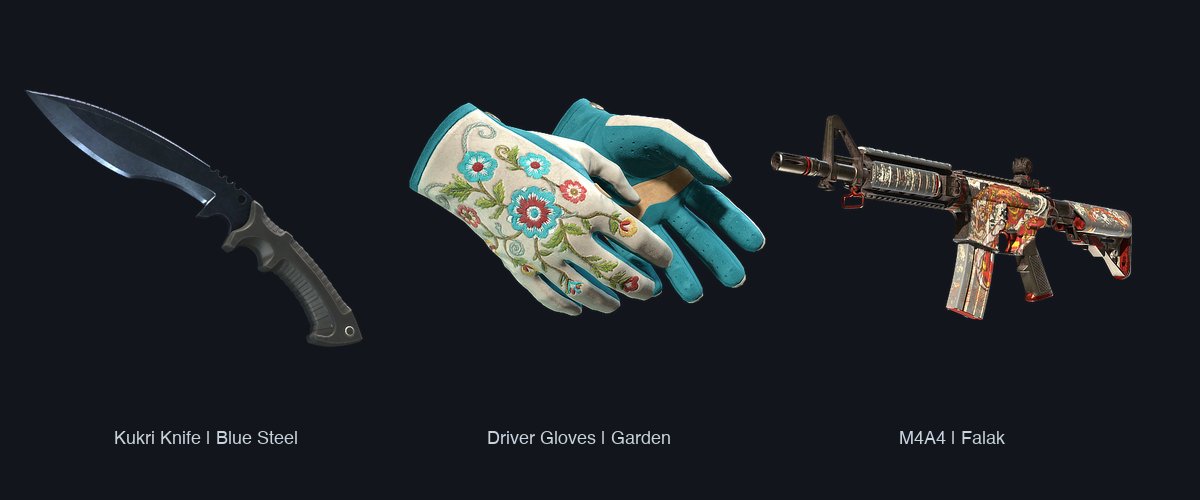
#5: M4A4 | Falak and Desert Eagle | Eastern Enigma — The $15 Entry Point
The Arabesque collection landed on July 8, 2026 alongside Premier Season 5. It is one of two community-designed sets that won Valve's "Call to Arms" workshop event, and its middle tier is where the value sits: the Classified rifles and pistols trade in the $15 to $25 range in Factory New condition.
M4A4 | Falak and Desert Eagle | Eastern Enigma are the two names to know. Both carry the mirrored-facet work that only exists because Source 2 can render it, and both are cheap enough to buy outright rather than gamble on. That distinction matters here: the odds of pulling a Covert from a single 4-credit Armory redemption sit around 0.26%, so at $15.99 a pass you are buying roughly a quarter of one percent of a Covert per credit spent. Buying the Classified tier directly is simply the cheaper route to the same collection's DNA.
#4: Desert Eagle | Heat Treated — The 25-Credit Experiment
Most Armory rewards are random. The limited editions are not, and that makes them structurally odd assets. Desert Eagle | Heat Treated was priced at 25 credits during its window — roughly two-thirds of a full pass, or about $10 of pass value — and it was a guaranteed specific item rather than a lottery pull.
When the window closed, the only way to get another one was to buy it from someone who redeemed during that window. That is the entire supply, forever. Valve has since rotated several of these limited editions out, and each rotation converts a store item into a finite collectible in a single patch. Watch what disappears next: the redeeming stops, the asking price usually does not.
#3: AWP | Sovereign Flame — The $320 Launch That Settled
Arabesque's Covert tier is where CS2's new lighting engine does the most visible work. AWP | Sovereign Flame opened at roughly $320 in the first days after release, carried by the gold-and-fire elements that read very differently under Source 2's volumetric lighting than they would have in CS:GO's renderer.
Launch pricing on any new Covert is a hype number, and it always decays. The pattern is consistent enough to trade around: new collections debut at a premium, then settle over two to four weeks as the supply of redeemed items reaches the market. If you want the skin rather than the launch-day screenshot, the settling period is your window — not the first weekend.
#2: ★ Kukri Knife | Blue Steel — The Only New Knife Model CS2 Has Ever Made
Here is the number that surprises most people: in three years, CS2 has introduced exactly one new knife model. The Kukri Knife debuted in the Kilowatt Case in 2024, and no new blade shape has followed it. Every other knife in the game is a CS:GO design wearing a newer coat of paint.
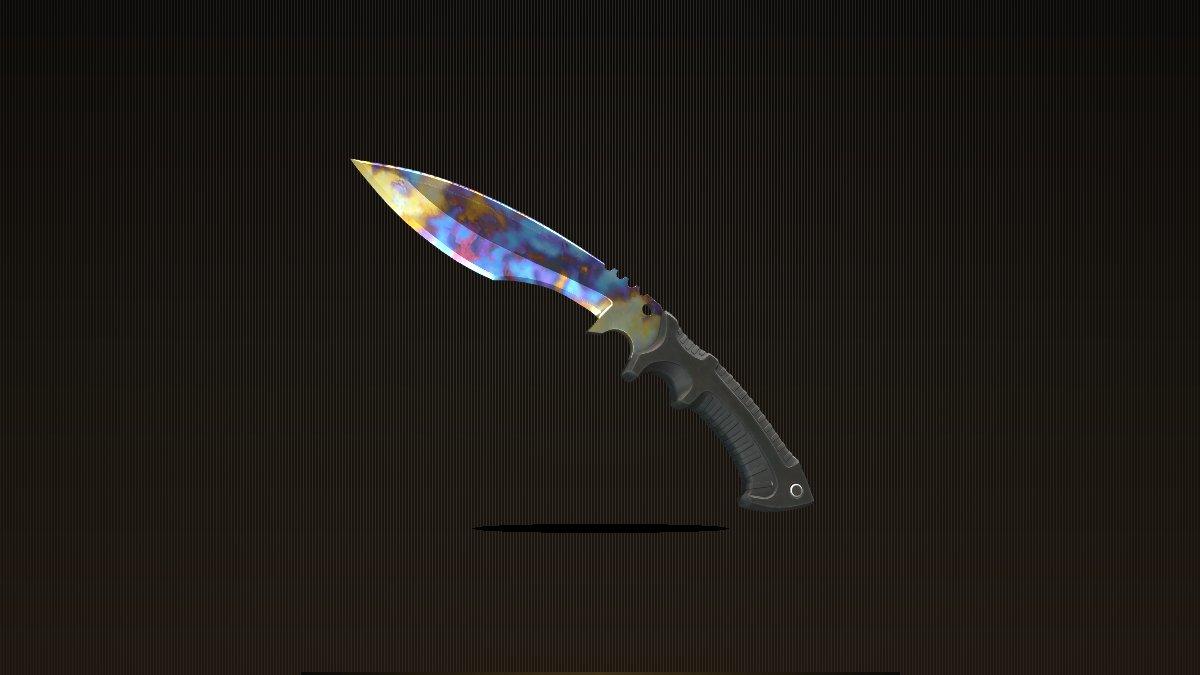
The blade is modelled on the traditional Nepalese kukri — a wide edge with a pronounced forward curve that shifts weight toward the tip — which is exactly why it divides opinion. It does not inspect like a butterfly knife or a karambit, and that is the point.
Blue Steel's price ladder runs from $199.00 in Factory New down through $111.94 in Minimal Wear, $99.18 in Field-Tested, $91.16 in Well-Worn and $89.82 in Battle-Scarred. Notice the shape of that curve: the drop from Factory New to Minimal Wear is a 44% haircut, but the four lower wear tiers all sit inside a $22 band. Wear condition matters enormously at the top and almost not at all at the bottom — which is true of most knife finishes and is the single most useful thing to remember when you are comparing listings.
#1: ★ Driver Gloves | Garden — The $616 Pair Nobody Expected
Gloves were the most neglected corner of Counter-Strike for years. The last genuinely new glove finishes arrived in December 2020 — until the Dead Hand Terminal shipped in March 2026 with 22 new glove finishes in the rare special slot, the first real expansion of the category in over five years.
But the interesting glove story is a technique, not a count. Embroidery arrived in CS2 through the Budapest Major stickers — raised stitches, visible thread relief, a slight roughness you can study in inspect — and Driver Gloves | Garden carried it from stickers onto leather. Red and blue flowers bloom across pale leather on thin green stems, framed by teal cuffs, with a texture that reads as genuinely stitched rather than painted.
That price ladder runs $1,202.90 Factory New, $616.67 Minimal Wear, $290.01 Field-Tested, $246.84 Well-Worn and $192.57 Battle-Scarred. The Minimal Wear pair is the entry point most buyers take, and the Field-Tested to Well-Worn gap is only $43 — a reminder that below Minimal Wear you are paying for a wear label, not for looks.
Why Source 2 Supply Behaves Differently
Compare the two halves of the market and the pattern is clear. Legacy CS:GO supply keeps growing, because those cases are still in the drop pool and still opening. CS2-original supply mostly does not grow, because it arrives through Armory windows that close, Terminal offers that are priced rather than gambled, and limited editions that get retired.
The October 2025 trade-up change showed how violently that logic can be rewritten overnight: making knives obtainable through trade-up contracts opened a second supply channel for an entire category and repriced it immediately. Valve controls supply. No chart survives a supply change.
Which is why the three-year list above is short and getting shorter with each rotation. If you want exposure to CS2's own era rather than its inherited one, the practical route is to watch what Valve retires and buy before the window shuts — or to open the containers still feeding the market, like the Arcane Dawn case on SkinVS, where a single pull can hand you an item from a collection that has already stopped dropping.
Three years in, the Source 2 catalogue is still small enough to read end to end. That will not stay true.