The Same Skin Costs 40% More on Steam. We Checked 3,674 of Them

The Same Skin Costs 40% More on Steam. We Checked 3,674 of Them
On 4 October 2026, across 3,674 CS2 skins listed on both the Steam Community Market and at least one marketplace that pays out withdrawable cash, the Steam listing was more expensive 99.3% of the time. The median premium was 40.0%.
That is not a rounding error or a bad day of trading. It is a structural feature of the market, it is measurable, and almost nobody who buys skins casually knows it is there.
This is the argument that Steam is the worst place to buy a CS2 skin — and the honest case against that argument, because there is one.
The 40% Tax Nobody Argues About
The figure comes from Veriloot's price-gap index, a snapshot taken at 10:25 UTC on 4 October 2026. The method is deliberately conservative: compare the Steam price, fees included, against the cheapest listing of the identical skin on a cash marketplace that pays real money, and divide.
The distribution tells you how consistent the markup is. The first quartile of that comparison was +33.0%. The third quartile was +48.5%. In other words, three-quarters of skins on Steam carry a premium somewhere between a third and a half over the cheapest cash venue. There is no tail of cheap Steam listings quietly balancing the books.
Nor is it a stale-data artefact. The median age of the Steam quotes in the comparison was 4 hours 25 minutes, with a maximum of just under 24 hours. These were live listings, not months-old snapshots.
Why The Gap Is So Wide
The first cause is mechanical. Steam charges a 15% transaction fee on every sale, cut from the seller's proceeds. That fee is baked into every ask you see, because sellers price up to net out. Cash marketplaces compete on a lower take, and that difference flows straight into the sticker price.
The second cause is what Steam pays you in. Sale proceeds arrive as Steam Wallet credit — spendable on the store, not withdrawable as money. Wallet balance is worth less than cash to most people, and the market prices that accordingly. When you pay $40 of real money for a Steam listing and the seller receives $34 of wallet credit, you have bought $34 of value at a $6 markup.
Third, Steam is a single venue. Cash marketplaces number in the dozens, and they compete. That competition shows up in how listings are distributed.
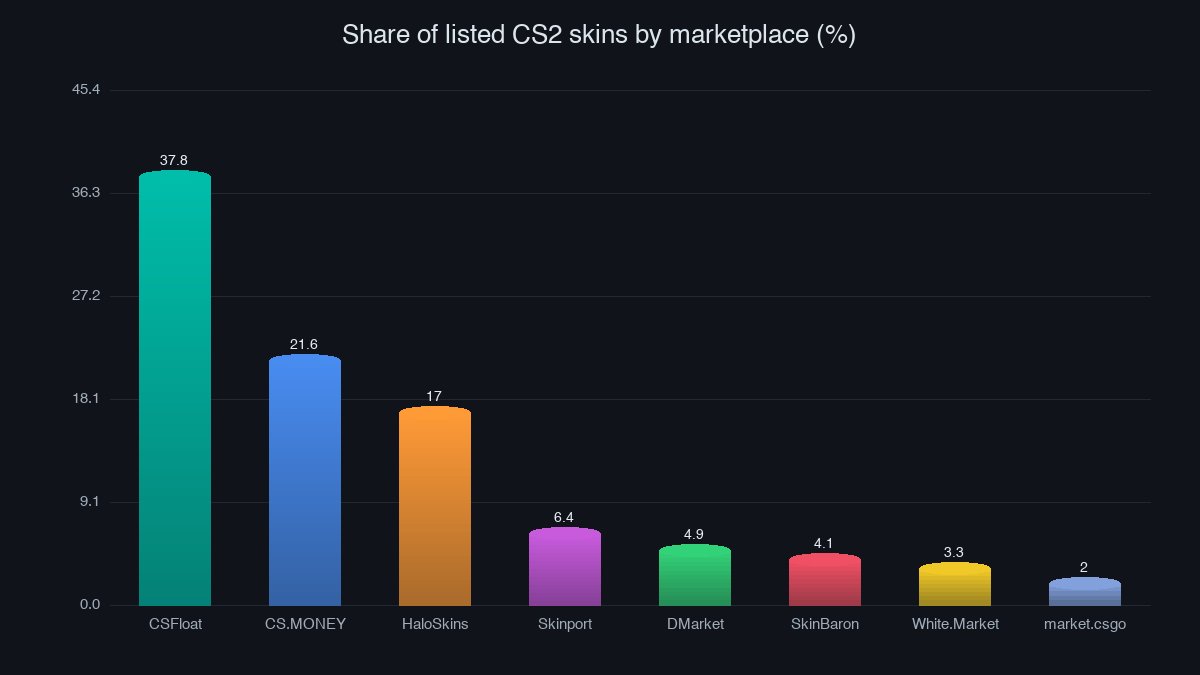
The concentration is real but it is not a monopoly. CSFloat holds 37.8% of the skins in the comparison set, CS.MONEY 21.6%, HaloSkins 17.0%. Below them sits a long tail — Skinport at 6.4%, DMarket 4.9%, SkinBaron 4.1%, White.Market 3.3%, with market.csgo, Waxpeer and Trackly.gg under 2% each. That breadth is exactly what keeps prices honest.
What You Actually Save
The Steam premium is not the only gap. Even among cash marketplaces, the same skin carries wildly different asks: across 5,167 skins listed on at least four venues, the median spread between the cheapest and most expensive listing of the identical item was 16.4%. The ninth decile was 32.9%.
Put the two findings together and the practical rule becomes simple. If you find a skin on Steam at $100, the same item is typically available for around $71 on the cheapest cash venue — and across the cash venues themselves, you can easily shave another 16% by not taking the first price you see.
There is a second-order effect worth knowing. The cheapest venue is not the same venue for every item. A knife's best ask might sit on CSFloat while the same collection's rifle is cheapest on HaloSkins, and the spread between any two sites on a single skin is itself a median 16.4%. Shopping one site and calling it research is how that gap stays invisible — and it is the main reason two people can buy the same skin on the same afternoon and end up $60 apart.
Scale that to a collection. Category averages on 21 September 2026 put gloves at $1,851.22, knives at $759.76, rifles at $245.07 and pistols at $58.14. A 40% premium on a single pair of gloves is more than $700. On a knife, it is roughly $300. This is not savings you need to hunt for — it is sitting in the first listing you open, on the wrong site.
There is a timing dimension too. The market has been cooling: the SkinGrind 100 index, tracking 100 of the most traded items on Steam since 2015, stood at 4,715.36 on 3 October 2026 — down 8.9% over 30 days and 25.5% below its April high of 6,328.23. Paying a 40% venue premium while an index falls 8.9% in a month means paying the markup on top of a genuine loss.
The Bull Case For Steam
Steam has three real advantages, and they are worth stating plainly rather than dismissing.
Safety and liquidity. There is no counterparty risk, no withdrawal queue, no third-party KYC, and no possibility of the venue holding your items. Volume is enormous, so items move. For a $2 skin bought on impulse, a 40% premium can be $0.80 — cheaper than the effort of registering anywhere else.
Discoverability. Since a May 2026 marketplace overhaul, Steam listings show float, pattern and applied stickers at a glance, in-browser. Judging a specific pattern — a Case Hardened blue gem, a Fade percentage — is faster there than almost anywhere.
Wallet economics. If you already hold Steam Wallet from selling other items, that balance is genuinely free money to deploy. Paying a premium in currency you cannot withdraw is not the same as paying it in cash.
What Steam does not win on is delivery speed. Since a June 2026 change, items bought on the Community Market become tradable exactly 168 hours after purchase, replacing the old synchronised daily unlock. Cash marketplaces generally hand items over for immediate trade. If you want the skin in your inventory tonight, that seven-day wait is a real cost the sticker price never shows.
And the counter-argument to the 40% headline has a legitimate core: a median is not a forecast. Individual skins vary enormously, and some rare, low-liquidity items genuinely trade near parity or occasionally cheaper on Steam because that is where the buyer is.
Where I Land
The pushback does not rescue the headline, because 99.3% is not a median being skewed by outliers — it is the shape of the whole distribution. Steam is dearer on essentially every skin, all the time.
The reasonable conclusion is segmentation, not absolutism. For a cheap impulse buy under $5, use Steam and stop overthinking it. For anything with three figures attached to it — a knife, a pair of gloves, a Covert rifle — the 40% is real money and there is no serious argument for paying it.
Practically, that means checking at least two cash venues before you commit, and treating the Steam price as a ceiling rather than a reference. A rise of 108.7% on a Souvenir AUG or 107.2% on a UMP-45 Plastique — both recorded in the first week of October — can only be captured if you were buying on the venue where those listings actually existed.
Buy where the price is lowest and the payout is real. The SkinVS shop keeps live multi-venue prices on the same page so you can see the gap for yourself before you spend — and if you would rather let a case decide, Silent Form is waiting. The 40% is your call to make, not one to make by accident.