How to Check CS2 Skin Liquidity in 3 Steps Before the Price Lies to You

How to Check CS2 Skin Liquidity in 3 Steps Before the Price Lies to You
A Battle-Scarred Souvenir USP-S was "up" 22,439% last week. It was listed at $1,063.86. Nobody bought it.
That is not a market event. It is a single seller placing an absurd ask on an empty order book, and a dashboard faithfully reporting the resulting percentage. The same weekly snapshot that produced that number also produced a CZ75-Auto listed at $156.40 — a common skin that normally trades for pocket change — and a Bowie Knife that "crashed" 99.95% to $71.33. Every single item on both the winners list and the losers list printed zero volume over seven days.
If you are buying or selling CS2 items with any real money behind it, that is the trap you have to learn to spot. Here is how to actually check it, in three steps.
Step 1: Read Volume, Not the Percentage
The percentage change on any price tracker is a derived number. It compares one ask to another ask. If no trade happened in between, it is describing listing behaviour, not demand.
A useful rule: a move over about 5% on zero volume is noise, and a move over 100% on zero volume is a listing artifact. The CS2 market produced a $1,063.86 Souvenir USP-S and a $1,914.85 Battle-Scarred Souvenir AUG this way — both on no trades at all. Souvenir pricing depends entirely on the specific tournament, map and sticker combination, so with zero volume there is no way to validate either figure. They are not blue-chip assets. They are illiquid curiosities with a price tag attached.
This cuts both directions, which is the part people miss. A -97.30% collapse on the sticker for jdm64 from Cluj-Napoca 2015 was not a crash. It was a previously inflated ask being withdrawn. The item did not lose value — the fantasy price evaporated. Anyone who panic-sold into that headline sold to nobody, because there was nobody there.
The filter is blunt and it works: open the item's volume column before the price column. If the trailing-7-day number is zero, close the tab. You have learned everything the listing can teach you.
Step 2: Price the Spread and the Fee You Will Actually Pay
Volume tells you whether the item trades. Spread tells you what it costs you to be one of the people who does.
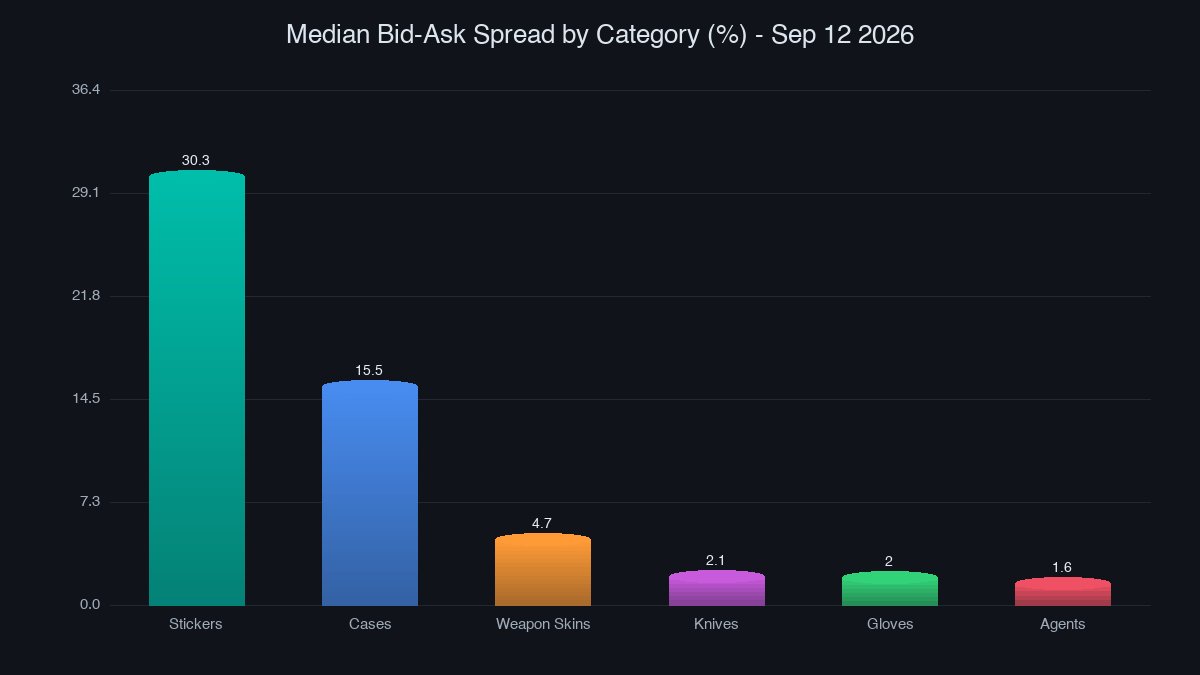
Across 9,723 measured items in SteamDB's September 12 snapshot, the median bid-ask spread was 25.3%. That is the round-trip cost of buying at the ask and selling at the bid, before any fee. But the headline number hides a market split cleanly in half:
- Stickers: median spread 30.3% across 7,840 items
- Cases and containers: 15.5% across 324 items
- Weapon skins: 4.7% across 730 items
- Knives: 2.1% across 302 items
- Gloves: 2.0% across 64 items
- Agents: 1.6% across 34 items
Read that as an exit-cost table. A sticker portfolio looks cheap per unit and is brutally expensive to unwind — you can lose nearly a third of your position just crossing the book. A glove or a premium knife costs you about 2% to get out of.
Then add the venue fee, because it is not a rounding error. Steam's Community Market charges a seller fee of 15% with no buyer surcharge. The median classic marketplace charges 3%, with venues ranging from 0% to 8%. Peer-to-peer venues sit at a median of 2.5%, ranging 0% to 5%. Instant-sell services — the ones that buy your skin in seconds — median 15% and range as high as 60%, because that spread is their entire margin.
Put the two together and the picture is unkind. Selling a $500 knife on Steam costs about $75 in fee plus roughly $10 in spread. Selling the same knife peer-to-peer costs around $12.50 plus the same spread. Same item, same day, same buyer pool — a difference of more than $60, decided entirely by which button you pressed.
Step 3: Confirm Depth on the Venue You Will Actually Sell On
A tight median spread means the category is liquid. It does not mean your specific item is. This is where most people stop one step too early.
Three checks, in order. First, are there actual bid orders on the item, or only asks? An item with twelve asks and no bids has an infinite spread no matter what the median says. Second, what are the bid sizes? One bid for a single unit at the top of the book is not liquidity — it is a person who will vanish the moment you try to use them. Third, does depth hold at a realistic size? If you are moving five units, the price you see is not the price you will get.
The macro backdrop makes this more important right now, not less. SteamDB's 28-day window from August 14 to September 12 counted 9,836 items falling against 5,870 rising out of 17,539 qualifying listing variants, with an overall median move of -2.3%. Gloves were the worst major category at -4.1% (340 drops to 90 gainers). Weapon skins came in at -2.8%, knives at -2.3%. Only stickers and cases held near flat, at -0.5% and -0.6%.
A falling market is precisely when wide spreads get wider. When the tape turns, sellers who need out start paying whatever the bid demands, and a 30% sticker spread becomes 50%. If you did not check depth on the way in, you discover it on the way out, at the worst possible moment.
What a Liquid Skin Actually Looks Like
Here is the contrast, in one item. A ★ Driver Gloves | King Snake (Minimal Wear) sits in a category with a 2.0% median spread across 64 measured glove variants — among the tightest in the entire tracked market, tighter than knives, tighter than weapon skins, tighter than the 25.3% market-wide figure by an order of magnitude.
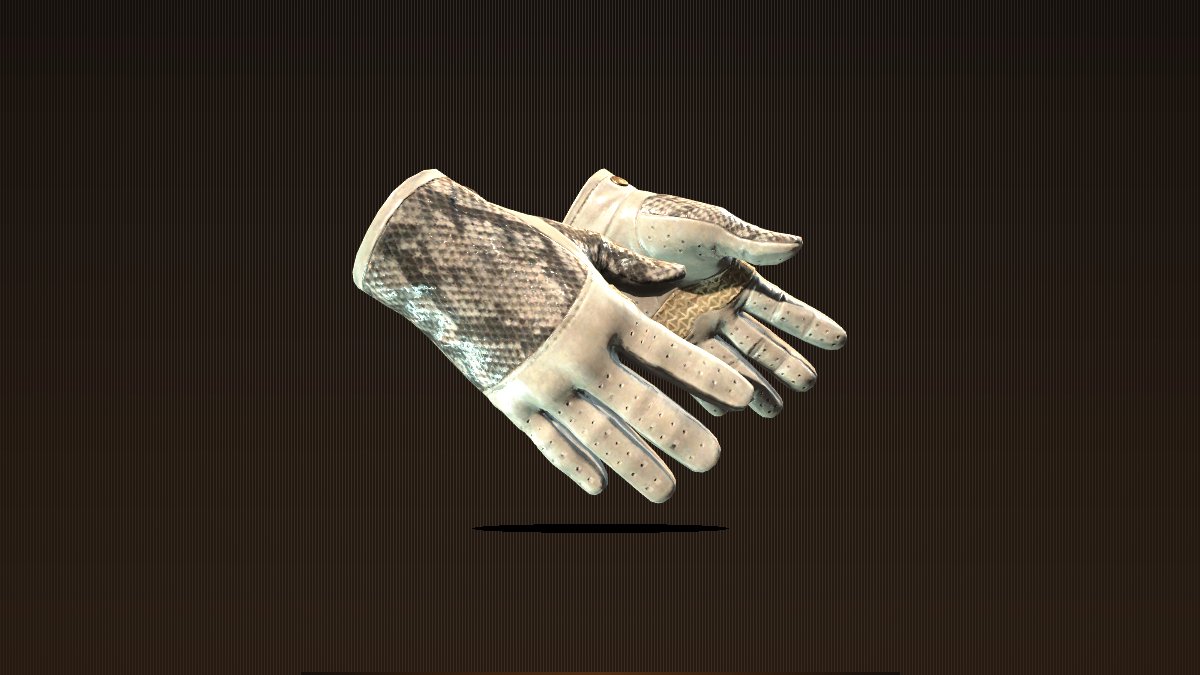
That does not make it a good buy — gloves just posted the steepest 28-day decline of any major category at -4.1%, and a tight spread protects you from execution cost, not from being wrong about direction. What it does mean is that when you decide to exit, there will be a bid waiting, and you will not be the person staring at a $1,063.86 Souvenir USP-S wondering why the chart says you are up 22,439%.
The same logic explains what the sustained part of the market looks like. Where genuine volume exists — mainstream Doppler phases like Ruby, Sapphire and Black Pearl, tier-1 Case Hardened patterns, and Factory New or Minimal Wear flagship knives and gloves — spreads stay tight and the book has real depth. None of those items appeared on last week's anomaly lists. That is not a coincidence. It is the definition of the difference between a price and a market.
One number to remember
Add spread and fee before you buy anything, and treat the result as a loss you have already taken. A sticker bought on Steam and sold peer-to-peer is a different instrument from the same sticker bought and sold on the same venue — and neither is the instrument the price tracker showed you. Total tracked inventory across 36 marketplaces sat at 38,202,968 live listings against a floor value of $1,044,666 in the September 12 snapshot. There is no shortage of listings. There is a shortage of listings that will actually fill.
If you want to trade where the fee structure does not eat the edge, SkinVS Trade runs peer-to-peer pricing without the Steam-level seller cut, and if you would rather watch how a tracked container's pool and odds behave before committing, Carnival Time shows the full pool up front. Check volume, check spread, check depth. In that order. The percentage on the dashboard is the last thing you should look at, and often the only thing that was ever wrong.