Why CS2 Rifles Lost Two-Thirds of Their Value While Knives Held

Why CS2 Rifles Lost Two-Thirds of Their Value While Knives Held
On 15 May 2026, the rifle index tracked by CSMarketCap was worth $1.60 million. On 5 October it was worth $0.52 million. Same rifles, same tracking method, 3,348 items on the first date and 3,349 on the second. Nothing was delisted, nothing was reclassified. The market simply decided those guns were worth two-thirds less.
Over the same stretch, the knife index went from $1.91 million to $1.95 million. That is a gain of 1.8% in a period when almost everything else on the market was bleeding. If you have been watching your inventory and wondering why your AK-47 collection feels heavier than your knife, this is the data behind that feeling.
The Crossover Nobody Announced
For most of the past three years the two halves of the market traded places politely. In March 2023, when CSMarketCap first split its index by category, knives held 36.3% of total category value and weapon skins held 34.7%. In March 2024 it was 37.4% knives against 37.9% weapons. As late as January 2026 weapons were actually ahead, 42.6% to 36.3%.
Then the line crossed on 22 May 2026 and never crossed back. By 1 June the split was 41.5% to 34.4%. By 10 June it was 46.8% to 24.6% — a gap that opened in nine days and stayed open. Knives passed 49.7% on 1 July, and since 8 August they have been above half the index every single day.
As of 5 October, knives are 52.8% of everything the market is worth at the floor. Weapon skins are 20.0%. More than half of the value now sits in one category, and it is not the category the game is named after.
The Numbers Behind the Percentages
Percentages hide the shape of a move, so here is the same period in dollars. The knife index eked out +1.8%. SMGs lost 25.6%. Pistols lost 59.2%. Rifles lost 67.3%. Heavy weapons lost 87.7% — the Negev and M249 tier has effectively been written off.
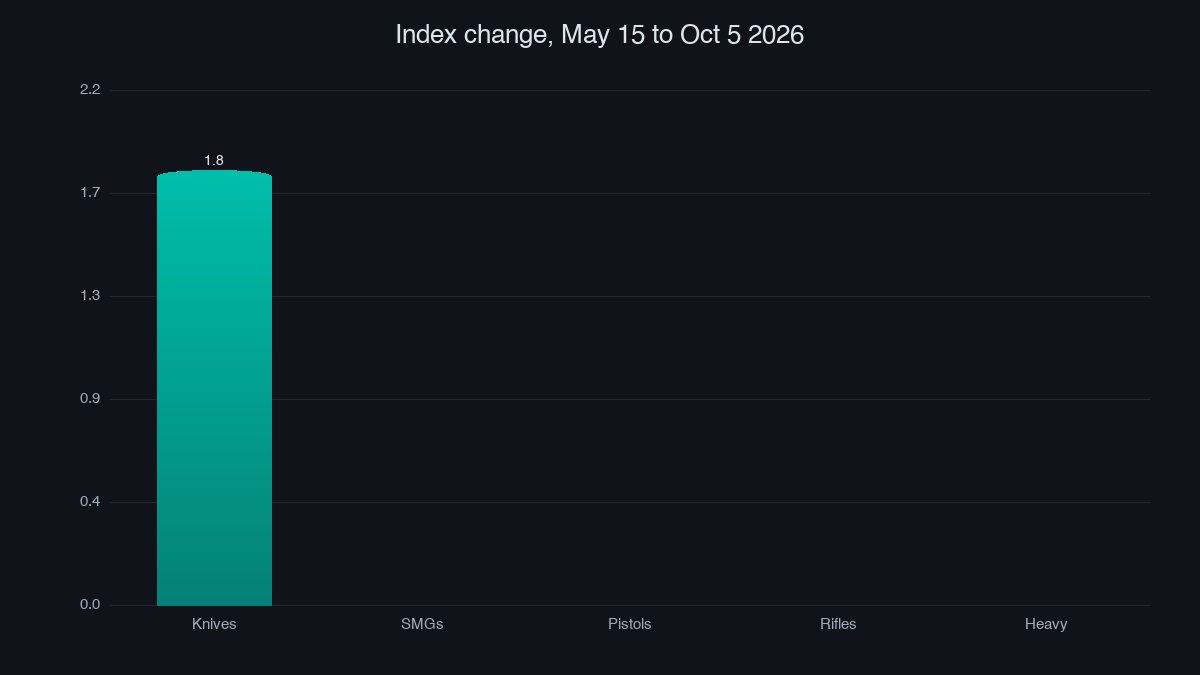
The heaviest damage is concentrated exactly where supply is deepest. Rifles are the most-opened, most-listed category in the game, and when demand cools the floor has to fall further before anyone bothers to buy, because there is always another identical listing one scroll down. Knives do not work that way: supply is capped by a 0.26% drop rate and a much smaller pool of sellers, so the floor moves slowly even when volume dries up.
This is not a story about a single bad week. p2trades compared 248 skins between 3 and 10 October and found a median change of −2.7%, with 133 items falling and only 9 rising. Rifles fell 3.7% at the median, pistols 2.7%. Two whole categories moved as a block rather than a handful of names moving alone.
Supply explains the asymmetry better than sentiment does. A rifle finish enters the pool every time someone opens a cheap case, and cheap cases are opened constantly because they cost almost nothing. A knife enters the pool roughly once every 385 openings, and that is the same number for every case ever printed. One side of this market is being drip-fed new inventory every hour. The other side is rationed by a fixed probability that no amount of demand can change.
It Is Not Just Rifles — It Is Anything Cheap
A separate tracker following 55 liquid items on CSFloat recorded 53 of them falling between 13 September and 13 October, with a median drop of 7.4%. Measured from 31 July, the median item is down 11.9%. Two items rose in that window and neither by more than 4%.
Case floors show the mechanism clearly. Over the same 74 days the Revolution Case went from $0.26 to $0.16 (down 38.5%), the Recoil Case from $0.31 to $0.20 (down 35.5%), the Kilowatt Case from $0.15 to $0.11 (down 26.7%). Meanwhile the Chroma 3 Case moved from $3.06 to $3.00, down 2.0%, and the Fever Case actually rose from $0.52 to $0.54.
Same item type, opposite behaviour. The difference is price level. When a case costs eleven cents, its floor is a rounding error sitting next to a fixed $2.49 key — and when the contents are worth pennies, there is no bid underneath it. When a case costs three dollars, its contents include enough mid-tier skins that someone will always pay near the floor. Cheap items have no cushion; expensive ones do.
Where the Value Actually Went
Market-cap trackers put the whole economy somewhere between $5.1 billion and $5.7 billion in early October, with Pricempire briefly reporting $7 billion at the end of August. The absolute number matters less than the shape: in a 36,907-item snapshot, about three in five listings sat under $10, only 363 items cleared $1,000, and just 20 cleared $10,000.
That is the market the knife index is measuring. Value is not evenly spread across two thousand finishes; it is parked in a few hundred objects that people treat as assets, and everything below them behaves like a consumable. When money leaves, it leaves the consumable tier first and hardest.
The knife category is not immune either. Knives fell 5.2% in the week to 15 October and hit a yearly low on an eleventh straight week of losses, down 41.3% from their yearly high. Gloves fell 5.6% and hit their own yearly low for the first time this year. But relative to rifles, knives are still the only category that has held its footing for five months.
What This Means If You Are Holding Skins
Three practical readings, and none of them are "wait for the recovery".
First, liquidity has concentrated. Knives carried 27.4% of Steam trading volume by value in mid-October while rifles lost share. If you need to convert an inventory into cash quickly, the category with the most buyers is the category that held price, not the one with the most listings.
Second, the cheap end is a trap for sellers, not buyers. A $0.11 case and a $3.00 case are the same product with different contents, and the cheap one cannot recover on its own because the key tax does not move. If you are buying to use, this is genuinely the best entry point in two years. If you are buying to flip, you are competing with forty thousand listings that all want the same $0.16.
Third, the spread between venues matters more than the index. Across 14,178 items priced on both Steam and a cash market, the Steam price ran 1.43× the cheapest cash price at the median, and the median gap between cheapest and dearest venue for the same item was 13.9%. In a falling market that spread is where the money is, because the item is the same object regardless of which floor you found it on.
None of this requires you to predict the bottom. It requires you to notice which half of the market still has a bid under it, and to stop paying Steam prices for objects that are listed cheaper somewhere else on the same afternoon. If you want to see where the knife side of the market actually clears, the Frost Vault case is a reasonable place to watch the rare-special pool trade, and the SkinVS shop lists both categories side by side so you can compare a rifle floor and a knife floor on the same screen instead of trusting a single index number.
The index will do whatever it does next month. What has already happened is that the two halves of this market stopped moving together, and that is a more useful fact than any single price.