Five Red Skins, One Knife: Run the Trade-Up Math Before You Click
Five Red Skins, One Knife: Run the Trade-Up Math Before You Click
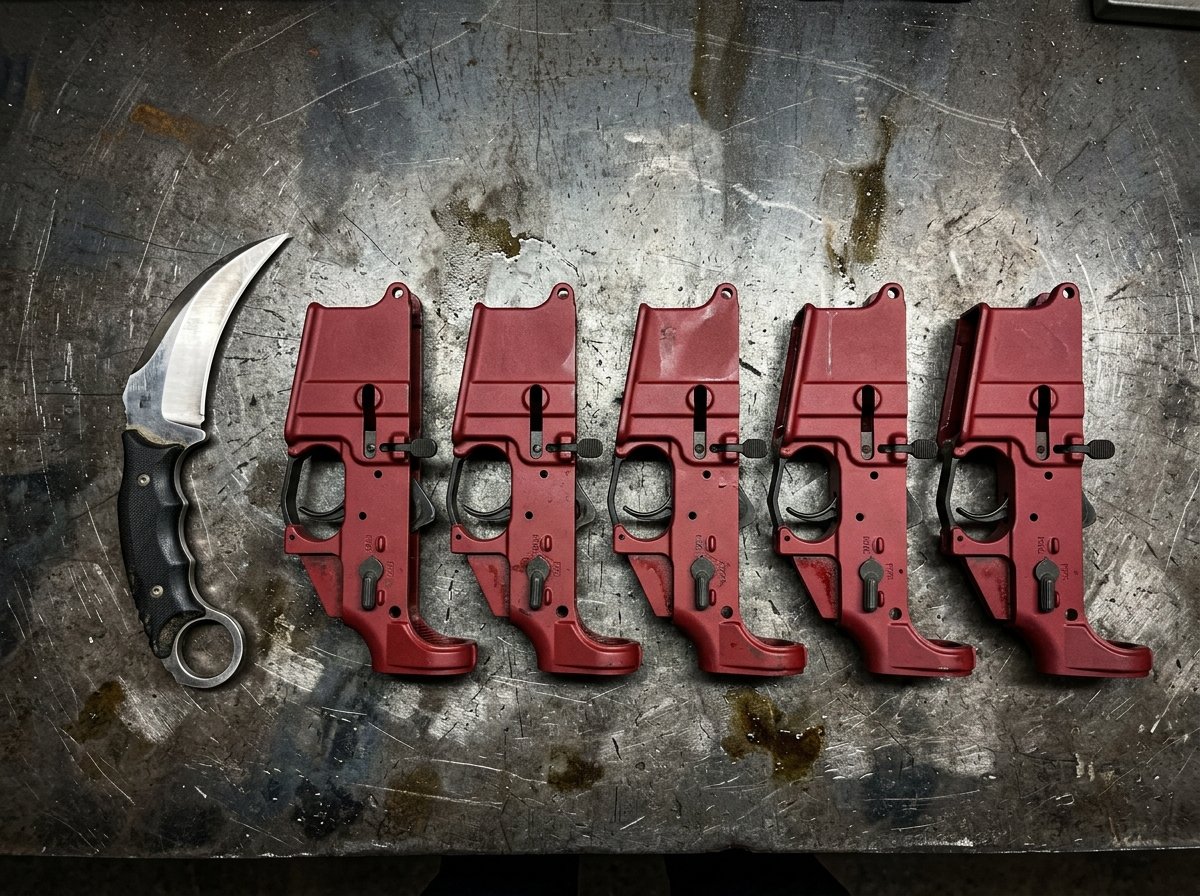
Five Field-Tested AWP | Chrome Cannon skins cost $113.30 on October 14. Put them into the Trade Up Contract and you get one Kukri Knife. The cheapest Kukri finish in the game starts at $28.87. The most expensive finish in the pool tops out around $134.22.
That is the entire trade-up economy in three numbers, and it has been that way since October 22, 2025, when Valve let players exchange five Covert-rarity skins for one knife or pair of gloves. Almost a year later, the rule is still live, the knife index is still 8.1% below its January 2024 starting level, and most people running the contract have never priced the output side of it.
Here is the version of the math nobody posts alongside their knife screenshot.
Step 1: Price the Five Inputs
Start with a collection whose gold pool you can identify, because the contract can only return a knife from a collection represented by your inputs. The Kilowatt Case is the cleanest example in the game right now: its rare special pool is the Kukri Knife, and it ships exactly two Covert skins, the AWP | Chrome Cannon and the AK-47 | Inheritance.
On October 14, the lowest listings were $22.66 for a Field-Tested Chrome Cannon and $30.00 for a Field-Tested Inheritance. That gives you three realistic entry prices for one contract:
- 5 × Chrome Cannon — $113.30
- 3 × Chrome Cannon + 2 × Inheritance — $127.98
- 5 × Inheritance — $150.00
This is already where most plans die. The inputs are not junk. Covert skins were repriced upward the moment they became knife feedstock, and nearly a year later they have stayed expensive relative to what they produce. You are not buying five cheap items and getting a lottery ticket — you are buying five mid-priced items and paying a premium for the privilege of gambling them.
One more mechanical detail matters here: the wear of the output follows the floats of your inputs. Five Battle-Scarred Coverts produce a worse knife than five Factory New ones. Cheap inputs buy a worse expected outcome, so the $113.30 version of this contract is not the same contract as the $150 version.
Step 2: Price What You Can Actually Pull
The Kukri Knife has 12 priced finishes. You do not choose which one you get. The contract draws from the collection's rare special pool, so your $113.30 buys one random finish from a spread that runs from $28.87 to roughly $134.22.
Put a probability shape on that and the problem is obvious. The cheap finishes are cheap because they are common and unloved — Forest DDPAT, Safari Mesh, Scorched, Boreal Forest. The finishes that carry the top of the range are the ones with the smallest share of the pool. Your realistic outcome sits far closer to the bottom of that spread than the middle, and a single unlucky pull wipes out three quarters of your input cost in one click.
Compare it to the wider knife market, which is also not helping you. There are 576 knife skins across 20 models, and the entry point for the entire category is about $35 for a Navaja Knife, against $1,863 for a Factory New Butterfly Knife | Fade. Knife prices are down 5.0% over 30 days, and the knife index is down 8.1% since January 2024. You are paying a fixed, elevated price for inputs whose output class is drifting downward.
Step 3: Subtract the Fee and the Lock
Every trade-up article stops at the pull. The money does not.
If you sell the knife on the Steam Community Market, Valve takes 15%. A knife listed at $79.60 puts roughly 85% of that into your wallet — about $67.66. On a $113.30 contract, that means a mid-range pull does not break even; it loses money after fees even when the pull is objectively fine.
Then there is the hold. Since July 2025, Trade Protection means any item received in a trade cannot be listed or passed on for seven days. Your knife is usable in game immediately and frozen on the market for a week. Any plan that depends on flipping the output quickly is a plan that ignores the lock.
The best possible outcome in the Kukri pool — the $134.22 finish — returns about $114 after Steam's cut. That is your ceiling: a rounding error above what you paid, achieved only if you hit the top of a 12-finish pool. The floor is $28.87, or roughly $24.50 after fees, against $113.30 in. That is a 78% loss on the worst outcome.
Step 4: Compare Against Just Buying It
This is the step that ends the argument. Price the exact knife you want, outright, and compare it to five Coverts plus fees plus a week of waiting.
In the Kilowatt example, the answer is not close. You can buy a Kukri finish directly for anything from $28.87 upward, and you get to pick the finish, the wear and the float. The contract offers a random finish at a fixed $113.30 entry. The only scenario where the contract wins is the one where you hit a top-tier finish — and even then it wins by a couple of dollars before you account for the week your capital was locked.
The broader numbers explain why this asymmetry exists. Around 20 million Covert skins were estimated in circulation when the rule changed, and the worst-case supply math put knife and glove supply rising from 5.5 million to 11 million. Valve opened a second supply channel and did not open a matching demand channel. When the update landed, market capitalisation fell from about $5.9 billion to $4.2 billion — roughly $1.7 billion — as knife and glove prices repriced by 43% to 70% in a day, while the Covert skins required as inputs spiked.
That repricing never fully reversed in relative terms. Knives got cheaper, Coverts got stickier, and the spread between five reds and one knife narrowed until the contract stopped being a shortcut and became a tax.
When the Contract Does Make Sense
There are real cases where clicking the button is correct, and none of them involve buying five Coverts at market price today.
The first is when you already own the inputs. If five Covert skins are sitting in your inventory from case openings you were going to do anyway, their cost basis is not the market price — it is zero marginal spend. Converting dead inventory into a knife is reasonable, even at a bad ratio, because the alternative is holding skins you never use.
The second is when a specific knife's floor exceeds five times the input cost. This happens in thin pools where the gold pool is small and the finishes are uniformly desirable. It requires checking the actual finish list, the listing depth, and the current floor — not the headline knife price. If the math does not clear five times with room for fees, it does not clear.
The third is StatTrak. Five StatTrak Coverts return a StatTrak knife, and StatTrak carries a real premium on popular models. That does not make the contract profitable by itself, but it changes the ratio enough that the calculation is worth running rather than dismissing.
What does not work is the plan most people run: buy the five cheapest Coverts you can find, click, and hope. The pool is bigger than your hope, the fees are fixed, and the lock is mandatory.
The Version I Would Actually Run
If I wanted a Kukri this week, I would open the marketplace, filter by the finish I want, and buy it at the wear I want — $28.87 for the cheapest finish, more for the ones worth owning. I would keep the five Coverts in my inventory as Coverts, because they still hold value as feedstock for someone else's contract.
If I wanted the gambling version, I would be honest that it is gambling, size it accordingly, and expect the bottom of the pool rather than the top. The expectation is the whole game: five reds costing $113.30 produce a distribution whose midpoint sits well under $60, and no amount of reveal-clip editing changes that.
If you do want to feed the machine, open the containers that actually produce Covert skins rather than buying them at retail — a Silent Form run gives you the inputs plus everything underneath them, and the odds are published before you spend a cent. That is a materially different proposition from paying $22.66 three times for the privilege of rolling a 12-finish dice.