CS2 Case Returns in September 2026, Ranked by Real Payout Data
CS2 Case Returns in September 2026, Ranked by Real Payout Data
Everyone who opens a case believes they have a plan. Almost nobody has measured one. That is why the September numbers are worth reading: an independent audit published early this month re-checked 72 cases across five case-opening platforms and live-verified 57 of them on September 1, 2026. The result is one of the clearest pictures of what a case actually pays back that we have seen this year.
Short version: if you only look at the headline number on a case page, you are reading a marketing figure. The measured averages sit in a much tighter band than the ads suggest.
The Short Version
The audit covered Skin.Club, KeyDrop, Hellcase, G4skins and CSGO-skins. Fifteen rows for Hellcase were kept from an April 2026 snapshot because the site put its case pages behind a browser security check, so those are labelled and excluded from the live winners. Everything else was confirmed on the day.
The full live sample of 57 verified cases averaged an 88.36% expected return. The spread between the best and worst fully verified platform was under four percentage points — narrow enough that platform choice matters far less than which case you pick and what price band you play in.
Ranked: Average Case Return by Platform
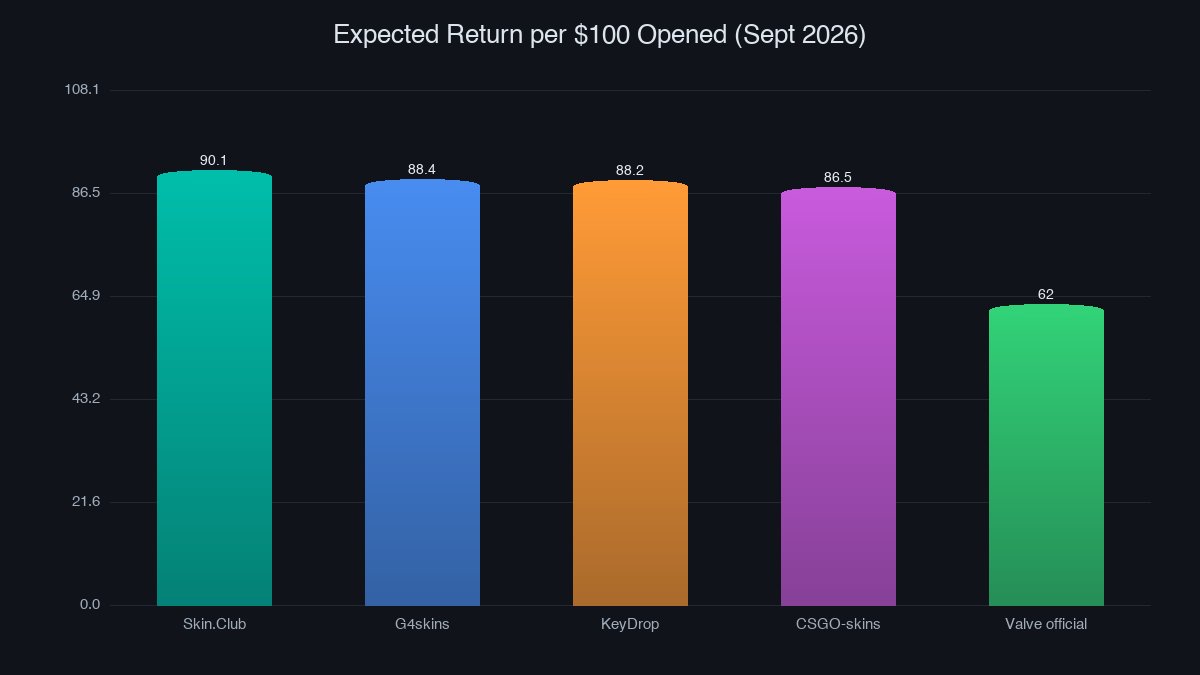
These figures describe the selection of cases each platform was tested on, not every case on the site. Sizes were 15 cases per platform, except CSGO-skins at 12.
#1 — Skin.Club: 90.08%. The strongest verified average in the September sample, and the only platform that held above 90%. It also comes with the largest community and content footprint of the group, which is part of why it stays at the top of these comparisons.
#2 — G4skins: 88.36%. A narrow lead over third place, decided by fractions. On a $100 session that gap is worth about twenty cents — real, but not a decision-maker on its own.
#3 — KeyDrop: 88.15%. Essentially level with G4skins, and notable for hosting the single best high-tier case in the whole audit. If you are playing at the top of the price range, this is where the best individual number lives.
#4 — CSGO-skins: 86.48%. The lowest of the four fully verified platforms, and the only one with no case priced above the $500 line. It is also the platform where price movements pushed two cases across the sample's dollar-band boundaries, which is a reminder that these bands are snapshots rather than fixed categories.
For context, Hellcase's April baseline sat at 87.08% — mid-pack, and impossible to compare fairly against a September refresh without re-verifying it.
The Best Individual Cases
Two cases stood out above everything else in the sample.
Farm Dead Hand — 90.89%. The strongest single case measured anywhere in the audit, and comfortably above the 88.36% live average. It is not a high-roller case either, which is what makes it interesting: it beat every premium option in the study.
EMERALD (KeyDrop) — 90.55%. The best case in the $500+ band, listed at $1,078.43 with a measured return around $976. That is the shape of the high-tier market in one line: you can get close to break-even, but the case still costs real money to find out.
Price Bands: Where the Money Actually Goes
The audit sorted cases into five bands, from under $5 up to $500 and above. The best-performing band in September was the top one, at 88.50%. The margins between bands were small, and that is the finding — not a story about expensive cases being dramatically better, but about the whole market settling into a similar range.
There is a practical implication. If cheap and expensive cases return roughly the same share, then the difference between them is not value, it is variance. A $2 case and a $500 case give you the same expected percentage back, but they deliver it in wildly different shapes: the cheap case pays small and often, the expensive one pays rarely and large.
Two mechanics drive almost all of that variance, and both are published by Valve:
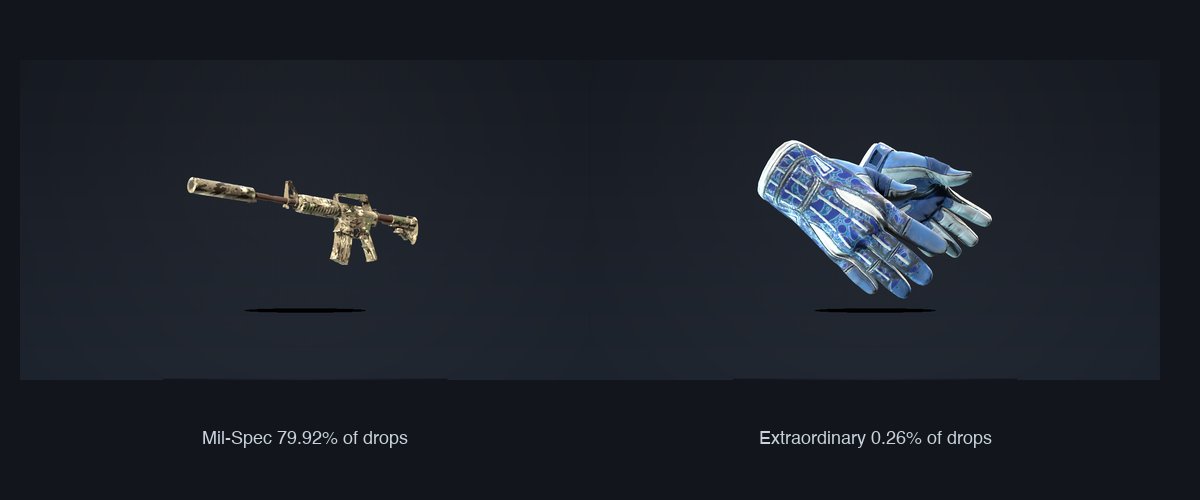
- Rarity tiers: Mil-Spec (blue) is roughly 79.92% of outcomes, Restricted (purple) 15.98%, Classified (pink) 3.20%, Covert (red) 0.64%, and the rare special item — knives and gloves — 0.26%.
- The StatTrak™ multiplier: every drop carries an additional 10% chance of being StatTrak. Stack that on the gold tier and the real chance of a StatTrak knife or glove lands near 0.026% — roughly 1 in 3,850 openings.
Why the Official Case Is a Different Animal
All of the above describes third-party platforms with custom drop tables. Valve's own in-game cases are built on the published rarity curve and a fixed key price near $2.49. Independent testing consistently lands official case returns somewhere in the 60% range — noticeably below every platform in this audit — and multiple estimates put the expected value of a standard unbox between negative 40% and negative 60%.
That gap is not a scandal. It is a different product. Valve's cases are tied to a fixed global supply of real items with a real resale market behind them, and the knife in the pool is a physical, tradeable asset. Third-party platforms buy and resell inventory to keep their offer competitive, which is what pulls their measured returns up toward the high 80s.
The tell for any operator — including the ones selling you cases right now — is whether the odds are published on the page before you commit, and whether the items you win are items you can actually withdraw and resell. Those two properties are worth more than a couple of percentage points of headline RTP, because they are the difference between a game and an investment.
What Changed Since August
The month-over-month movement was mild. Skin.Club stayed close to 90%, while KeyDrop and G4skins remained tightly grouped. CSGO-skins edged lower in the refreshed sample. The more telling changes were at the storefront level: KeyDrop retired several cases and replaced them with currently prominent titles including THE NEXUS, CHOSEN ONE, DO NOT ENTER and TAKE THE W.
Meanwhile the wider container market kept drifting. One widely-tracked terminal now trades under 10 cents with close to 400,000 listings sitting on Steam and few buyers in a hurry. That is the other half of the September picture — platforms are competing harder for case-opening volume at the same time as secondary-market demand cools.
The Takeaway
Read the September audit as a benchmark rather than a ranking. The realistic range for a well-run third-party case is roughly 86% to 91% back, the best single case measured was Farm Dead Hand at 90.89%, and the platform you choose is worth less than four percentage points between the best and worst fully verified option.
What that means in practice is simple. Open fewer cases, at numbers you have actually checked, on platforms that publish their odds and let you withdraw what you win. Because once you know the real payback is closer to nine dollars in ten, the case stops being a lottery ticket and starts being a purchase — and a purchase is something you can evaluate on merit. If you want a cleaner way to see that difference, start by comparing how live skin listings are actually priced against what a case promises, then look at Fan Favorite to see the format with the odds in front of you instead of behind a spinner.