Classic Cases vs Terminals: How Valve Rewired CS2 Unboxing

Classic Cases vs Terminals: How Valve Rewired CS2 Unboxing
For more than a decade, getting a CS2 skin meant one thing: buy a case, buy a key, spin the wheel. Then, quietly, Valve changed the rules. The last traditional weapon case dropped in March 2025, and since then the game has been moving toward a completely different unboxing model — one built around Sealed Terminals, Armory credits, and fixed-price offers instead of blind key rolls.
The shift matters more than most players realize, because it changes what you pay, what you can win, and how much you actually know before you commit your money. Here's the comparison, round by round.
Round 1: The Drop Model
A classic case is brutally simple. The case drops from a weekly XP reward, you pay $2.49 for a key, and the game rolls the same 79.92% / 15.98% / 3.20% / 0.64% / 0.26% rarity table every time. You find out what you got only after the money is spent.
A Sealed Terminal flips that model. Instead of a key and a blind roll, the Terminal presents you with a specific item at a fixed price — and you choose whether to accept it or pass. You get up to five offers, and you can decline up to four times before the Terminal is destroyed. Crucially, the item's float and condition are shown before you accept, so there's no surprise wear level hiding in the fine print.
The Armory Pass sits in between. You pay $15.99 for a pass, earn Armory Credits by playing (roughly one credit per 300 XP), and spend those credits in the in-game Armory — 4 credits for a weapon skin, 2 credits for a case, and up to 125 credits for a guaranteed limited item like the AK-47 | Aphrodite. It's a grind-to-loot system, not a direct purchase, and it's why Valve no longer needs to ship a new case every few months to keep engagement up.
Zoom out and the timeline is striking. The last traditional weapon case was the Fever Case in March 2025 — meaning the game has now gone well over a year without a classic key-and-case release. In their place, Valve has shipped two Terminals (Genesis in September 2025, Dead Hand in March 2026) and leaned hard on Armory refreshes. The old six-to-twelve-month case cadence is gone, replaced by a steady drip of smaller, more controllable formats.
Round 2: The Odds and the Cost
Here's the part that surprises people: the base rarity odds are identical everywhere. A classic case, an Armory case, and a Terminal all draw from the same 0.26% gold-tier rate for knives and gloves. The difference is what sits on top of that roll.
Classic cases stack the key cost on top of the odds. At $2.49 per key and roughly 385 opens per knife, you're looking at around $958 in keys before the math favors a single gold pull — and the median result is a blue worth under $0.20.
Armory redemptions are even thinner at the top end. The 4-credit collection pulls top out at Covert, and that Covert sits at roughly 0.13% (about 1 in 769) — meaning the system is explicitly built so that knives and gloves are not available through the Armory at all. The only real guarantee is the limited item, which costs 25 to 125 credits of grinding.
Terminals are the transparent option. You know the exact item, the exact float, and the exact price before you spend a cent. The "gamble" shrinks to a single yes-or-no decision, which is exactly why the format exists — it's Valve's answer to regulators and players who are tired of blind loot boxes.
Round 3: What's Actually Inside
The contents tell the story of where Valve is heading. The Dead Hand Collection, released on March 11, 2026, shipped 17 community weapon skins plus 22 brand-new glove finishes — the first new gloves since 2020. That's the headline: after years of knives dominating the gold tier, gloves are back in the spotlight.
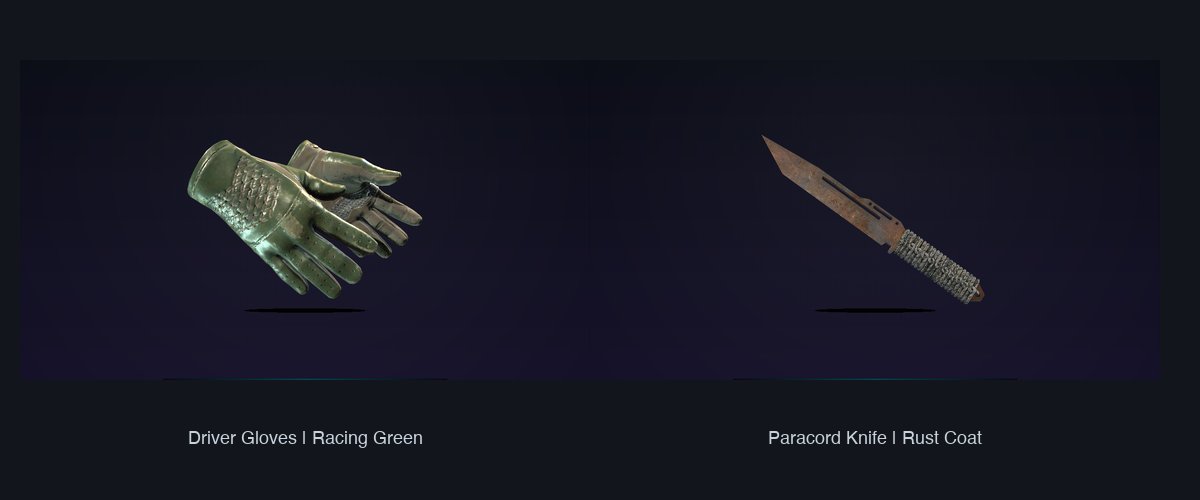
The Dead Hand Terminal drops weekly for Prime accounts at an estimated 32% rate and trades around $0.48. Its predecessor, the Genesis Terminal from September 2025, drops at roughly 17% and sits near $0.05. Compare that to the last classic Armory case — the Fever Case from March 31, 2025 — and you can see the pipeline: Terminals are replacing cases as the primary weekly drop, while the Armory handles the paid progression lane.
The new gloves span a wide price range, which is part of why the Dead Hand release landed so well with collectors. Entry-level pairs like the Driver Gloves | Seigaiha keep the floor affordable, while finishes like the Specialist Gloves | Pillow Punchers push into four-figure territory. That spread — from budget to grail — is exactly what a healthy new item class needs, and it's a signal Valve intends gloves to share the gold-tier spotlight with knives for the foreseeable future.
That's also why some of the biggest names in the skin community — dataminers like Thour and analysts like Gabe Follower and TDM Heyzeus — now argue that traditional loot-box cases are effectively over. "RIP Cases," as one widely shared read on it put it. Whether or not a classic case ever returns, the direction is clear: unboxing is becoming more structured, more transparent, and less dependent on blind keys.
The Verdict
So which model is better for you? It depends on what you're after. If you want the pure chase and don't mind paying $2.49 a roll for a shot at a knife, classic cases still deliver that exact thrill — the odds just haven't moved in nearly a decade. If you want a specific skin with no surprises, the Terminal's fixed-price offers are the most honest unboxing Valve has ever shipped. And if you enjoy the grind, the Armory Pass turns your playtime into a slow trickle of skins.
There's also a quieter effect worth watching: supply. Because Terminals drop weekly at a fixed rate with a fixed-price offer, Valve has far more control over how many of each new item enters the market than it ever did with keys. That tighter grip on supply is part of why the new Dead Hand gloves have held value more steadily than past case releases, and why collectors are watching Terminal drop rates as closely as they used to watch case prices.
For most players, the smartest move hasn't changed: skip the blind rolls and buy the exact item you want. That's the whole idea behind the skinvs.com marketplace — you see the skin, the float, and the price up front, with none of the key-and-hope routine in between.
If you'd rather feel the new system for yourself, a Phantom Cache case on skinvs.com gives you the modern opening experience without waiting for a weekly drop. Whichever lane you pick, one thing is settled: the era of the blind case is ending, and the market is moving with it.