How to Buy Your First CS2 Knife in September 2026 Without Overpaying
How to Buy Your First CS2 Knife in September 2026 Without Overpaying
As of September 2026, the cheapest knife listings in Counter-Strike 2 sit under $60. That is the headline number, and it hides the interesting part. Every knife in the game has the same 0.26% drop chance, so rarity is not what separates a $45 knife from a $4,000 one. The model and the finish do all the work.
That single fact is what makes a smart budget buy possible. You are not shopping for luck. You are shopping for a name on a blade, and some names are dramatically cheaper than others for reasons that have nothing to do with how the knife looks in your hands. Get the four steps below right and you can walk into a knife for the price of a decent pair of headphones, with a resale path already in mind.
Step 1: Pick the Model by Liquidity, Not Looks
The cheapest knife is worthless if you cannot sell it again. Liquidity, not price, decides how easily you exit. Looking at the budget models, the spread is wide.
- Shadow Daggers — average liquidity around 58.3% across the cheapest listings. The strongest resale case in the budget tier, and the only dual-wield knife in the game.
- Kukri Knife — roughly 41%. Newer model, large blade, smooth pullout animation, and a black handle that plays well with gloves.
- Paracord Knife — about 30%.
- Navaja Knife — around 26.4%. The lowest entry price, but a small blade and weaker demand.
- Survival Knife — roughly 25%. The busy blade design with hooks and serrations narrows the buyer pool.
- Gut Knife — about 17%. Recognizable and large, but the weakest resale among the budget picks.
The lesson is simple. If you might sell in six months, Shadow Daggers and Kukri give you the best odds of finding a buyer at a fair price. If you genuinely plan to keep it forever, Navaja gets you in for the least money.
Step 2: Buy the Wear That Hides Scratches
Wear is where budget buyers either save hundreds or waste them. The rule is to match the wear tier to the finish, not to the price tag.
Full-range finishes barely change across wear. Rust Coat, Boreal Forest, Forest DDPAT, and Scorched look nearly identical from Factory New down to Battle-Scarred, because the pattern is meant to look weathered or faded in the first place. Paying a Factory New premium on those finishes buys you a label, not a look. A Battle-Scarred Navaja in Rust Coat carries the same visual character as a low-float copy and costs a fraction of it.
Pattern-driven finishes are the opposite. Lore, Tiger Tooth, and Case Hardened lose visible detail as wear climbs, so a lower float is genuinely worth paying for on those. If you are on a budget, the play is to buy a pattern-driven finish in Field-Tested or Well-Worn only when the specific pattern still reads clearly, and otherwise stick to full-range finishes where the wear simply does not matter.
There is one more shortcut worth knowing: the dedicated knife trade-up. Five Covert skins from the same collection guarantee a knife or gloves from that collection. Whether the result lands under $300 depends entirely on which collection you feed in and what those five inputs cost you.
Step 3: Shop From a Price List, Not From Hype
Here is what the budget tier actually looked like in September 2026. These are market snapshots, so treat them as a starting point rather than a fixed quote.
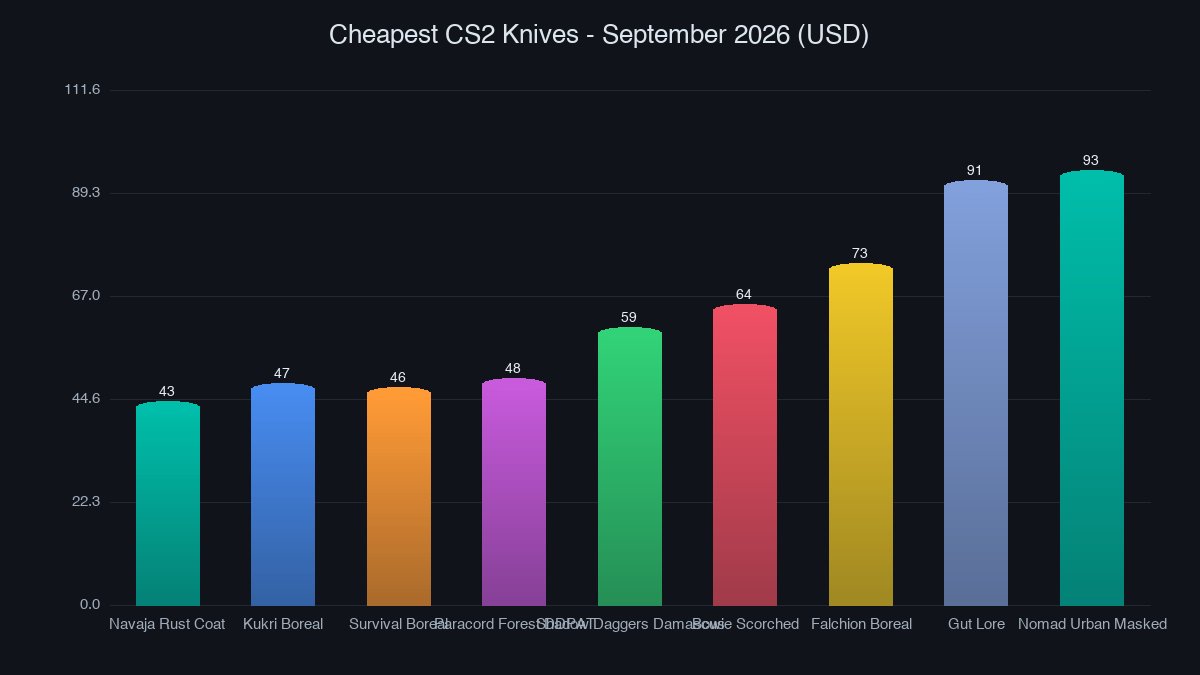
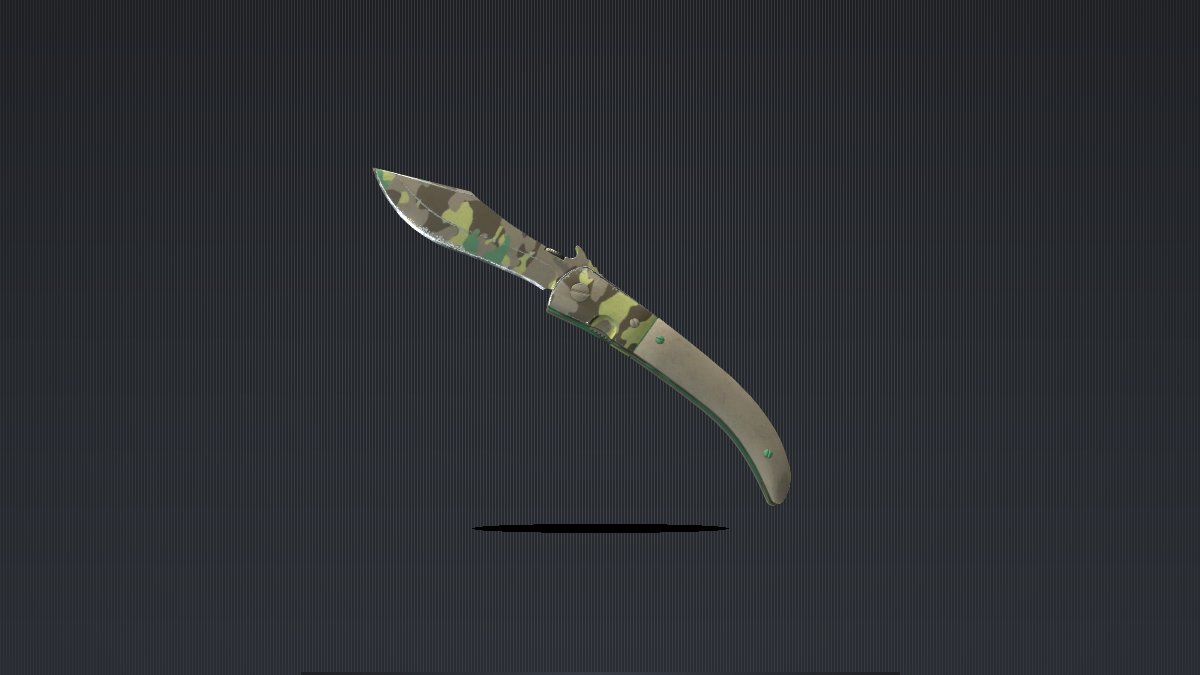
- Navaja Knife | Rust Coat (Battle-Scarred) — roughly $41 to $46
- Kukri Knife | Boreal Forest (Field-Tested) — about $43 to $52
- Survival Knife | Boreal Forest (Field-Tested) — around $44 to $48
- Paracord Knife | Forest DDPAT (Well-Worn) — roughly $45 to $51
- Shadow Daggers | Damascus Steel (Field-Tested) — about $48 to $70
- Bowie Knife | Scorched (Field-Tested) — around $58 to $71
- Falchion Knife | Boreal Forest (Field-Tested) — roughly $61 to $86
- Nomad Knife | Urban Masked (Field-Tested) — about $88 to $98
- Gut Knife | Lore (Well-Worn) — around $83 to $99
Notice how tight the bottom of that list is. The gap between the cheapest knife in the game and the fifth-cheapest is under $10, which means the entry price is set by the model, not by anything you can negotiate. Also notice that the budget tier is not standing still. Across knife models, 30-day median price moves have been running in the ±4.2% to ±6.9% range, so a $45 listing today can be a $42 or a $48 listing next month. Buying on a small dip is realistic; waiting for a knife to halve is not.
When you are ready to compare real listings instead of guide prices, the fastest route is to pull up current knives side by side on the skinvs market, where you can see what sellers are actually asking before you commit.
Step 4: Don't Lose It on the Way In
A cheap knife is still a real asset, and the scams targeting first-time buyers in 2026 are polished. Most of the money lost never involves a hack. It involves a buyer who was talked into doing something outside the trade window.
The Steam API key scam is the most damaging. A fake site or "trade bot" gets you to log in or paste your Steam Web API key, then silently registers a key on your account. From that point on, your outgoing offers can be cancelled and replaced with clones routed to the attacker. Your phone confirmation still looks normal because you did start a trade. Check your API key page at steamcommunity.com/dev/apikey regularly. If a key is there that you did not create, revoke it, change your password, and deauthorize all devices.
A cheap decoy item is the best tripwire. Add a $0.01 sticker to your side of the offer. If the partner's side looks empty on the mobile confirmation, the trade has been intercepted. Cancel immediately.
Two more patterns to recognize: the fake middleman, and the "I accidentally reported you" admin impersonation. Valve staff do not contact players through Steam chat, Discord, or Telegram, and they never ask you to move items. There is also no legitimate middleman for a normal trade. And watch for the quick-switch, where a Doppler phase or a StatTrak item is swapped for a near-identical cheaper version mid-negotiation, since phases share a single item name.
One piece of good news: since July 15, 2025, CS2 items received through supported trades have Trade Protected status for a limited window, and eligible recent trades can be reversed from your Steam Trade History. That is a safety net, not a plan. Read both sides of the window every time, reach sites through your own bookmark, and never paste a trade URL or API key into a page someone sent you.
The Short Version
Buy the model with the best liquidity you can afford, choose the wear that matches the finish instead of the marketing, and treat the trade itself as the risky part of the transaction. Do those three things and a first knife in September 2026 costs you under $60, not a story you have to explain later.