The Genesis Terminal Wants $500 for One Skin. Here's the Math Behind It
The Genesis Terminal Wants $500 for One Skin. Here's the Math Behind It
Five offers. No key. No odds sheet. That is the entire pitch of the Genesis Uplink Terminal, the weekly drop Valve pushed into Counter-Strike 2 on September 9, 2026 — and it has already produced the strangest price list in the game's history.
Players who have run it report being asked $300+ for a standard Covert and $500+ for a StatTrak Factory New Covert from the new Genesis Collection. A classic case key costs roughly $2.50. The terminal is not really a case. It is a negotiating table, and Valve sets the opening bid.
The Raw Numbers
Here is how the terminal actually works, based on player runs and coverage from Dust2.us and Dexerto. You get a sealed terminal — either bought or dropped through the weekly care package. When you open it, "Booth the Arms Dealer" offers you a single item at a single price. You accept and pay, or you decline and get another offer. Up to five offers per terminal.
That structure is why the numbers look so strange. In a case, you pay a fixed key price (~$2.50) and the odds are public: 79.92% of outcomes land in the blue Mil-Spec tier, and knives or gloves sit at about 0.26% — roughly one in 385 openings. Nothing about the value of what you receive is negotiable. You spin, you get, you move on.
The terminal keeps the rarity distribution familiar but replaces the key with a computed price. And that price is not published anywhere. Community analysis of the first week suggests Valve's "dynamic pricing" responds to how often players accept an offer at a given level — buy a lot at $100, and the ask climbs; stop buying, and it drifts down. That is a demand sensor, not a market quote, and it is the single most important thing to understand before you accept anything.
Put the two systems side by side and the gap is not subtle. A case key is a fixed $2.50 for a lottery ticket. A terminal ask is a variable number, sometimes three figures, for a specific item you can already see. One is a gamble. The other is a shop with a price tag that moves while you stand in it.
"Free to open" is the line you will see repeated, and it is technically true — you pay nothing to look at the five offers. What you pay for is the item itself, and the price attached to it. That is a meaningful break from the case model, where the container and the outcome are billed separately and the second half is pure chance. Here there is no chance at the moment of payment. You know exactly what you are buying. The only real question is whether the number on the screen is fair.
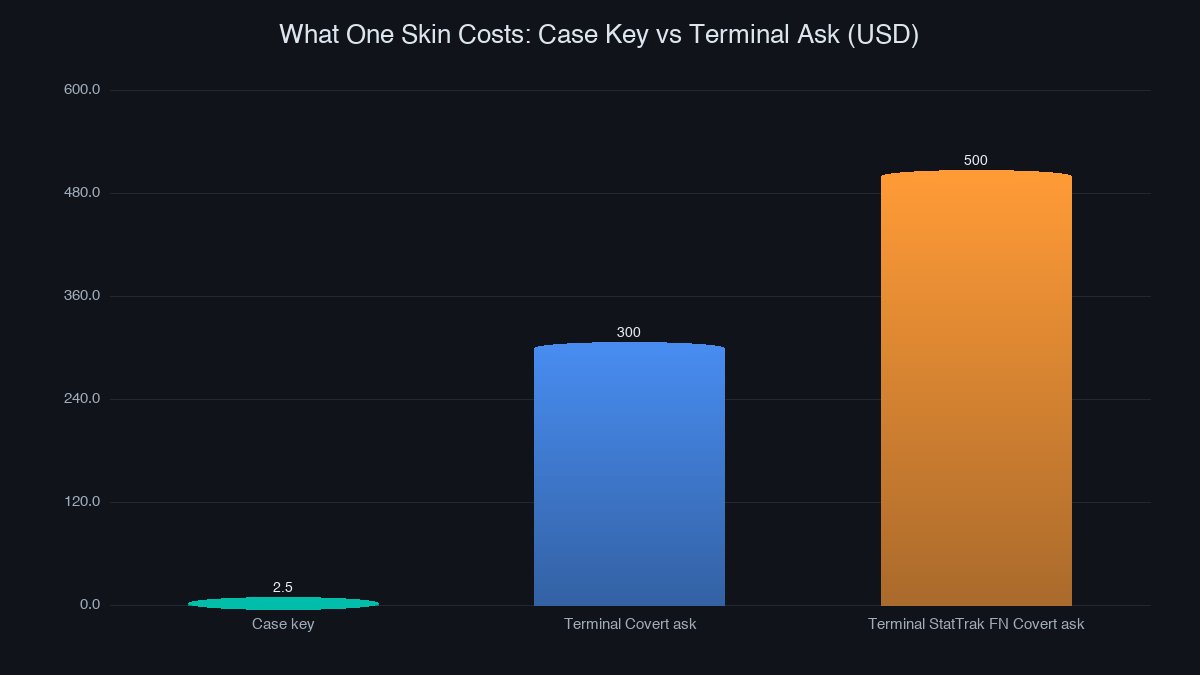
Look at that spread for a second. The entire design of the terminal is visible in three bars: a $2.50 key on one side, and asks ten to two hundred times larger on the other. Both get you a skin. Only one of them tells you the odds in advance.
What Surprised Us
The first surprise was not the price. It was what the market did around it. Within days of the Genesis launch, sealed terminals were changing hands for several times their floor as players front-ran the novelty — and then gave most of that back once supply caught up. The classic pattern, compressed into a week.
One number is still missing from that picture: the actual probability of a sealed terminal dropping in the weekly care package. Valve has not published it, and community estimates remain guesswork until more weeks of drop data accumulate. That uncertainty feeds straight into the resale market, which is exactly how early sellers were able to ask multiples of the eventual floor — and, briefly, get it.
The second surprise is where the numbers landed in the broader index. Tracking the terminal-tier items as their own basket, the group sits at roughly 431 items and has given up about 7.4%. That is ugly, but it is mild next to Armory weapons — 382 items, down almost 17.9% over the same stretch. Dead Hand gloves (88 items) are off about 6.9%, and rare cases about the same. Even the active drop cases, the boring ones nobody speculates on, are down 2.7%.
The structural story underneath those percentages matters more than any single one. Valve has not shipped a traditional key-and-case release since the Fever Case on March 31, 2025. Since then, new skins have arrived through the Armory pass, through the Dead Hand Terminal in March 2026, and now through Genesis. The current Prime weekly drop pool is down to three weapon cases and two terminals. The pipeline that used to feed the secondary market a steady stream of keyed cases is now a trickle of alternative containers.
And the money is still enormous. Estimates put case-opening spend alone above $1 billion a year, with roughly $900 million flowing through the Armory between October 2024 and July 2026. When you are working at that scale, changing the container format is not a cosmetic decision. It is Valve rebuilding the front door while the building stays full.
Where Your Money Actually Goes
This is the part that matters if you are the one holding the terminal. The ask you see is generated by demand, so it carries no relationship to what the item sells for on the open market. The people who accept early bids set the anchor for everyone behind them. That is how a Factory New Covert ends up quoted at $500 while comparable coverts trade far lower on listing sites.
There is also a behavioural trap built into the ladder itself. Five offers create the feeling of a process, and processes push people toward a decision. By the fourth decline, the temptation is to accept whatever is on screen just to close the loop. The correct frame is the opposite: each offer is an independent proposal. Declining costs you nothing, and the fifth ask is often where the patience premium gets paid back.
So treat every offer as a comparison, not a result. Three things are worth checking before you press accept:
- The exact wear and StatTrak state. A Factory New StatTrak Covert and a Field-Tested standard version of the same skin are different products with wildly different prices. The terminal quotes them differently for a reason.
- The live floor on the same item. If the ask sits above what the item is actually listing for, declining is free. You lose nothing by walking the ladder.
- The float range on the offer. Low-float copies inside a wear bracket carry a premium that a dynamic ask does not account for.
The players calling this a trap are not wrong about the pricing — but they are wrong that there is no decision to make. There is exactly one, and you get to make it up to five times.
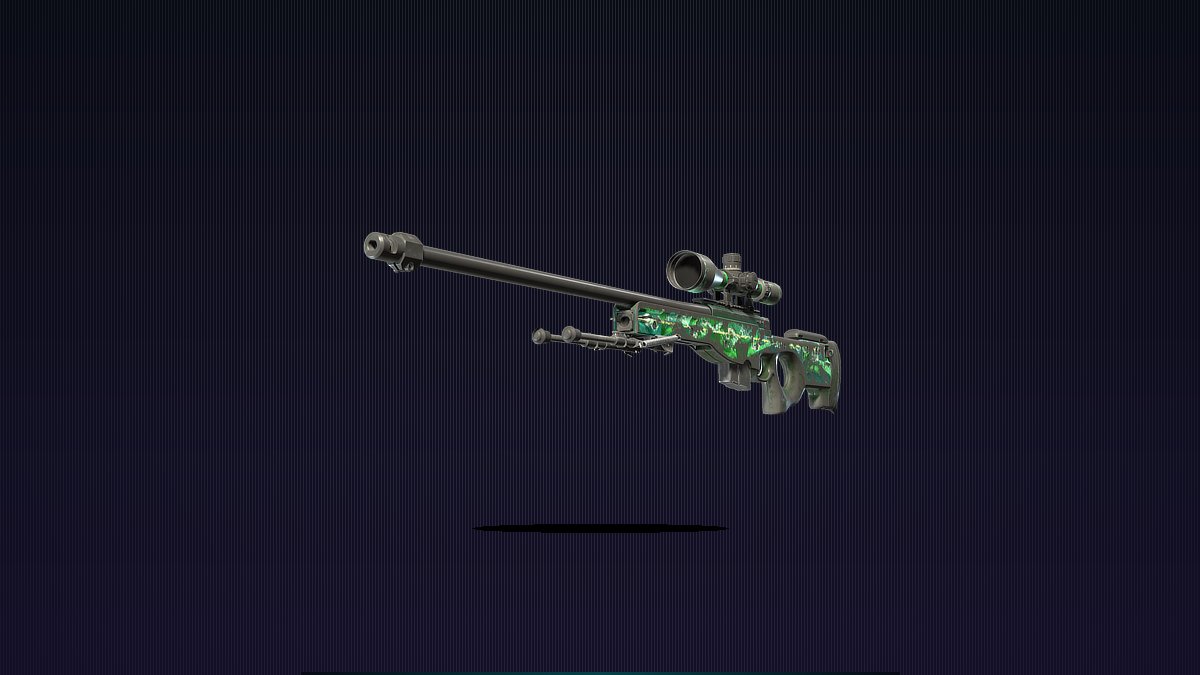
Take a Classified rifle like the AWP | Green Energy in Battle-Scarred — the kind of offer that turns up mid-ladder. On the open market, the wear bracket alone tells you roughly where it should sit. A dynamic ask does not care what the market thinks; it only cares what the last buyer paid. That gap between a demand sensor and a price floor is where most of the disappointment in these threads comes from.
The Smart Play
If your goal is a specific skin at a specific wear, the terminal is the wrong tool. Its strength is convenience and access to the Genesis Collection while supply is still thin. Its weakness is that the number on the screen was set by other people's buying behaviour, not by the market.
The honest read on the first ten days of Genesis: the novelty premium is already bleeding out, the index is drifting down with the rest of the market, and the terminal's asking prices are still finding their level. Early adopters paid tuition. You do not have to.
If you want a defined price instead of a moving one, take the other route — buy the skin you actually want at the listing price, or open a case where the odds and the key cost are both public. Our Phantom Cache runs on the classic model: fixed key, published odds, no negotiation. And if you would rather skip containers entirely, the live market listings let you set the price yourself instead of accepting one.
Valve is clearly redesigning how skins enter the economy. That is not inherently bad news for players — but it does mean the old habits are worth re-examining. Check the market before you check the offer. Every time.