CS2 Skin Market Crashes Below $4.5 Billion: What's Really Happening
CS2 Skin Market Crashes Below $4.5 Billion: What's Really Happening
On May 26, 2026, the CS2 skin economy lost $325 million in a single 24-hour period. That's not a typo — nearly a third of a billion dollars in paper value evaporated while traders watched their portfolios bleed red. The total market capitalization has now drifted below $4.5 billion, marking the steepest sustained decline of the year. If you've been wondering why your inventory feels lighter lately, you're not alone.
The Numbers: Before and After
The CS2 market didn't crash overnight — it's been eroding for months. Community data trackers estimate that from peak values, some skin categories have dropped as much as 50%. The total market cap has shed roughly 6% in just the last seven days, compounding a longer downward trend that began in early 2026.
To put that in perspective: the CS2 skin economy was valued north of $5 billion at its recent highs. Today it's struggling to hold $4.5 billion. That half-trillion-dollar gap represents real money pulled out of the ecosystem — by investors taking profits, by panic sellers cutting losses, and by a general cooling of speculative demand.
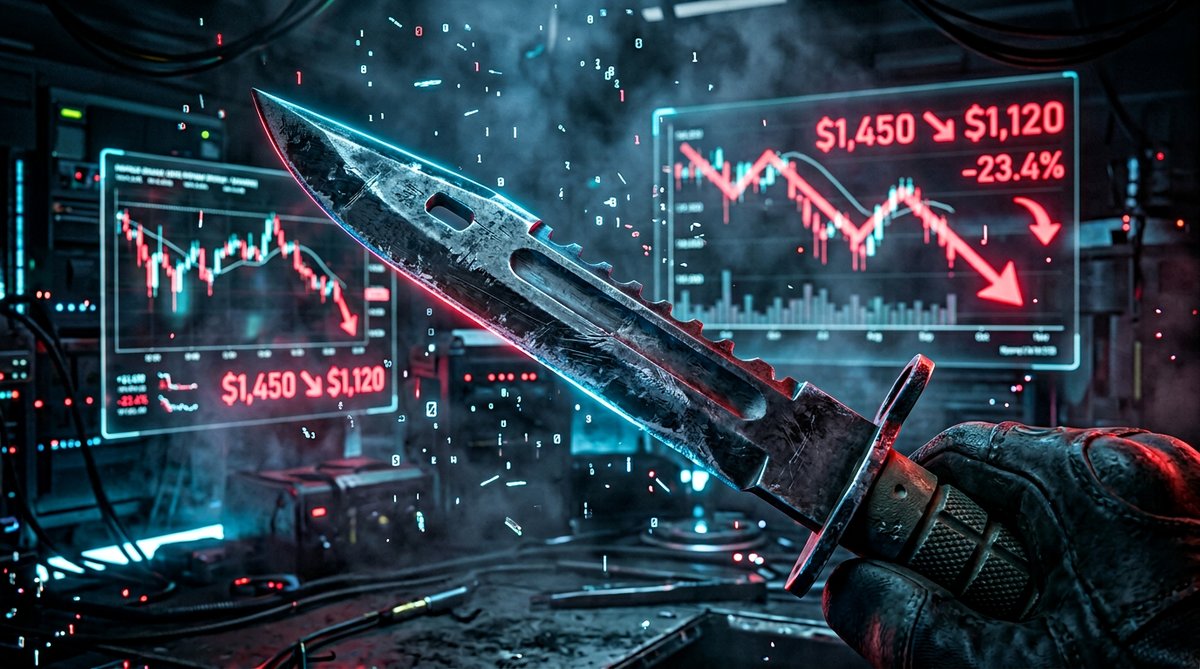
High-end knives and gloves — traditionally the most stable store of value in CS2 — haven't been spared. Popular Doppler and Fade patterns that were commanding $2,000+ just months ago are now seeing listings below $1,500. Even staple investments like the AK-47 Fire Serpent and AWP Dragon Lore have softened noticeably.
As SteamAnalyst noted in their 2026 market report, "the CS2 economy continues to go through one of its hardest periods in recent times," with the drop from peak values reaching as much as 50% in some stretches.
What Triggered the Selloff
No single factor caused this. It's a convergence of several headwinds hitting at once:
The Cologne 2026 sticker overhaul. Valve replaced the traditional capsule system with a token-based shop where players bookmark stickers they want. The 100 most expensive Cologne 2026 stickers now cost $19,447.37 to buy one of each — a pricing model that's alienating sticker investors who relied on capsule supply dynamics for profit. As the community.skin.club tracker noted, the new system has "shaken confidence across the entire market."
Armory rotation delays. The community has been expecting an Armory refresh for months. Each delay pushes more players toward holding cash rather than skins, draining liquidity from the market. The longer Valve waits, the more nervous speculative buyers become.
Trading site instability. Several third-party trading platforms have collapsed or drastically reduced operations in 2026. When trading infrastructure shrinks, market velocity drops. Fewer transactions mean wider spreads between buy and sell prices — and sellers almost always lose in that equation.
China's shifting role. Chinese buyers have historically been the engine of CS2 skin appreciation, but recent economic headwinds and regulatory uncertainty around virtual item trading have cooled that demand. When the biggest buyer base steps back, prices follow.
Who's Buying (And Who's Not)
The current market reveals a fascinating split. Institutional-scale investors and whale collectors have largely paused new acquisitions, waiting for clearer signals. Many are sitting on cash, ready to deploy when the bottom feels established.
Meanwhile, everyday players are still buying — they're just buying differently. Instead of chasing investment-grade skins, they're picking up play skins at newly discounted prices. A Factory New M4A1-S that would have cost $80 six months ago might be $55 today. For someone who just wants a clean loadout, that's a win.
This bifurcation — whales waiting, casuals buying — creates an unusual market dynamic where low-to-mid tier skins are actually moving faster than premium ones. Normally the reverse is true.
The Steam Community Market's latest change compounds this: items listed for sale now remain in your inventory for use while they're listed. That means a seller can equip their skin in-game even as it sits on the market. More supply stays visible, more sellers can afford to wait for their price, and the pressure to undercut becomes less urgent.
The Silver Lining
For the first time in months, several indicators suggest we're approaching a floor rather than free-fall. Buy orders for popular cases like the Phantom Cache and Fan Favorite are accumulating at support levels. Smart money recognizes that CS2's player base isn't shrinking — it's actually grown in 2026 — and a larger player base eventually means more demand for skins.
History also offers comfort. The CS2 market has survived worse: the 2023 Paris sticker crash, the 2024 post-Major correction, and multiple ban waves that temporarily spooked investors. Each time, the market found its footing within 3-6 months and resumed its long-term upward trajectory.
If you've been holding quality skins through this downturn, the worst may be behind us. The bloodbath is real — but bloodbaths create the buying opportunities that the next bull run is built on.
The CS2 market rewards patience. When fear is this widespread, the contrarian move might not be selling — it might be opening a Phantom Cache case and holding what you get. Sometimes the best investment strategy during a crash is simply staying in the game.