A Gold Singapore Sticker Costs $30. Resale Data Says Gold Is Worth Less Than Holo

A Gold Singapore Sticker Costs $30. Resale Data Says Gold Is Worth Less Than Holo
On November 17 Valve put 772 stickers from the PGL Singapore Major on sale, and for the first time in a year nobody had to guess the price. Paper costs 25 tokens. Foil costs 150. Holo costs 800. Gold costs 3,000. With tokens at 100 for $0.99, that is $0.25, $1.49, $7.92 and $29.70 — a clean ladder with a 120x gap between the cheapest and the most expensive finish.
The ladder is tidy. It also assumes something about the market that the market has never agreed with.
We pulled the 1,200 most-traded stickers in the SkinVS catalog and sorted them by finish. Across the last three Majors, Gold does not reliably sell for more than Holo. In the most recent one it sold for a lot less. Which makes Valve's 3.75x premium from Holo to Gold a bet on a finish the secondary market has been quietly demoting for two years.
What Valve Actually Changed
At IEM Cologne 2026, sticker prices floated. Valve let demand set the number, so a popular player's Gold autograph could cost several times what an unpopular one did. Valve has now admitted the experiment failed. HLTV tied the reversal to weak Cologne sales, and the scale of it is in the reporting: Cologne sticker sales ran almost five times lower than Budapest's.
The team-level damage was worse than the sticker-level damage. PARIVISION's CEO said his organisation earned three times more from Budapest Stage 1 stickers than from reaching Stage 3 at Cologne — a team that went deeper made less. Gaimin Gladiators had already shut its CS division in June.
So Singapore runs on a fixed ladder, and it changes three things at once:
- No capsules. You buy the exact sticker you want. There is no pack to open and no random reveal.
- No player premium. A donk Gold and a bench player's Gold cost the same 3,000 tokens. That never happened under dynamic pricing.
- Souvenirs are craftable at a fixed price, set by the rarity of the weapon you pick. The old random souvenir package is gone from this Major.
The revenue split stayed put. Half of sticker proceeds go to players, teams and the tournament organiser, divided by each team's initial seed and final placement. So the fixed price is not Valve cutting the scene out — it is Valve deciding the scene's income should be predictable rather than demand-following.
The Ladder Is Priced on Rarity. The Market Prices on Looks.
Here is the part the price list does not tell you. We took every sticker in the catalog tagged to a recent Major and grouped them by finish, because the finish — not the team — is now the only thing that decides what you pay.
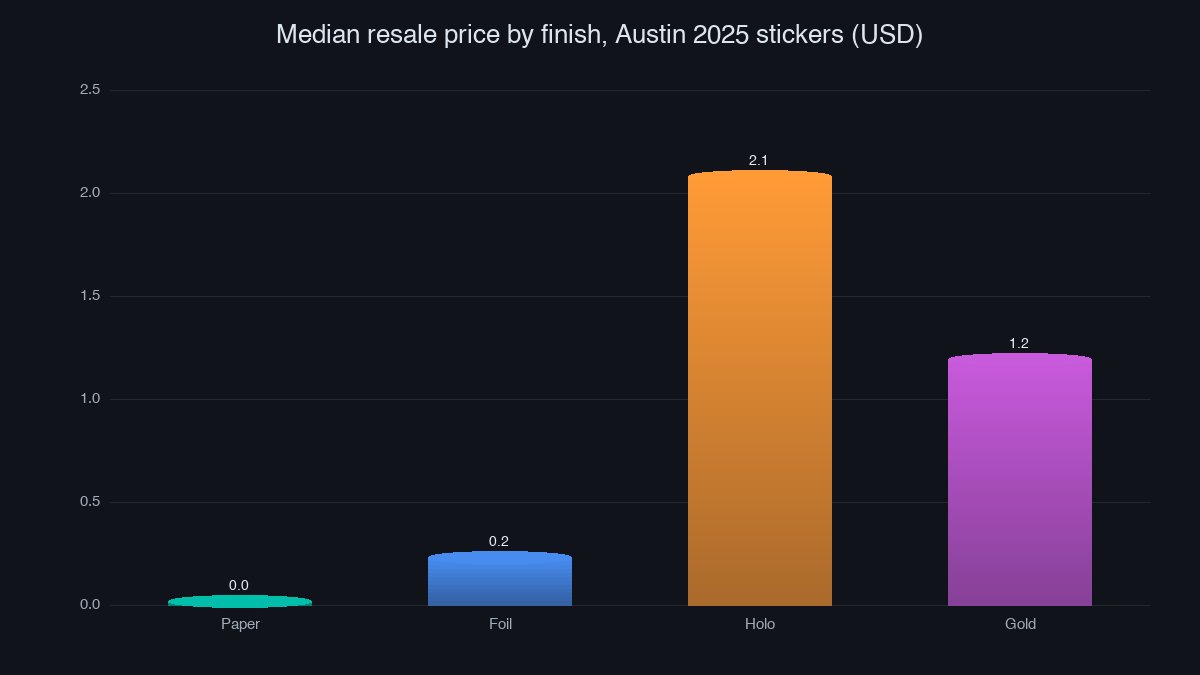
For Austin 2025, across 169 listings in the top 1,200:
- Paper: 83 items, median $0.02
- Foil: 38 items, median $0.24
- Holo: 42 items, median $2.12
- Gold: 6 items, median $1.22
Read the last two lines again. Holo has 8.8x the median of Foil. Gold has 0.58x the median of Holo. On the resale market, the top finish trades at a discount to the one below it.
Shanghai 2024 repeats the pattern with a smaller gap: Holo n=27 at $3.20, Gold n=2 at $2.79. Copenhagen 2024 is the only Major where Gold wins, and it wins by twelve cents: Gold n=3 at $2.88 against Holo n=17 at $2.66.
Before anyone builds a strategy on six Gold listings, the honest caveat: the Gold sample is thin — 6, 2 and 3 items respectively, out of roughly 400 stickers checked per Major. Thin samples move. What is not thin is the Holo-versus-Foil step, which runs on 42, 27 and 17 listings, and which is consistently steeper than Valve's own ladder: the market charges 8.8x from Foil to Holo where Valve charges 5.3x.
Two clean conclusions survive the sample-size problem. The market values Holo far above Foil, more than Valve does. And the market does not value Gold far above Holo, which Valve does.
The Break-Even Nobody Hits
Run the fixed prices against those resale medians and the arithmetic gets uncomfortable fast.
- Paper: $0.25 in, $0.02 median resale. That is a 92% loss before you pay any marketplace fee.
- Foil: $1.49 in, $0.24 median. 84% loss.
- Holo: $7.92 in, $2.12 median. 73% loss. The best Austin Holo — Team Liquid — reached $5.15. Still a 35% loss.
- Gold: $29.70 in, $1.22 median. 96% loss. The best Austin Gold — XANTARES — hit $4.99. An 83% loss.
None of that means the stickers are bad. It means a Major sticker bought at the shop is a memento with a known, published price, not an investment with an edge. The Austin numbers are also a year settled; Singapore stickers will hold a premium for weeks precisely because supply is fixed at whatever the playerbase buys during the event, and the Major has not even started.
There is one more structural detail worth knowing. Pick'Em coin upgrades pay 300 tokens each, with three upgrades available — 900 tokens total, or about $8.91 of shop credit for a Viewer Pass holder. That buys a Holo (800) with 100 tokens left over. It does not come close to a Gold at 3,000. The free path is capped exactly one rung below the top tier, which is a deliberate design choice and not an accident of pricing.
Who Comes Out Ahead
Three groups do fine under fixed pricing, and none of them are resellers.
Teams get a number they can plan around. Under dynamic pricing, results and income decoupled — you could win more rounds and earn less. Under fixed pricing, the split is a function of seed and placement again, which is what every Major before Cologne did.
Buyers who want one specific sticker win outright. If you have followed a player since their academy days, you no longer pay a demand tax for the privilege. At Cologne a popular Gold autograph was reportedly trading near $50 on the secondary market; Singapore sells the same finish for $29.70 with no randomness in between.
Collectors who want souvenirs get the biggest change nobody is talking about. Crafting a souvenir at a fixed price, scaled to weapon rarity, replaces a random draw. You can now target a souvenir from a specific map and a specific weapon tier, which was impossible when the only route was a package drop.
Resellers lose the capsule lottery, and that is the actual purpose of the change. The capsule was a slot machine with a published odds table; the fixed shop is a price list. If you want to trade stickers rather than collect them, the sane entry point is the existing secondary market — where a Holo from a settled Major still costs less than a fresh one from the shop, and where the SkinVS marketplace lists thousands of them with real asks instead of a 3,000-token sticker price.
What to Watch After December 13
The Major runs November 24 to December 13 in Singapore. Three things resolve after that, and all three move sticker prices.
First, the post-Major discount. Dataminers are already speculating that Valve will repeat its traditional end-of-event markdown now that dynamic pricing is out of the way. Nothing is confirmed. If a discount lands, every sticker bought at full price in the first three weeks takes an immediate mark-to-market hit.
Second, supply. Singapore stickers are not in case pools and not in souvenir packages — they only enter the ecosystem through the shop and through Pick'Em token rewards. That makes total supply a direct function of how many tokens the playerbase spends, which is a far more predictable number than capsule unboxing ever was. Predictable supply is usually bearish for a sticker's resale price, because it removes the scarcity story.
Third, whether Valve keeps the ladder. If Singapore sells well, fixed pricing becomes the template and the Cologne experiment becomes a footnote. If it sells badly, the argument that stickers are overpriced at the top end gets a lot harder to dismiss — and the Holo-versus-Gold gap in the resale data is already making that argument for free.
If you are opening anything this week, the sticker shop is not where the value is. Compare it to the case side of the same update: Valve shipped no new case, collection or Armory rotation on November 17, so the containers people are actually opening are the old ones — like Phantom Cache, still moving at scale while the sticker shop takes its first week of orders.