Every "Top Gainer" on the CS2 Market This Week Traded Zero Times
Every "Top Gainer" on the CS2 Market This Week Traded Zero Times
Here is a number from the CS2 skin market this week: one sticker rose 31,448%. It went from near-worthless to $91.49, and it is one of the five biggest movers on any leaderboard you care to open.
Here is the number that should stop you cold. Over the seven days it "rose", that item recorded zero confirmed trades.
Not thin volume. Not one sale. Nothing. And it wasn't alone - every single item on both the gainers and the losers leaderboards printed a 7-day volume of 0. So what is actually being measured when a tracker tells you a skin is up 31,448%?
The Pattern That Doesn't Add Up
Take the five biggest reported gainers from the week to 12 October. A sticker called World Eaters 1 sat at $91.49, up 31,448% in seven days. An MP9 | Nexus in Battle-Scarred condition showed $7.41, up 5,600%. Three Cologne 2026 autographs - Aleksib at $9.68, a makazze Holo slab at $93.59, a REZ Foil at $5.98 - posted moves between 3,000% and 3,900%.
The losers list is the mirror image and just as fake. An Autograph Capsule from G2 Esports at Cluj-Napoca 2015 showed $5.62, down 99.41%. A StatTrak CZ75-Auto | Hexane at $8.84, down 98.34%. A 2015 sticker of player jdm64 at $28.73, down 97.3%. Every one of them on zero volume.
If those numbers were real, thousands of people would be buying and selling. Instead, two ledgers of nine items each recorded a combined total of zero trades. A real market move and a listing change are two different events, and this week the leaderboards were almost entirely built out of the second one.
What Zero Volume Actually Means
A price feed needs a number to publish. When nobody is trading, it does not go blank - it takes the cheapest ask on the market and reports that as the price. That is a defensible shortcut most of the time, because normally there is a buyer somewhere near the ask and real sales keep the line anchored.
In the thin end of the CS2 market, that anchor is missing. A single seller lists one copy of an obscure sticker at an absurd number, a scraper picks it up as the new price, and the percentage calculator does the rest. The previous reference price was itself a stale listing from months ago, so the two numbers being compared have no trades behind either of them. You get a 31,448% move that represents a seller changing their mind, not a market repricing.
There is a second mechanism, and it is less innocent: wash trading. Two linked accounts trade the same item back and forth at steadily rising prices to paint a chart. In thin sticker markets this is cheap to do, and it creates a visible "uptrend" that no genuine demand produced. If you buy into a move that was manufactured by its own seller, the next real bid is whatever the last honest buyer was willing to pay - often a fraction of the headline.
The Real Market Looks Nothing Like That
So what was genuinely moving? Broadly, almost everything, and downward. The market's own index had its worst week in twelve weeks in early October, closing at a yearly low, with the share of declining liquid items jumping from 51.5% to 82.3%. That is a wipeout across the segment that actually trades, and it is the opposite of what the leaderboards were showing on the same days.
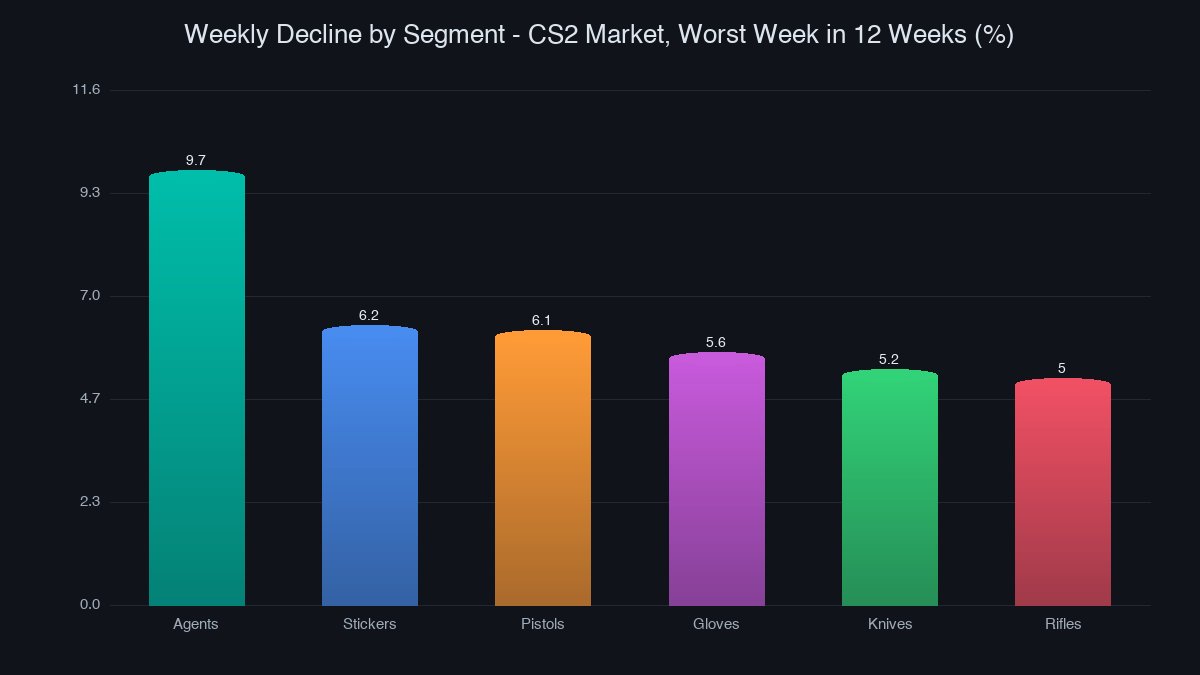
Look at the split by category, because the ordering tells you where the pain is. Agents lost the most at 9.7% in a single week, followed by stickers at 6.2%, pistols at 6.1% and gloves at 5.6%. Knives fell 5.2% - their eleventh consecutive weekly decline and a fresh yearly low - while still accounting for 27.4% of Steam trading volume by value. When the biggest-spending category is falling while holding the largest share of turnover, you are watching holders sell into weakness, not a rally.
Turnover confirms the mood. Steam trading value was around $15.5 million in the week covered, down 3.7% on the week before, and market breadth was 14% of liquid items rising against 77% falling out of roughly 3,200 tracked. A different tracker measuring the same window across 22,923 priceable variants found 7,066 had risen and 14,543 had fallen, for a median move of -1.7%. Nobody's honest data says the market went vertical this fortnight.
The weekly catalog reports agree on direction, too. One week-over-week measure of a tracked catalog of roughly $22 million showed a 0.89% decline, with knives climbing to 46.05% of total catalog value - not because knife prices rose, but because everything else fell faster.
How to Tell Signal From Noise
The fix is almost insultingly simple, and it costs you one glance: check the volume column before you check the percentage. A 400% move on zero trades is a listing. A 6% move on hundreds of sales is a market. Only one of those is tradeable in any practical sense, and any tracker that shows you a percentage without a volume figure is showing you half a sentence.
Three more filters do most of the remaining work. First, distrust any move above a few hundred percent on a single day - genuine liquid items do not move like that, which is precisely why the sites that publish clean data cap their leaderboards and exclude items with too few listings. Second, be sceptical of the categories that are structurally thin: souvenir skins, old foil autographs from 2015 to 2017, and slab products all have small buyer pools, so their quoted prices can be set by one person. Third, if a percentage move does not appear on a second marketplace in the same direction, it is not a price - it is one venue's listing book.
That last point is worth money on its own. On 4 October, across 5,167 skins listed on at least four marketplaces, the median gap between the cheapest and most expensive listing of the same skin was 16.4%, and Steam was a median 40.0% more expensive than the cheapest marketplace that pays out withdrawable cash. That spread is real, measurable and repeatable. A sticker's 31,448% is none of those things.
Where The Money Actually Went
If the leaderboards were noise, where was the two-way flow? It was in the boring places, and that is the useful signal. Knives and gloves - the categories with the deepest order books and the widest recognition - were conspicuously absent from the zero-volume anomaly lists. When the blue-chip segment does not show up in a list of fake spikes, it generally means real bids and real offers are still crossing there, even while prices drift down.
The same reports show the premium buyers keep paying is intact rather than collapsing. StatTrak variants carried a median premium of 21.24% over their normal counterparts across 3,125 matched pairs, up nearly a full percentage point on the previous week. Buyers were not refusing to pay up for quality - they were doing it on the items where both sides of the trade exist.
And there is one more number that reframes every "up 500%" claim you will read this month. Selling a skin through Steam costs you roughly 15% of the sale price, so any position needs about 18% just to get back to break-even in cash. A winner that rose 6% on 400 real sales does not clear that bar. A winner that rose 31,448% on no sales at all never even reached the starting line.
That is why the practical play in this market is unglamorous. Pick the specific item you want, check the wear tier and the current lowest listing, and buy that exact copy on a venue that publishes sales volume - the kind of listing where two copies of the same skin look different, because their floats are different. Our marketplace lists knives and gloves by float so you can do precisely that, and the Silent Form case remains a popular opening route if you would rather unbox than buy outright. Either way, check volume first. The percentages were never the price.