Why One CS2 Charm Sells for $97 and Another for 8 Cents
Why One CS2 Charm Sells for $97 and Another for 8 Cents
Twenty-two charms shipped in the same collection, on the same day, from the same store. The most expensive one now trades at $97.61. The cheapest sits at $0.08. That is a 1,200x spread inside a single cosmetic set — and it explains more about CS2's newest asset class than any price guide will.
On October 1, Valve pushed a 6.5 GB update that added four community maps, 45 new charms and 38 new stickers. No new case. No new weapon finishes. For a certain kind of trader, that was the most interesting patch of the year.
Two Charm Collections, Two Very Different Audiences
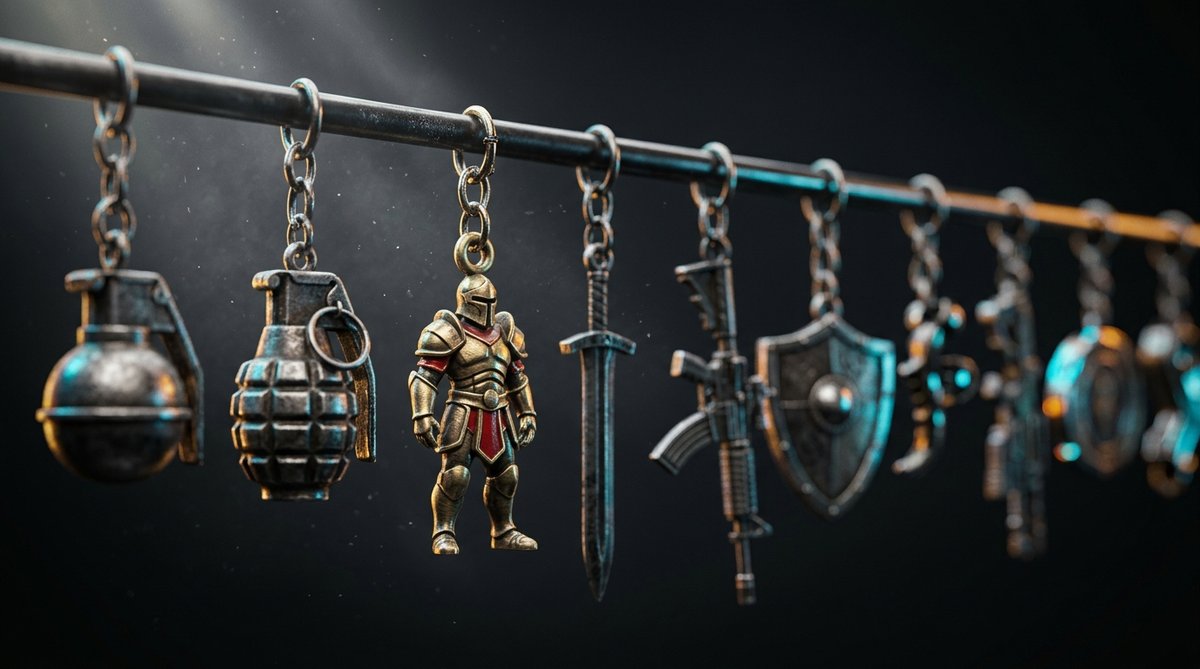
The October drop split its charms into two sets. Missing Link added 23 charms modelled on agent characters — small figures in costume, some of them direct nods to playable Terrorist models. Dr. Boom added 22 explosive-themed charms: grenade bodies, bomb tags, and a pumpkin variant timed three weeks before Halloween.
Both sets are Armory items, which means they are not case drops. You earn Armory Credits by playing with an active pass, then redeem them. Charms cost three to four credits each, and a pass runs about $16 for 40 credits.
What makes the collection worth studying is the internal spread. Across all 22 Dr. Boom charms, asking prices run from $0.07 to $154.53. That is not noise. That is the market pricing four distinct rarity tiers against each other in real time.
Round 1: The Price Ladder
Sort the Dr. Boom set by asking price and the tiers separate cleanly, with no middle ground.
- Butane Buddy — $97.61
- 8 Ball IGL — $26.57
- Lil' Ferno — $11.47
- Glitter Bomb — $11.26
- Flash Bomb — $2.07
- Lil' Bloody — $0.69
- Bomb Tag — $0.41
- Splatter Cat — $0.14
- Fluffy — $0.08
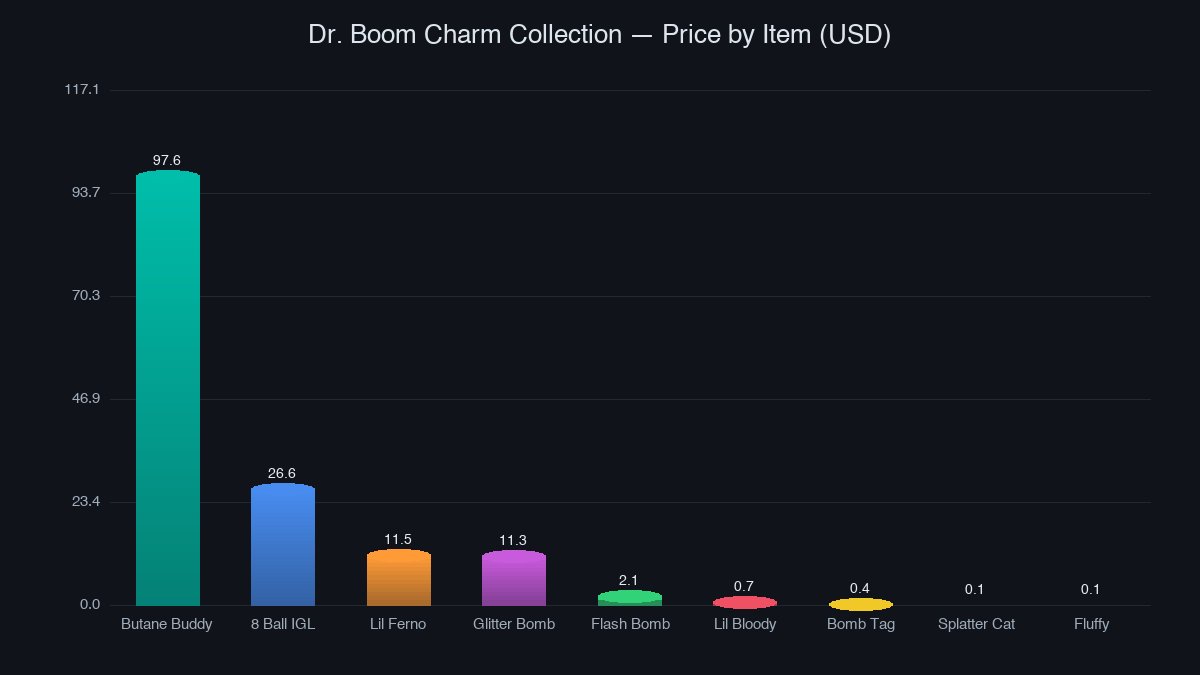
Notice the shape. Nine charms, and eight of them together account for less than a third of the collection's value. The top item alone is worth roughly four times everything below 8 Ball IGL combined. This is the same long-tail distribution you see in knives and gloves, compressed into a product that sells for the price of a coffee.
The bottleneck is not supply. Armory charms are redeemable by anyone holding a pass, so the floor stays glued near zero and refills constantly. The ceiling is purely demand-side: Butane Buddy and 8 Ball IGL are the two designs the community decided were worth wearing on a $2,000 knife.
Round 2: What $97 Actually Buys You
Here is the uncomfortable part. A charm is one item per weapon. You cannot stack three on an AK-47 to build a themed loadout. Valve's own notes are explicit: "A weapon can have one charm attached at a time."
That single attachment slot is the whole reason the ceiling exists. If charms stacked, cheap designs would sell on volume and expensive ones would be irrelevant. Because there is exactly one visible slot on your primary rifle, the charm becomes a status marker — the same psychology that drives $400 sticker crafts onto $30 guns.
Compare it against the item it hangs on. A ★ Kukri Knife starts around $101.27 on SkinVS. A ★ Sport Gloves | Vice (Field-Tested) sits at $470.72. So the flagship charm costs roughly the same as the cheapest knife on the market, while delivering a fraction of the visual change.
That ratio is backwards for any rational buyer, which is exactly why charm pricing does not behave like weapon pricing. It is not about pixels. It is about rarity signalling on an object every other player sees when you get a kill.
Round 3: The Detachment Tax
Charms are not consumable, but they are not free to move either. Detaching one requires a Charm Detachment. Redeeming a charm from the Armory hands you three free ones; beyond that you buy them, and a pack lists at $0.80.
Then came the change nobody asked for. With the October 8 patch, detachment packs started appearing as an option in weekly drops. Because the weekly drop rolls a single item slot, a detachment pack now competes directly with the chance of an actual skin. Valve did not mention it in the patch notes — players found it in the drop table and, predictably, were not pleased.
Read that as an economic signal rather than a complaint. Valve is deliberately capping how freely charms circulate. Every extra detachment cost is friction on resale, and friction on resale is what stops an $0.08 charm from being relisted forty times a day by the same account.
Where the Spread Really Comes From
Three forces are stacking on top of each other.
First, the seven-day lock. Every item acquired from the in-game store, the Armory, trade offers or the Steam Community Market now carries a 7-day re-trade and re-market restriction. When the first Dr. Boom charms reached the market, nobody could flip them for a week. Prices gapped before supply could respond, and the gap never closed.
Second, capsule doubling. The sticker capsules tied to the same update doubled in price on the Steam Market almost immediately after launch. Traders who missed the initial window bought in at 2x, which dragged the whole cosmetic basket up with it.
Third, Halloween timing. Dr. Boom is a grenade-themed collection with pumpkin variants, shipped three weeks out from Halloween. Seasonal demand on a limited-run cosmetic is the most reliable price pump in CS2 — and the cheapest charms in the set were never going to benefit, because nobody is paying a seasonal premium for a spooky $0.08 cat.
The Sticker Sibling Nobody Is Watching
The same update added 38 stickers in two packs: Community Stickers 2025 with 29 designs, and Sugarface 2 with nine variants. On paper that is a bigger drop than the charms. In practice the two categories are diverging fast.
Stickers have a floor problem charms do not. A sticker can be applied once and destroyed in value by scraping, so the used market is permanently degraded by consumption. Charms survive detachment. That single design difference means charms retain a resale pathway that applied stickers simply do not have, and it is why capital has been rotating into charms while sticker packs sit closer to their redemption cost.
The doubling on capsules looks less like conviction and more like a short squeeze on a thin float. Worth noting before you treat it as a trend.
How the Two Halves of the Market Behave
The set has two completely separate economies running in parallel, and confusing them is how people lose money.
The floor economy — Fluffy, Splatter Cat, Bomb Tag — behaves like filler. Supply is effectively unlimited because anyone with a pass can redeem one, so these trade as bulk. They will never recover, and they do not need to: they exist so the collection has a cheap entry point for players who just want something dangling off their rifle.
The ceiling economy — Butane Buddy, 8 Ball IGL — behaves like a premium skin. Supply is bounded by how many players spent credits on that specific design before it became fashionable, and demand is concentrated among owners of expensive loadouts. A $97.61 ask on a charm only makes sense if the buyer already owns a knife worth twenty times that.
There are now 571 charms indexed across the market, spread over rarity tiers including High Grade, Remarkable, Exotic and Extraordinary. A category that did not exist two years ago has more internal structure than most weapon collections.
What This Means If You Are Buying
Two practical rules fall out of the data.
If you want a charm to actually use, buy at the floor and ignore the ceiling. The cheapest Dr. Boom designs cost less than the detachment pack you would need to move them, so treat them as permanent attachments and stop thinking about resale. You get nearly all of the visual effect for about 1% of the price.
If you are buying for value, the window that matters is the first week after a collection launches — and it is the exact week you cannot trade. The 7-day lock means repricing happens before anyone can act on it. By the time listings opened, Butane Buddy had already separated from the pack, and there was no cheap entry left.
The honest read is that charms are the most speculative corner of CS2 cosmetics right now. A 1,200x spread inside one collection is not a stable market. It is a market still working out what it is, and it is being repriced every Tuesday by a drop table.
If you would rather hold something with a floor under it, the Missing Link case runs the same collection mechanic with a knife at the top of the table instead of an $0.08 cat. And if you want to skip the gamble entirely, the SkinVS marketplace lists live prices on charms and weapons side by side, which is the fastest way to see where any given design actually sits before you commit.