Crafting a Knife in CS2 Costs $120. Buying One Costs $37.
Crafting a Knife in CS2 Costs $120. Buying One Costs $37.
There is a number in the CS2 knife market that does not make sense until you write it down next to the other number.
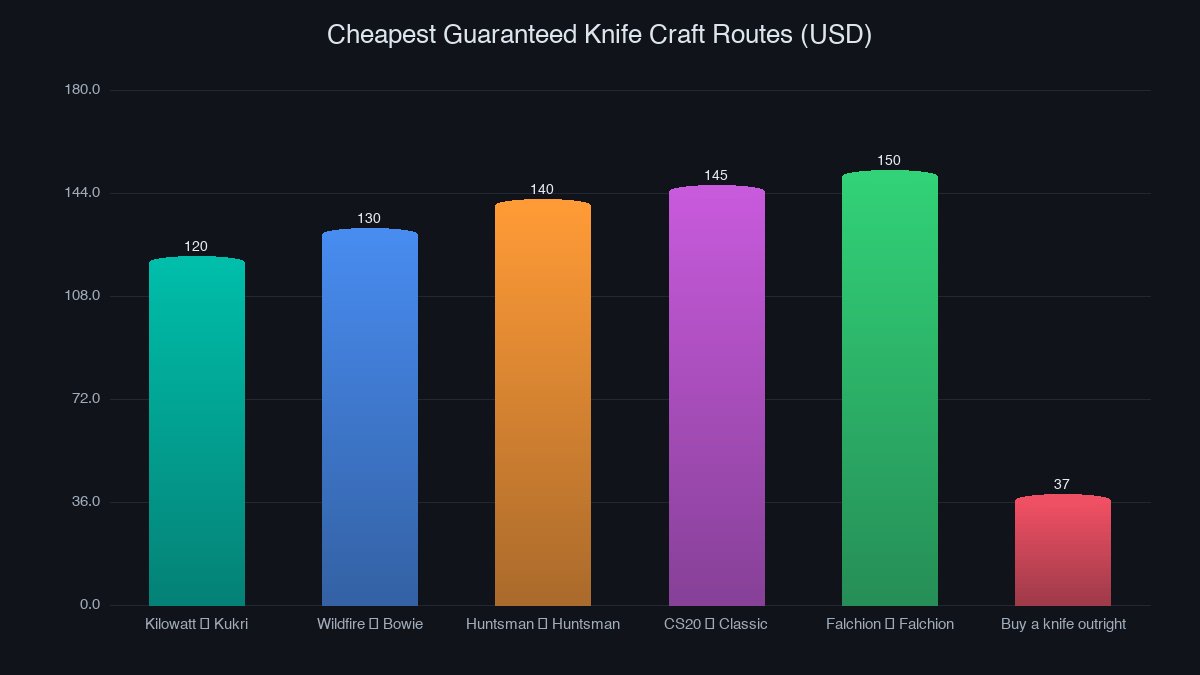
The cheapest guaranteed knife trade-up in 2026 costs about $120 in inputs. The cheapest knife you can simply buy costs about $37. Same game, same item class, three times the price to gamble on a random finish instead of buying one you can see.
That gap is the clearest window into what the October 2025 trade-up update actually did to this economy. Let's do the maths properly.
The Two Numbers That Explain 2026
On 22 October 2025, Valve extended Trade Up Contracts so that five Covert (red) skins could produce one knife or a pair of gloves, drawn from the gold pool of the collections you fed in. Five StatTrak Coverts return a StatTrak knife, and you cannot mix the two.
The market responded inside 24 hours. Tracked knife and glove prices dropped 40–65%, with some items losing 70% or more in the first selloff. Skin market trackers put the value destroyed at over $1.75 billion, and total market cap estimates fell from roughly $6 billion to around $4.27 billion — the largest single-event repricing in the game's history.
What almost nobody priced in was the second-order effect: the red skins suddenly had a job. Five of them are no longer ugly Mil-Spec filler; they are a ticket to a gold item. Cheapest Covert floors that used to sit near $10 now hold around $30, because a contract does not care whether the skin looks good, only which collection it came from.
How Five Red Skins Turn Into a Knife
The mechanic is short. You cannot pick the model, the finish, the wear or the pattern seed. You can only pick the collections.
Each of the five inputs gives its collection a 1-in-5 share of deciding the output pool, so five Coverts from one case lock the result to that case's knife pool. That's why "cheapest trade-up" is really a question about which single-collection route has the cheapest fuel, and the answer changes week to week.
As of the 2026 catalog data, those routes look like this:
- Kilowatt Case — AWP | Chrome Cannon (Battle-Scarred) at roughly $24 each, so about $120 total for a guaranteed Kukri Knife. This is the current budget king.
- Operation Wildfire — M4A4 | The Battlestar (Field-Tested) around $27, so about $130 for a Bowie Knife.
- Huntsman Case — M4A4 | Desert-Strike (Field-Tested) around $28, about $140 for a Huntsman Knife.
- CS20 Case — FAMAS | Commemoration (Field-Tested) around $29, about $145 for a Classic Knife.
- Falchion Case — AWP | Hyper Beast (Battle-Scarred) around $30, about $150 for a Falchion Knife.
Every one of those routes gets you a real, full-size knife for less than the price of a single mid-tier Karambit. That's the genuine win from the update, and it's why knife ownership is no longer a rich-player hobby.
Where the Cheap Routes Actually Sit
Here is where the arithmetic turns. The cheapest knives on the market sit in the mid-$30s to $50 band — a Shadow Daggers | Bright Water in Field-Tested runs about $37, and worn Navaja Knife finishes (Rust Coat, Safari Mesh) sit in the same range. Entry-level Safari Mesh, Boreal Forest, Scorched and Forest DDPAT blades that used to cost $100–$130 before the crash now trade around $40–$65.
So a player who wants "a knife" has a $37 door and a $120 door, and the $120 door is the one that gives them a random finish, random wear and random seed.
What do you actually get for the extra $83? A guaranteed model — you know you're pulling a Kukri or a Bowie — and a shot at a finish that would be expensive to buy. What you don't get is any control over which finish you land on, and the floor outcomes are exactly the finishes nobody wants to buy.
Valve's own trade-up maths has always been unsentimental about this. On a Breakout contract, the cheapest Coverts sat around $169 each, so inputs ran roughly $830–$850, while the floor outcome — a Battle-Scarred Butterfly Knife in Forest DDPAT — was worth about $422. The jackpot, a Factory New Fade, sat at $2,334. You need well above median luck just to clear cost.
The Float Tax Nobody Prices In
The detail that turns a "close enough" trade-up into a loss is float averaging, and it catches players who never think about it.
A contract doesn't pass your input floats through — it averages them and then re-maps that average onto the output's own float range. A P250 | Supernova has a range of 0.00–0.40, so a Factory New copy at 0.05 float normalises to 0.125, not 0.05. Feed ten of those in and any output with a full range lands at 0.125, which is Minimal Wear even though every input was Factory New.
The same trap scales up. In the July 2026 snapshot, a souvenir M4A1-S | Knight asked about $2,600, so ten of them — a 100% guaranteed AWP | Dragon Lore — ran roughly $26,000. But Knight's range is 0.00–0.10, so a typical Factory New Knight at 0.04 float normalises to 0.40, producing a Dragon Lore at 0.28 float. That's Field-Tested, worth about $6,193, not the five-figure Factory New number the buyer had in their head.
This is the part of knife crafting that separates the players who come out ahead from the ones who write angry forum posts. If you want Factory New output, you don't just need low-float inputs — you need inputs whose float is low relative to the top of their own range, priced accordingly.
What Surprised Us
Two things, both visible in the weekly data rather than the headlines.
First, the average knife didn't keep falling forever. Once the crafting wave was absorbed, the floor stabilised: recent weekly reports tracking 219–220 curated skins show a median move of 0.0% across the board, with knives posting a median of zero across 61 tracked items and more fallers than risers but no broad collapse. The crash was an event, not a trend.
Second, the market split into two tiers and stayed split. Anything the trade-up system can narrow toward — common Doppler phases, Tiger Tooth, Marble Fade — sits under permanent supply pressure and keeps trading lower. Anything the system cannot target — a specific Case Hardened seed, a full-fade gradient, an Emerald phase — has held its value or climbed, and the supply of those only shrinks as items get trade-locked into collections. Buyers who understand that distinction are shopping in two different markets that happen to share a knife-shaped label.
The Smart Play This Month
If your goal is owning a knife, buy the knife. The $37 blade and the $120 contract end in the same loadout slot, and one of them involves no randomness at all. Crafting is a reasonable hobby and a bad savings plan — and that's Valve's design, not a mistake.
If your goal is a specific knife, the only honest routes are patience on the market or paying for it outright. The contract cannot target a pattern seed, a gem percentage or a fade gradient, which is precisely why those items held their value while everything around them reset.
And if you're just here for the boxes: it's worth remembering that a gold item from a case is a 0.26% chance, roughly 1 in 385 openings, at about $3 per case-and-key. The expected cost of unboxing your way to a knife is over $1,000. The trade-up contract cut that down by eight times and still costs three times more than simply buying the thing you wanted. If you want to see the pools for yourself before deciding, the Fan Favorite case is a decent place to start checking what's actually inside, and the marketplace will show you what those items go for once they're out.
Five years ago, "just buy the knife" was a punchline for people who couldn't afford one. In 2026 it's the arbitrage. That's how fast one patch notes line rewrote this economy.
Prices and route costs are drawn from 2026 catalog and market snapshot data (Skin.land knife route table, SteamDB trade-up snapshot, InvenGlobal knife economy report, CS2DECK and Key-Drop weekly market reports) and move daily — check live listings before spending.