584 Knife Finishes, 20 Models, One 53x Price Gap
584 Knife Finishes, 20 Models, One 53x Price Gap
Here is a number that sounds like it should matter more than it does: Counter-Strike 2 contains 2,062 weapon finishes. Of those, 584 are knives — more knife entries than the entire rifle category, which holds 471.
That count gets passed around as if it explains the market. It doesn't. A catalogue tells you what exists. It tells you nothing about what anything costs, and in the knife market the gap between those two things is where all the money lives. So I pulled the catalogue numbers and then put them next to live listings, and the two halves of the picture disagree in an interesting way.
The Count Nobody Argues With
The breakdown, from CSDB — an independent database with no connection to Valve — reads like this across the whole game: rifles 471, pistols 425, submachine guns 293, heavy weapons 210, gloves 72, knives 584, and seven items that sit outside the usual categories. Rarity runs across seven grades: Consumer and Industrial at the bottom, then Mil-Spec, Restricted, Classified and Covert, with Contraband above everything.
Knife structure is unusually tidy. There are 20 models, and finish breadth comes in exactly three tiers with no exceptions — 24 finishes, 18 finishes, or 12 finishes, plus a no-finish "vanilla" version of every model. Case availability is the opposite of tidy: five models appear in sixteen cases each, while one model appears in a single case. The Karambit and M9 Bayonet sit in 16 cases, first supplied by the original CS:GO Weapon Case in 2013 and last topped up by Gamma 2 in 2016. The Butterfly Knife appears in just five cases, from Operation Breakout in 2014 to Dreams & Nightmares in 2021.
One honesty note before anyone quotes the 2,062 figure as gospel: a second independent database, cs2.gs, counts 2,128 finishes — 1,478 on weapons, 556 on knives, 94 on gloves. Different snapshot dates and different definitions of what counts as a distinct finish. The structural facts survive the discrepancy; the exact totals don't. Treat catalogue counts as approximate and price data as the thing you can actually check.
The Ladder: What Live Listings Show
Now the part with consequences. Every one of those 584 knife entries sits in the same gold rarity tier. Here is what that tier actually costs on SkinVS right now, cheapest to dearest, all Factory New or Battle-Scarred where noted:
- Shadow Daggers | Rust Coat (Battle-Scarred) — $47.59
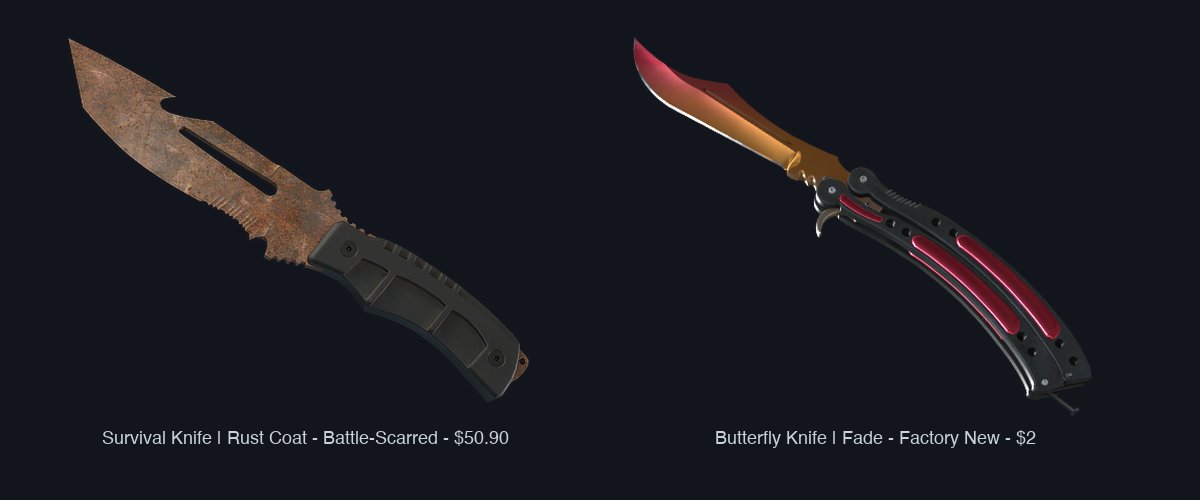
- Survival Knife | Rust Coat (Battle-Scarred) — $50.90
- Survival Knife | Forest DDPAT (Field-Tested) — $55.05
- Kukri Knife | Night Stripe (Field-Tested) — $56.37
- Paracord Knife | Ultraviolet (Battle-Scarred) — $74.39
- Kukri Knife (vanilla, no finish) — $99.08
- Kukri Knife | Fade (Factory New) — $194.53
- Butterfly Knife | Fade (Factory New) — $2,555.43
Same tier. Same rarity colour in the UI. A 53.7x spread from bottom to top, and a median of $74.39 across that sample — meaning that even in the top rarity band, more than half the ladder lives under a hundred dollars.
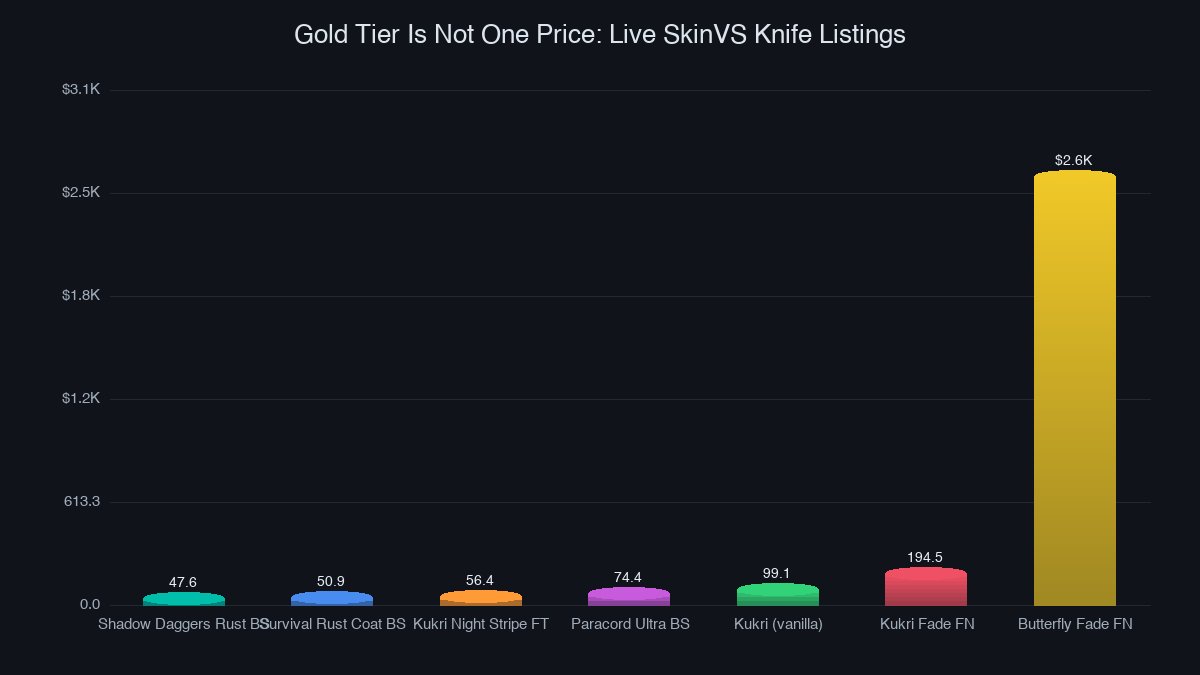
The most useful comparison isn't the extremes, it's the middle. A vanilla Kukri with no finish at all asks $99.08. The same knife in Fade, Factory New, asks $194.53 — almost exactly double. So on one model you can buy the entire finish premium for about $95. On the Butterfly, the spread between a plain entry and Fade Factory New is 13.1x the price of the Kukri's best finish. Model choice, not finish count, is what decides which ladder rung you land on.
Why the Floor Sits Where It Sits
Two years ago, a knife under fifty dollars was a rounding error you bought to fill an inventory slot. The floor existed because supply was gated by a 0.26% chance — roughly 1 in 385 case openings — and nothing else. Scarcity was the whole price.
That gate is gone. Since the October 2025 trade-up change, five Covert skins from the same collection convert into one knife or one pair of gloves. That puts a soft ceiling on any ordinary knife: when a knife costs much more than the five reds needed to craft one, people craft, supply rises, and the gap closes. The contract hands you a random result from the collection's pool, though — not the exact model, finish, float or pattern you wanted. So the floor gets pulled down to roughly the cost of five reds, while anything a trade-up can't aim at holds its premium.
You can see that logic in the live ladder. Rust Coat, Forest DDPAT, Night Stripe, Ultraviolet, Safari Mesh — the finishes nobody picks on purpose — cluster at the bottom, because a random trade-up result lands there constantly. Fade, Doppler and Case Hardened don't, because a trade-up can't target them. The catalogue treats all 584 entries as equal gold. The market treats roughly a dozen as real gold and the rest as gold-coloured filler.
Supply depth reinforces it. The full SkinVS knife inventory runs 3,964 listings against 470 glove listings and 3,940 rifle listings — 8.4 knives for every pair of gloves. Knives are the most listed category on the platform, and the most listed category is where price compression happens first.
The rarity counts tell the same story from another angle. Covert items — the red tier that feeds every knife trade-up — number 4,923 listings. Restricted sits at 2,608, Classified at 1,562, and the cheap end is thinner than people assume: 1,460 Consumer and 1,381 Industrial listings. The feedstock for crafting is the single deepest pool on the platform, which is exactly why the crafted output can't hold a premium.
Gloves are the counter-example worth watching. With 470 listings against nearly four thousand knives, the glove market has a fraction of the supply depth, and its floor has behaved differently since the trade-up change. If knife prices keep compressing toward the cost of five reds, the relative scarcity of gloves becomes the more interesting number on the board.
What the Numbers Imply
Three conclusions worth holding onto.
First, catalogue depth is not value. Adding finishes doesn't lift a tier; a model that can be crafted cheaply stays cheap no matter how many patterns you print on it. If you're evaluating a knife as a store of value, count the cases carrying it and the finishes that trade-ups can't reach — not the finish count.
Second, the bottom of the gold tier is now a commodity and should be priced like one. Forty-eight dollars for a knife is not a crash signal; it's the new floor doing its job. Expect it to track the cost of five Coverts rather than any sentiment about knives as a category. The relevant comparison for a $47 knife is not a $2,555 Butterfly, it's five reds from the same collection.
Third, the interesting spread has moved up, not down. With the floor anchored, the gap between a mid-tier knife and a genuinely scarce one keeps widening — the same split the market has been living with since the trade-up update repriced everything within a week. Covert skins became raw material; ordinary knives became commodity; low floats, rare patterns and top finishes kept their premium.
If you want to test any of this rather than take my word for it, the ladder above is a snapshot that moves. The Frost Vault pool is a decent place to watch it happen: check what its gold-tier items are listed at today against the same items next week, and you'll see the floor and the ceiling behaving very differently. That gap — not the 584 in the catalogue — is the number that decides whether a case is worth opening.