Case, Trade-Up or Direct Buy: The Real Cost of a CS2 Knife in Three Routes
Case, Trade-Up or Direct Buy: The Real Cost of a CS2 Knife in Three Routes
There are exactly three ways to end up holding a CS2 knife, and they cost wildly different amounts of money for the same object. One of them is a 0.26% dice roll, one is a contract with a fixed input cost and a random output, and one is a shopping trip.
The interesting part is not which is cheapest in theory. It is how far apart they are once you put real October 2026 prices on each route — because the gap between a case-farmed knife and a bought knife has grown to roughly ten times.
Round 1: The Case Route
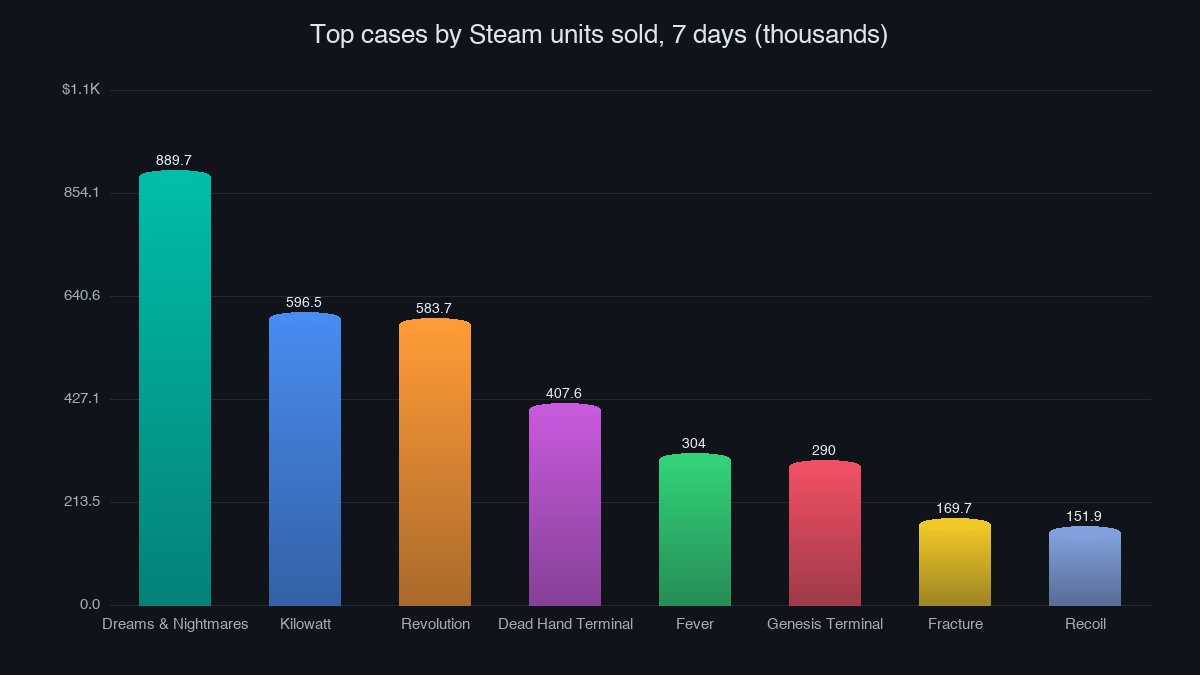
Start with what people actually do. The Dreams & Nightmares Case moved 889,700 units on the Steam Community Market in one week at an average of $1.43, for roughly $1.28 million in turnover — the highest-turnover case in the game by a wide margin. Kilowatt sold 596,500 copies at $0.13, Revolution 583,700 at $0.21, and the Sealed Dead Hand Terminal 407,600 at $0.36.
Volume like that is not a signal about returns. It is a signal about price of entry: people open cases because a case costs pennies and a key costs $2.49.
The opening counters agree with the sales counters. Tracking that estimates unboxing activity puts the Dreams & Nightmares Case at roughly 170,000 openings a day and about 1.1 million over a seven-day window, an 18.5% share of every tracked opening in the last three months. One case in five opened in CS2 is this one, and it has held that position while knife prices slid all year. Demand for the chance did not fall when demand for the prize did.
Now the math. On the Dreams & Nightmares Case, one opening costs $3.32 — $0.83 for the case plus the key. Third-party ROI models put the expected return per opening at about $1.35. That is 41 cents back per dollar spent, before selling fees, and one tracking site ranks the case 33rd out of 42 on unboxing ROI while it sits first out of 44 on Steam sales volume.
The rare slot is the reason anyone tolerates that. Valve publishes the special-item rate at 0.26% — about one drop per 385 openings. At $3.32 an opening, the average path to a single knife costs roughly $1,278.20. To be fair to the case, that knife can be worth more than $1,278; that is what the variance is buying. But the mean cost of the ticket is not close to the mean price of the prize.
Cheap cases do not fix this. A $0.13 Kilowatt case plus a $2.49 key is still $2.62 to fire at a 0.26% slot. The key price is the floor, and keys cannot be bought on the market or traded — everyone pays the same $2.49.
Round 2: The Trade-Up Route
The contract route has a much better headline number and a much worse fine print. Five regular Covert skins go in, one regular knife or one pair of gloves comes out. Five StatTrak Covert skins go in, one StatTrak knife comes out. There is no StatTrak glove outcome.
Price it out. An AK-47 | Inheritance in Field-Tested trades near $42.56, so five of them is about $212.80. That is roughly one-sixth of the case route's average cost, and four-fifths cheaper than the cheapest premium knife on the board. On paper, this is the bargain.
Then the fine print arrives, in two parts.
The pool is decided by your inputs. The output comes from a collection represented among the five skins you submitted. Feed in an AK-47 | Bloodsport and you are drawing from the Spectrum Case pool — Butterfly, Bowie, Falchion, Huntsman, Shadow Daggers finishes. Feed in Coverts from a collection with no case attached, and there is no knife pool at all. "Five reds for a knife" is an incomplete sentence; the fifth word is "from these collections".
The output is random within that pool. You cannot aim at a finish, and you cannot aim at a float. The 2026 float behaviour normalises each input inside its own allowed range, averages those normalised positions, then maps the average into the output's range. A normalised average of 0.08 against an output range of 0.00–0.70 lands at 0.056 and reads Factory New; nudge it to 0.12 and the same recipe returns 0.084 and reads Minimal Wear, because 0.07 is the boundary. Two skins that cost you the same can hand back items a wear tier apart.
That is the trade-up's real shape: you are buying a lottery ticket with a predictable price and an unpredictable prize, exactly like a case — just with a 0.26% slot replaced by a pool you chose.
Round 3: The Direct Buy
The third route has no variance at all. A Butterfly Knife | Freehand in Well-Worn is $493 on the cheapest venue, against $950 on Steam — a 93% spread on the identical item, which is the entire argument for checking third-party markets before touching the Community Market.
What you get for that $493 is certainty, plus liquidity data most traders never look at. That knife has a tracked supply of 926 copies, of which 71 — about 7.7% — are listed for sale, and 18 sold in a recent seven-day window. It is a real market with real depth, not a listing that sits for months.
At the bottom end, a bare Navaja can be had from about $36. At the top, a Butterfly Knife | Fade in Factory New is quoted near $1,801. Every one of those prices is a price you know before you spend, which is not a small thing when the alternative is a distribution.
One caveat that applies to all three routes: where the money sits afterwards matters as much as the price. Steam wallet funds cannot be withdrawn as cash, and the Community Market's 15% cut is why the same knife lists at $950 there and $493 elsewhere. A cheap third-party price is only genuinely cheaper if the venue pays out in something you can actually use.
The Verdict
Rank the three routes by what they cost to reach a specific knife and the answer is not close. Direct buy: the sticker price. Trade-up: about $212.80 for a random draw from a pool you chose, with a real chance the draw is worth less than the inputs. Case: about $1,278 on average to hit one rare slot, with a return of roughly 41% on every opening along the way.
But cost is only half of it, and this is where most comparisons stop too early. A case and a trade-up are not purchases — they are activities you are paying to participate in, and both are priced accordingly. If what you want is the knife, buying it is cheaper on every number in this piece. If what you want is the hour of opening cases with friends, the case route is the cheapest way to buy that hour, and you should treat the 41% return as the price of the ticket rather than a temporary setback.
There is one honest case for the trade-up route, and it is narrow: when the five Covert inputs cost meaningfully less than the cheapest knife in the pool you would actually be happy to receive, the contract is a discount rather than a gamble. Run that comparison before you sign, not after. Inputs at $212.80 against a pool whose floor is $36 is not a discount — it is a bad bet dressed as a smart one.
Whichever route you pick, start with the price of the finish you want rather than the price of the entry. Cases like Fan Favorite are built around pools people genuinely chase, and the SkinVS marketplace shows the live ask on the exact wear you are after — so you can see the $1,278 case route and the $493 purchase side by side instead of guessing.
The knife market spent a year teaching the same lesson in a different language: the price of the object and the price of the chance to own it were never the same number, and the second one is always higher than it looks.