Valve's AUG Reload Buff Is Half a Second — and Quietly More Important Than It Looks
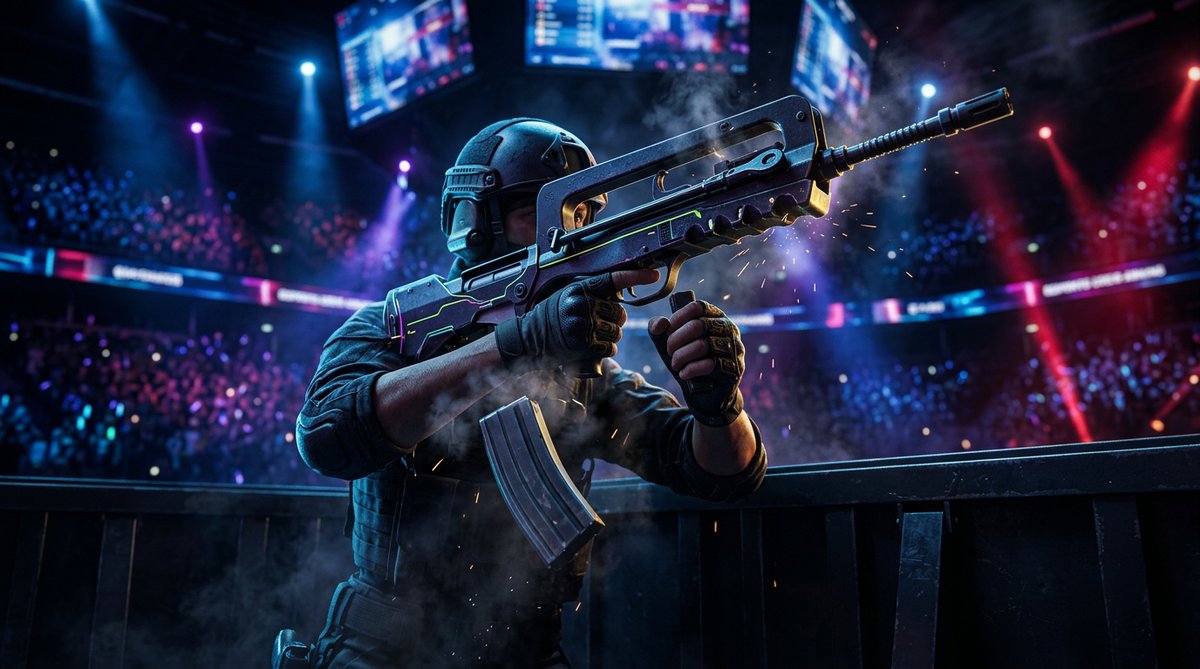
Valve's AUG Reload Buff Is Half a Second — and Quietly More Important Than It Looks
On October 8, 2026, Valve published a Counter-Strike 2 update with seven lines of patch notes. Exactly one of them changes how a gun feels: “Reduced the time for AUG reload by half second.” That is 500 milliseconds. It is also the only line in the entire build that a competitive player will genuinely feel the next time they anchor a site with a scoped rifle.
Everything else in the patch is housekeeping — and that contrast is the whole story.
The One Line That Actually Matters
The AUG is the Counter-Terrorist side's scoped rifle: cheaper than the AWP, faster to reposition, and built for holding angles. Its weakness has always been the reload window. While you are swapping magazines, you are a stationary target with a rifle that fires nothing.
Half a second off that window is not a stat tweak you can feel in a spreadsheet. It is the difference between getting your scope back up before an enemy clears the corner and getting traded instead. In a round that typically runs 115 seconds buy-to-defuse, shaving 500 milliseconds off your single most vulnerable moment compounds every time you survive an engagement and need a fresh magazine.
The change also stacks on a mechanic Valve reworked back in March 2026, when it redesigned reloading so that players drop the used magazine, discard whatever ammo was left inside it, and pull a full magazine from reserves. That system raised the cost of reloading badly. A shorter AUG reload partly refunds that cost — but only for the AUG.
Why a Quarter of a Second Is Real Money in CS2
Counter-Strike has a long history of tiny timing numbers reshaping the meta. A weapon's draw animation, a defuse kit's reach, a jump-throw window — these are the levers Valve pulls when it wants to shift which side wins retakes on Inferno and Anubis without touching damage values.
The AUG sits in an awkward economic slot. At $3,300 it is a serious commitment for a CT economy and an obvious buy after a lost round with money in the bank. If the rifle becomes meaningfully better at holding long angles, it steals buy-round share from the M4 and the AWP. If players start buying it more often, demand for AUG skins follows the same gravity — and that is where the skin market is watching.
Here is the uncomfortable part for anyone long on AUG skins. According to CS2 price tracking, the AUG | Sand Storm finished a recent seven-day window down 41.2%, landing at roughly $16.58 across 23 marketplaces. Valve can buff the gun every patch; it cannot force the whole skin market back up on its own. A weapon buff moves popularity, not necessarily price.
It helps to separate the two things a patch like this touches. The first is performance — how the rifle feels in a real round, which professionals adapt to within days. The second is perception — whether casual players read “AUG buff” and decide the weapon is now good, which is what actually moves a skin's order book. Performance changes fast and quietly; perception changes slowly and loudly. Valve can guarantee the first and has no control over the second.
The AUG's history backs that up. It has been nerfed, rebuffed, and price-adjusted across multiple CS2 seasons without its signature skins ever becoming a reliable store of value. A half-second reload is a nudge to players, not a signal to investors — and treating it as the latter is how people get burned.
The Bull Case and the Bear Case
The bull case: Valve rarely publishes a balance line unless it has telemetry showing the weapon underperforming. A half-second reload cut is a targeted nudge, not a random edit. If the AUG's pick rate rises on the CT side, its most-watched skins gain a reason to be discussed, traded, and opened — and attention is the raw material of this market.
The bear case: pros will tell you reload timing rarely decides rounds at the top level, where players simply avoid reloading in the open. There is no broadcast data in the patch notes, no stated win-rate target, and no skin economy change. A single MISC line is exactly the kind of change that gets forgotten by the next update — and Valve has been shipping a lot of updates lately.
My take: this is a real but narrow buff. It rewards players who already understand the AUG's role and does nothing for anyone who treats it as a worse AWP. Treat any price reaction as sentiment, not substance.
There is one more layer worth considering: the CT economy. When a save round becomes a comfortable AUG round, the whole buy structure shifts, and shifted buy structures change which skins appear most often in a match. That is a second-order effect, and second-order effects are where smart traders look before the crowd does — but only when they are patient enough to wait for the pick-rate data that will not exist for weeks.
The Rest of the Patch Nobody Will Talk About
The other six lines are fixes, and two of them are genuinely useful:
- Added a ping icon for dropped defuse kits. A small communication win for solo-queue players who were losing bomb sites to silent kit swaps.
- Fixed the sound event during silent reload for the Desert Eagle. Silent reloads arrived in the September 22 Rush Hour update — hold the reload key and swap quietly but slowly. The Deagle's sound cue was leaking, which quietly defeated the feature.
- Fixed a case of buzzing soundscape sounds during demo playback — welcome for anyone reviewing matches.
- Clipping fixes for Rush maps, the queued 3v3 mode Valve added in September.
- Localization and stability updates.
The cadence is worth noting. This is one of seven “Counter-Strike 2 Update” posts in eleven days, starting with the September 22 Rush Hour drop that added silent reloads, the 3v3 Rush mode, and a rebuilt Premier map-selection process. Valve is in a polishing phase — fixing the edges of a big feature shipment rather than launching new headline content.
What This Means If You Play — and If You Collect
For players: re-learn your AUG reload timing. The window is shorter, and good CT anchors should be buying the rifle a little more often on save-adjacent rounds. Combine it with a dropped defuse kit ping and a clean silent reload, and the CT side just got marginally more comfortable.
For collectors and traders: do not confuse a mechanical buff with a price guarantee. The strongest signal in this patch is not the reload change at all — it is that Valve is still shipping small, frequent fixes. Small updates do not move markets. They move meta, and meta only becomes money when a weapon's pick rate follows it for months.
If you want to act on the moment instead of guessing at it, the fastest way to test demand is to watch what people are opening. The Silent Form sits closest to this patch's theme — quiet reloads, silent angles — and it is a simple way to see whether AUG-era hype turns into real volume or fades before the next update.
Half a second will not make headlines. But in a game with 115-second rounds, half a second is exactly the kind of number Valve has used to change the meta before.