I Watched My $4,000 CS2 Inventory Lose $900 in One Week — Here's What the Market Data Actually Says

I Watched My $4,000 CS2 Inventory Lose $900 in One Week — Here's What the Market Data Actually Says
On a Tuesday morning in late November 2025, I opened my Steam inventory and saw a number I wasn't prepared for. My collection — an M9 Bayonet Tiger Tooth, a pair of Specialist Gloves Crimson Kimono, and a carefully curated set of Covert rifles — had dropped from $4,050 to $3,160 in five days. Valve had shipped a routine update adjusting drop rates, and the mid-tier market panicked. I didn't sell. I started digging into the data instead. Here's what the numbers actually reveal about the CS2 skin market in 2026 — beyond the $5.5 billion headline.
The Morning I Checked My Inventory
The first instinct when your inventory drops 22% in a week is to sell everything before it gets worse. I've been there. You refresh the Steam Market page, watching your items tick down $50 at a time. The Reddit threads are full of doom-posting. YouTube thumbnails scream "CS2 MARKET CRASH 2025" in all caps.
But here's what I found when I actually looked at the data instead of the panic: the crash was almost entirely concentrated in one segment. My knife and gloves — the true premium items — had barely moved. The M9 Bayonet was down 3.7%. The gloves were down 4.1%. The Covert rifles? Down 18-24%. The inventory "crash" wasn't a crash at all — it was a rebalancing that hit the mid-tier hardest, and my portfolio happened to be overweight in exactly that tier.
The Real Numbers Behind the Panic
When the market hit an all-time high of $5.5 billion in September 2025, the celebration was loud. Everyone from finance YouTubers to esports journalists ran stories about "digital gold." What they didn't mention: that number is total listed value across 28,817 unique items, not actual liquidity. If everyone tried to sell, the crash wouldn't be $2 billion — it would be closer to $5 billion.
The real liquid market — items that change hands monthly — sits at approximately $800-900 million. That's still enormous for a video game economy, but it's a very different story than "$5.5 billion." It's like the difference between your house's Zillow estimate and what someone would actually wire you tomorrow. In CS2 skins, that gap is a chasm.
Why the Top 5% Controls 80% of the Market
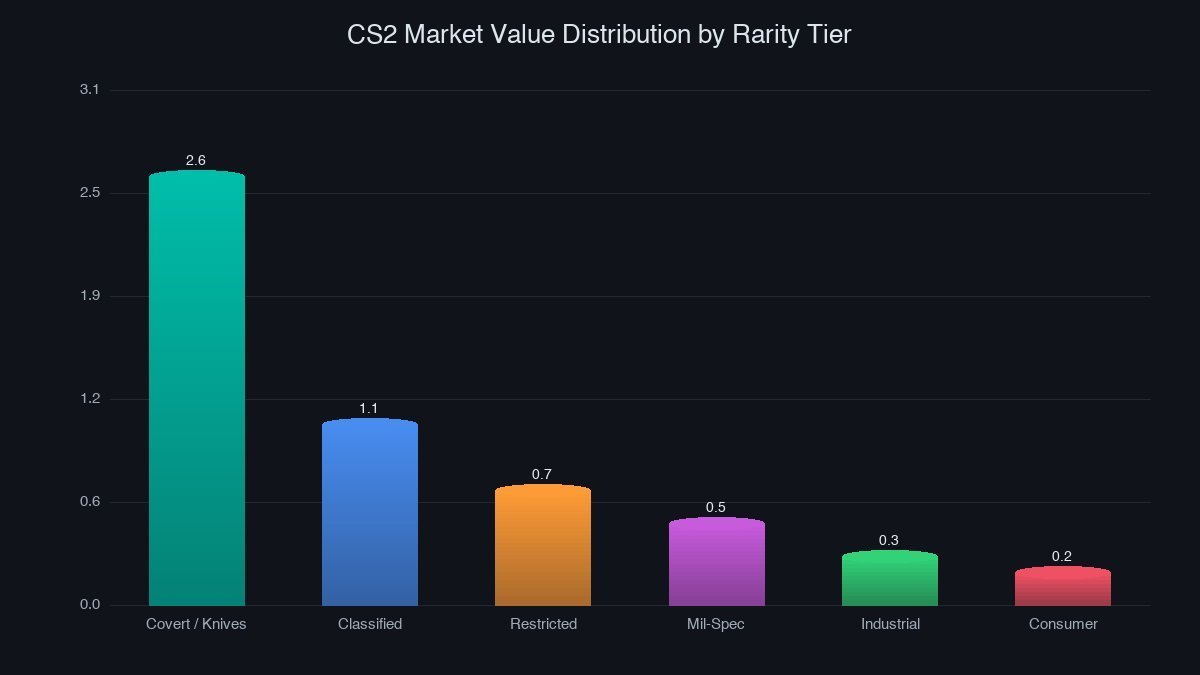
This is the statistic that changed how I look at my own inventory. The top 5% of CS2 items capture roughly 80% of total market value. Knives alone — less than 2% of total items by count — represent 25-30% of the entire market cap. Gloves and high-tier Covert rifles add another 20-25%.
At the other end, 2,065 consumer-grade skins collectively average just over $6 each. The vast majority of CS2's "28,817 items" are statistical noise. For anyone building or managing an inventory, this means one thing: quality concentration matters infinitely more than quantity. Ten $50 skins will almost always lose more value in a correction than one $500 knife. I learned this the expensive way.
What I Should Have Bought Instead
While I was losing sleep over $900 in mid-tier depreciation, two categories were quietly printing returns. Stickers — specifically legacy tournament capsules from pre-2023 Majors — have appreciated 300% in total value since 2023. The Stockholm 2021 and Antwerp 2022 capsules alone saw 40-60% price jumps after Valve announced the Cologne 2026 direct-purchase shop, which effectively makes old random-drop capsules into limited-edition collectibles.
And then there are cases. The CS2 case market operates on supply destruction — every case that gets opened is gone forever. When a case leaves the active drop pool, its price typically appreciates 50-200% within 6-12 months. A $100 investment in discontinued cases in 2020 would be worth roughly $1,200-$1,800 today. That outperforms most knife skins over the same period by a wide margin.
I didn't own any cases in November 2025. I own some now.
The Two-Speed Economy Nobody Talks About
Here's the insight that took me three months of tracking to fully understand: the CS2 skin market runs at two completely different speeds. The upper tier — Dragon Lores, Howls, high-tier knives — operates like fine art: low volume, high stability. During the late 2025 correction, AWP Dragon Lore and M4A4 Howl prices dipped less than 5%. These items aren't immune to market swings, but their owners tend to be long-term holders who don't panic-sell.
The mid and lower tiers behave more like consumer electronics — high volume, high volatility. Your average Restricted or Mil-Spec skin can swing 15-25% in a single quarter depending entirely on Valve's update cadence. If a new case introduces a similar-looking skin in the same rarity tier, prices can crater within days. There's no warning, no circuit breaker, and no buyer protection.
Knowing which tier your items fall into isn't academic — it's the difference between strategic patience and impulse-selling at the bottom.
Still Wondering?
Is the CS2 skin market in a bubble right now? By traditional investment standards, the price-to-utility ratio of CS2 skins is infinite — they generate zero cash flow. But as collectibles, they're relatively young. Magic: The Gathering's secondary market runs $10-15 billion with lower liquidity than CS2 skins. The bubble question depends entirely on whether you're comparing to stocks or to trading cards.
What's the safest CS2 "investment" for 2026? Discontinued cases and legacy sticker capsules from pre-2023 Majors. Their supply is fixed by definition, and new player adoption creates steady demand. But "safe" is a loaded word in a market where Valve can change the rules without notice. The $2 billion correction wasn't a crash — it was Valve adjusting drop tables. They can do it again tomorrow.
Should I panic-sell if my inventory drops 20%? Depends entirely on what you own. If it's mid-tier Restricted and Mil-Spec rifles, the data suggests these recoveries take 3-6 months on average — and some never fully recover. If it's high-tier knives and gloves, history shows these items are remarkably resilient. My personal rule after November 2025: if an item's price movement makes me check Steam three times a day, I shouldn't own it.
The CS2 skin market isn't a stock exchange, a casino, or a savings account. It's a player-driven collectible economy with $800 million in monthly liquidity and zero regulatory oversight. Treat it like one — hold what you love, diversify away from the mid-tier, and never invest money you can't afford to watch drop 20% overnight. If you want to track your own inventory's tier distribution or browse market trends across every rarity level, skinvs gives you real-time pricing on thousands of items without the noise that sent me into a panic last November.