Valve Just Gave CS2 Skin Designers a Real Workbench
Valve Just Gave CS2 Skin Designers a Real Workbench
The November 2 patch notes spent four lines on the Item Editor. Almost nobody read them. They are, quietly, the most consequential change to how CS2 skins get made since Valve started paying community artists.
Here is the short version: finishes can now control metalness and roughness per color, stickers can be auto-corrected for physically based rendering, and creators can preview all of it with a single console command. That is not a cosmetic tweak. It is Valve handing the workshop the same levers its own artists use.
What Actually Shipped on November 2
The update was framed as a Workshop release. Valve enabled uploading CS2 maps to the Workshop, and let community servers host those maps. For most players that reads as "more surf and Aim_botz servers," which is exactly why the skin-related lines got skimmed.
Buried under the Workshop heading, three Item Editor changes landed:
- Paint metalness and roughness by color for Solid Color, Hydrographic and Spray-Paint finishes.
- An Automatic PBR Color Correction toggle, now available on all sticker types.
- Expanded help documentation, including mat_fullbright 10 as the recommended way to inspect PBR while authoring.
The rest of the patch was housekeeping: fixes for commands dropped on bad connections, weapons occasionally firing faster than intended, duplicate muzzle effects on a single shot, weapons vanishing between overtime rounds, and dropped guns falling out of the map. Inferno got clipping and skybox fixes, plus a removal of birds that players kept mistaking for grenades. Knife swings now prioritize enemies over teammates, and smokes gained a minimum fuse so they cannot pop early inside a crevice.
Good fixes, all of them. But the Item Editor lines are the ones that will change what you see on the market two years from now.
Why Metalness and Roughness by Color Is a Big Deal
Every CS2 finish is built from texture maps that describe how a surface responds to light. Metalness decides whether a pixel behaves like painted plastic or bare steel. Roughness decides whether it looks polished or scuffed. For years, community authors could paint color freely but had far less control over those two properties at the pixel level.
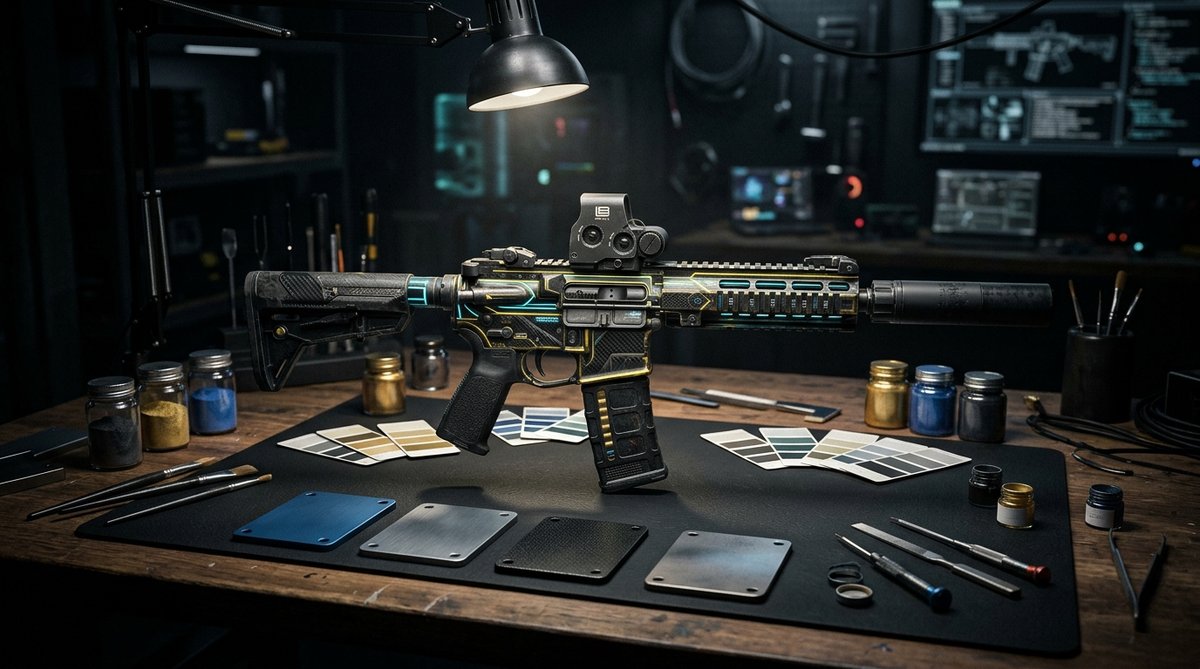
Now a creator can say: the blue inlay on this receiver is brushed aluminum, the black polymer around it is matte, and the gold trim is polished. Those are three completely different light responses on one weapon, authored by color instead of by hand-painted mask.
In practice that means fewer finishes that look like a decal wrapped around a gun, and more that look like an object built from materials. Compare a 2019-era spray-paint skin with the current top of the craft, and the gap is almost entirely about material response, not artwork. This change closes part of that gap for everyone, not just the artists Valve already trusts.
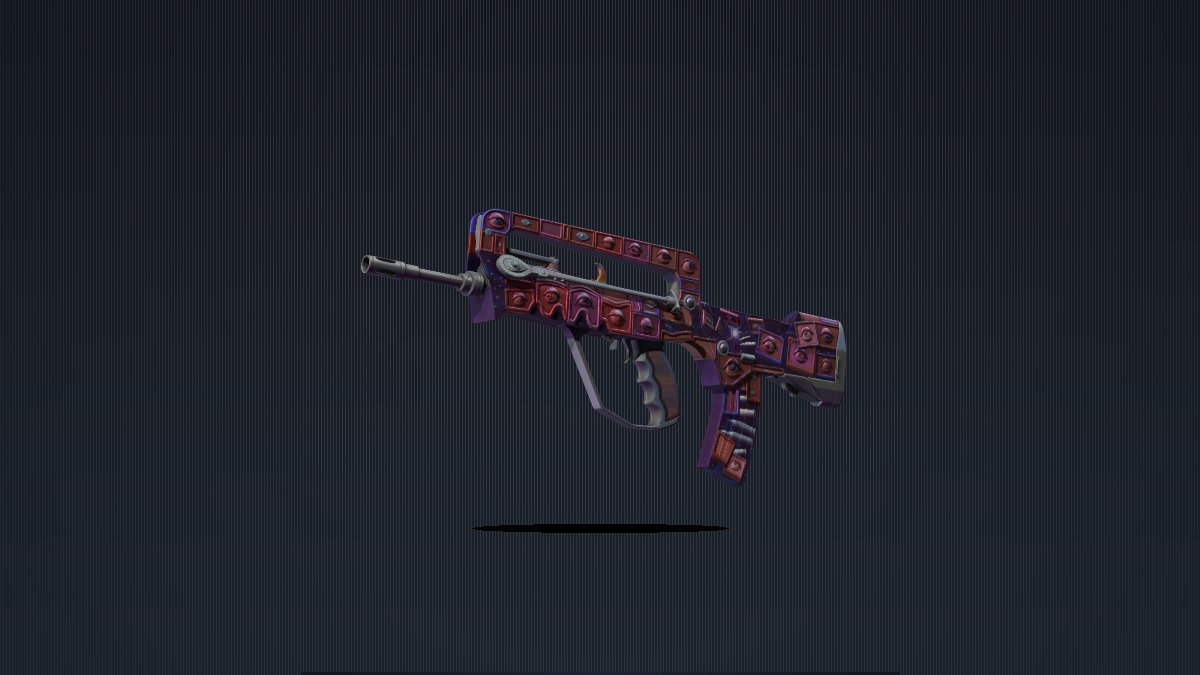
Take a finish like the FAMAS | Rapid Eye Movement. It is a community design, and what sells it is not the pattern itself but the way the pattern behaves: some regions read as anodized metal, others as flat paint. Under a bombsite lamp the two separate. Under flat lighting they collapse into one texture. That is the exact problem per-color material control is meant to solve, and it is why the difference between a good finish and a great one is so hard to explain in a screenshot.
Stickers Finally Get Color Correction
The sticker toggle matters for a less obvious reason: stickers are where CS2's lighting pipeline most often betrays the art. A holographic sticker designed against a flat backdrop can go muddy or blown out once it sits on a dark receiver in a dim bombsite.
Automatic PBR color correction gives authors a way to compensate without hand-tuning every surface. Valve also opened the same toggle to all sticker types, not a subset, which suggests the company wants consistency across the whole catalogue rather than a flagship feature.
And mat_fullbright 10 being documented is a small tell about intent. That command flattens lighting so you can inspect texture and material values directly. Documenting it in the help system says: we expect you to check your work like an engineer, not eyeball it in the preview window.
One detail worth flagging for anyone who trades on wear: roughness and wear are not the same axis, and it is easy to confuse them in a listing photo. A Factory New copy of a material-rich finish shows you where the highlights sit. A Battle-Scarred copy shows you the same material with the edges sanded down, and the contrast between polished and matte flattens as the wear pattern spreads. Finishes authored with strong per-color material separation will show wear more dramatically, not less, which cuts both ways: better looking at low float, more obviously tired at high float.
The Case for Not Caring
The fair objection is that tooling does not create demand. CS2 already gets its community finishes through Terminals, which replaced the old case cadence: Genesis arrived in September 2025 with 17 community-designed skins, Dead Hand followed in March 2026 with 17 finishes plus a batch of new gloves. Both shipped on Valve's schedule, not the workshop's.
So better tools do not mean more skins, faster. Valve still controls the tap, still sets the 0.26 percent rare-special-item chance that shapes every case and collection economy, and still decides which submissions become real items.
There is a second objection worth taking seriously: the audience does not consciously notice material fidelity. Nobody buys a skin because the roughness curve is correct. They buy it because it looks expensive.
Both objections are correct, and neither defeats the point. Tooling does not raise the number of releases. It raises the floor of the ones that do release, which is the part that compounds. A finish that reads as genuinely metallic on a $40 rifle does more for the medium than another clever colorway.
There is a market argument too, and it is the one that should worry collectors least. Prices across the whole catalogue have been sliding for months, which makes "will this hold value" a louder question than usual. Material quality is one of the few attributes that survives a downturn, because it is visible in-game rather than stored in a spreadsheet. A finish that looks convincing at a glance keeps its buyers when the speculative money leaves.
What This Signals About Valve's Roadmap
Look at the sequence. Workshop map support, Item Editor material controls, PBR documentation, sticker color correction, all inside one patch that otherwise only fixed bugs. Valve does not usually invest in authoring tools for a pipeline it plans to wind down. Terminals are the current supply channel, and they depend entirely on how good community submissions look.
My reading: this is groundwork. If the next Terminal or collection looks noticeably more material-rich than the last, the November 2 patch will be why, and nobody will connect the two.
For buyers, the practical takeaway is narrower than the hype. Finishes authored with real material separation will age better than flat wraps, because they hold up under the game's lighting instead of fighting it. That is a reason to look closely at newer collections rather than assume new means worse, and it is a reason to prefer items you can inspect in motion over screenshots.
If you want to see how material quality separates a shelf from a showcase, browse the SkinVS marketplace and open a few of the newer finishes side by side. Or skip the browsing and pull something straight out of Silent Form, where the difference between a painted surface and a machined one is the whole point. Either way, the four lines in the November 2 patch notes are worth remembering the next time a new collection lands and the finishes look unusually solid.