PEGI Carded Loot Boxes at 16 — CS2 Was Already Rated 18

PEGI Carded Loot Boxes at 16 — CS2 Was Already Rated 18
On October 20, 2026, the headlines landed: games with loot boxes are being bumped to PEGI 16 across Europe. EA Sports FC, Pokémon Go, Overwatch, League of Legends, Fallout Shelter, Warcraft Rumble — titles that had been sitting at 3, 7 or 12 suddenly wear a Paid random items label and, in the UK and every country that has written PEGI into law, can no longer legally be sold to under-16s.
Counter-Strike 2 was not on that list. It did not need to be. CS2 has carried a PEGI 18 rating since release. The rule that reshaped a dozen storefronts this month leaves the actual case economy untouched — not because Valve is protected, but because Valve was never in the low-rated category the rule targets.
That gap is the whole story. What regulation can reach, and what it can't, are two different markets now.
What PEGI Actually Did
PEGI announced the framework back in March 2026, adding "interactive risk" criteria to a rating system that had spent two decades judging content — violence, fear, language. From June 2026, newly submitted games were assessed on monetisation too.
The thresholds are blunt and specific. Paid random items default to PEGI 16, with PEGI 18 possible depending on how the mechanic is presented. Time-limited or quantity-limited offers get at least 12. Anything with NFTs or blockchain mechanisms is an instant 18. Daily-login rewards land at 7, or 12 if the game punishes you for staying away. Unrestricted voice or chat with no blocking tools is 18.
The October rollout extended that to existing titles. Connor Hinde, policy manager at the Games Rating Authority — PEGI's UK administrator — confirmed that digital-only games rated 3, 7 or 12 with paid random items are being re-rated to 16 with the Paid random items descriptor, across both the traditional PEGI Classic procedure and the IARC system storefronts use. The rollout began the week of October 12 and continues through the month.
PEGI director Dirk Bosmans gave the reasoning in plain terms: online games stay live and updated for years, so ratings drift out of step with the standards the body now applies. Re-rating is how they bring the back catalogue into line.
Round 1: Who the Rating Actually Reaches
Here is the comparison that matters, and it has nothing to do with how violent a game is.
Storefront titles: covered. A PEGI rating travels with the product across every platform that uses the system. If a parent has age restrictions set on a console or a mobile store, a PEGI 16 label does real work — it blocks the purchase. That is the mechanism regulators have been asking for since the first loot box hearings.
CS2: also covered, but at a level where the new rule changes nothing. An 18-rated game was already restricted. Adding a "paid random items" descriptor to a title that already requires adulthood for its core content does not move a single sale.
Third-party case-opening sites: not covered at all. PEGI rates games. It does not rate websites that sell openings of CS2 cases with their own odds, their own pricing and their own deposit flows. Those sites are outside the classification system entirely, and no amount of re-rating the game that supplies their inventory will touch them.
So the same mechanic — pay money, receive a random cosmetic — sits inside three different regulatory envelopes depending on which address you type. That is not a loophole in PEGI's rules. It is the boundary of what a game rating system was built to do.
Round 2: The Odds Nobody Has to Publish
This is where the comparison gets uncomfortable, because Valve is actually the transparent party here.
CS2's published per-opening odds have not changed in years: 79.92% Mil-Spec, 15.98% Restricted, 3.20% Classified, 0.64% Covert, and 0.26% for the rare special slot that holds every knife and glove. One in 385. The same numbers apply regardless of which case you open or what it costs.
Those numbers exist because Valve chose to disclose them. There is no European rule forcing a game to publish loot box odds — PEGI assigns an age label, it does not mandate a probability table. Valve published anyway, and has for years.
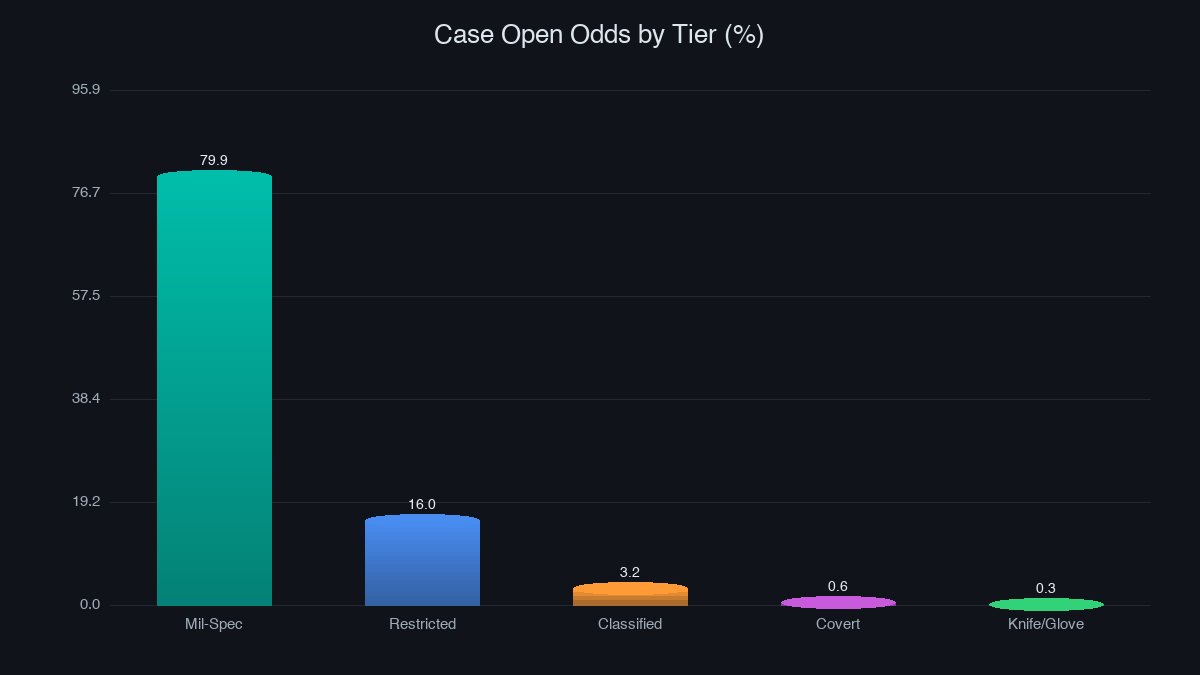
Third-party opening sites are a different picture. Some publish their odds. Some publish odds for a "case" they designed themselves, with different contents and different tiers from the game they're mimicking. A PEGI 16 label tells a parent that a game contains paid random items. It tells them nothing about the return rate, and neither does anything else on the store page.
That is the asymmetry worth naming: the regulated surface is the one that was already disclosing, and the unregulated surface is the one where odds are optional.
Round 3: Price per Spin
The cost side sharpens it further. A standard CS2 case opening is a case plus a $2.49 key. In practice that means somewhere between $2.58 and $3.36 per open depending on the case, with published expected values landing between about $0.72 and $1.35 — roughly 28 to 40 cents returned per dollar before selling fees.
Those are bad numbers, and they are documented. The 0.26% slot means the average player spends around $1,000 at current opening costs to see a single knife or glove drop, assuming average luck. That is the actual product being sold, stated up front.
Third-party sites compete on a different curve: cheaper opens, bigger advertised top prizes, and deposit bonuses that reset the mental accounting. They are not doing anything illegal in most jurisdictions. They are simply selling the same shape of product without the disclosure layer, which is exactly the segment the new PEGI label cannot reach.
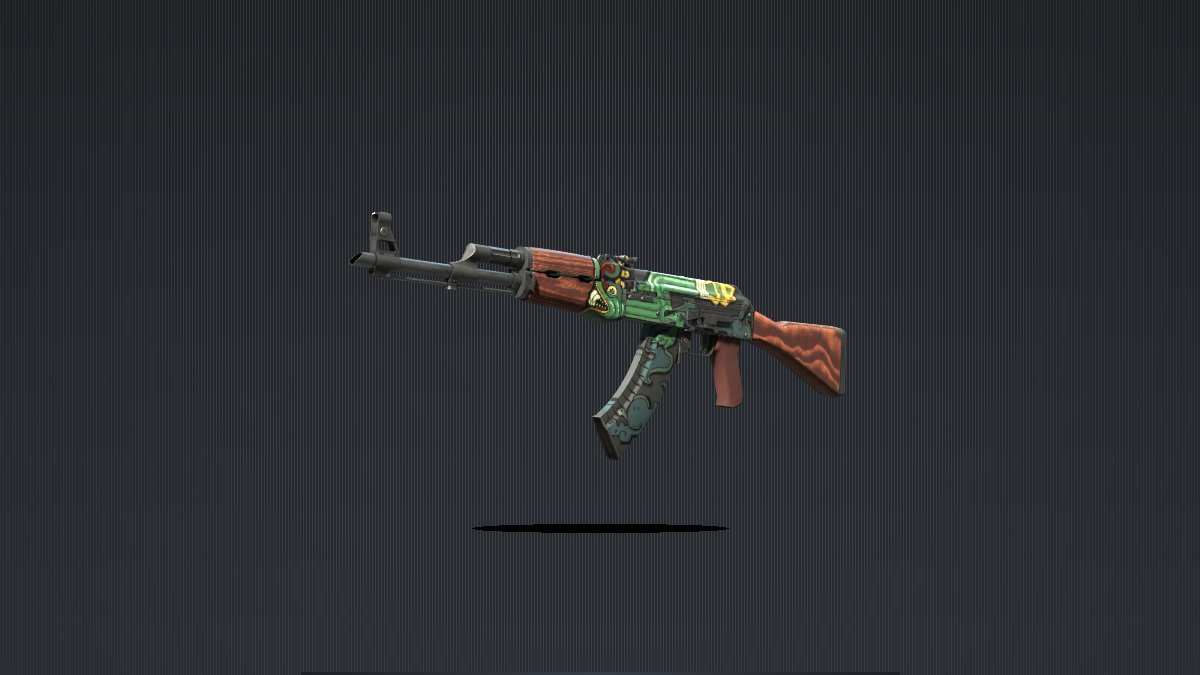
The skin in that image — a Covert AK — sits in the 0.64% tier. Not the jackpot. One step below it. That is worth sitting with before anyone frames case opening as a route to a high-end inventory.
Round 4: What This Does to the Market
Probably less than the headlines suggest, at least for CS2 specifically.
The market itself has been drifting sideways. The Skinory CS2 index put total capitalization around $3.6 billion in mid-October across roughly 29,680 priced items, and the Armoury Market Index fell 2.6% in the week ending October 18 to 428.9, with only about 35% of liquid items trading above their week-ago price. A rating change on mobile storefronts does not move a market that is priced by traders on Steam and third-party exchanges.
What it does move is the broader argument. CS2's regulatory pressure is coming from a different direction entirely: New York's Attorney General filed suit against Valve on February 25, 2026, over case mechanics. That is a consumer-protection action aimed at the game itself, not an age label applied at a storefront. If meaningful change comes to CS2 cases, it will arrive through litigation and gambling law, not through PEGI.
The scale of what's at stake explains why. There are 42 weapon cases, 164 souvenir packages and roughly 569 containers holding over 19,000 items in the system. October 2025 alone saw a record 31 million cases opened. Nothing about a rating label changes the economics of a machine that size.
The Verdict
PEGI's update is a real win, just not for the reason it's being shared. It puts a legally enforceable age gate in front of loot boxes in games that were previously rated suitable for a seven-year-old, which is a genuine correction. It also drags a gacha-heavy mobile market into the same disclosure conversation as console and PC titles.
But for CS2 the practical effect is close to zero, and for the sites that actually monetise CS2 openings most aggressively the effect is exactly zero. The mechanic everyone is arguing about lives on the wrong side of the boundary.
Which leaves the individual decision where it always was: read the odds, do the arithmetic, and treat the top tier as a lottery rather than a plan. Fan Favorite is a reasonable place to see the real distribution in action rather than take anyone's word for it — including ours.
A rating can tell you who should be allowed to buy something. It has never been able to tell you whether buying it is a good idea.