Why Are 98% of CS2 Skins Cheaper Than They Were in March?

Why Are 98% of CS2 Skins Cheaper Than They Were in March?
Start with the number that makes collectors wince. Of the 1,185 CS2 skins that have a clean, comparable price history in both March and October 2026, 1,165 are cheaper today than they were on March 2. That is 98% of the tracked market. The median skin did not slip a few percent — it lost 36.3% of its value in seven months, according to price-tracking site csdb.gg, which published its latest snapshot on October 2.
Only 18 skins out of that sample gained more than 1%. So this is not a rotation where some things fall and others rise to take their place. It is a broad, grinding cooldown that has been running quietly since the spring — long after the October 2025 crash headlines faded.
The 36% Nobody Is Talking About
Most CS2 market coverage is written in the days after something dramatic happens. The October 22, 2025 trade-up update is the obvious example: it let five Covert-tier skins be crafted into a knife or gloves, and roughly $1.75 billion of paper value evaporated within days. Total market capitalisation fell from above $6 billion to about $4.27 billion — a 28% haircut in 24 hours.
What the crash headlines missed is what happens next. Recovering from a supply shock is not a bounce; it is a slow re-pricing while the extra supply keeps circulating. Between April 12 and June 29, 2026, the median tracked CS2 item still lost about 9.1% — six months after the patch. By the time csdb.gg ran its March-to-October comparison, the drift had compounded into the single worst stretch of broad depreciation the skin market has recorded.
Nine full pricing snapshots taken across 36 marketplaces tell the same story item by item. The Kilowatt Case slid from $0.28 to $0.18 (down 35.3%) between April and June. The CS:GO Weapon Case, out of the active drop pool for more than a decade, still lost a fifth of its price, falling from $162.62 to $127.64. Meanwhile the most liquid mainstream items barely moved: AK-47 | Case Hardened in Field-Tested slipped 2.4%, and a Butterfly Knife | Doppler in Factory New lost just 1.4%. Scarcity is not a floor, and liquidity is not a weakness. Both facts matter later in this article.
The loser board is where that compounds into something ugly. FAMAS | CaliCamo fell from $2.19 to $0.27 (down 87.7%). Dual Berettas | Drift Wood went from $2.24 to $0.29 (down 87.1%). USP-S | Purple DDPAT lost 81.9%, sliding from $18.60 to $3.37. Galil AR | Dusk Ruins, once a $96.78 Well-Worn item, now sits at $15.87.
Notice what those items have in common: they are all mid-tier and lower-tier skins from collections that are still being opened every day. Their supply never stops growing, so when demand cools, price is the only thing left to absorb the excess.
The Two Markets Hiding Inside One
The gainers list tells the other half of the story. P2000 | Red FragCam rose 41.1% ($2.07 to $2.92). CZ75-Auto | Crimson Web gained 34.6%. Dual Berettas | Panther climbed 28%. M4A4 | Faded Zebra added 26.9% and FAMAS | Contrast Spray jumped 26.4%, from $13.51 to $17.07.
Every name on that list belongs to an older, discontinued collection. Nobody can manufacture more of them. No active case prints them, no trade-up contract feeds them, and no amount of daily case openings adds a single unit to the pool. When supply is fixed, even modest collector interest is enough to move the price — which is the exact opposite of what happens to a skin that drops from a case in the current rotation.
That is the real structural split in 2026, and it is the most useful thing to understand about the market right now:
- Abundant supply — anything craftable, anything in an actively dropping case, anything with deep listing depth — drifts down and keeps drifting.
- Scarce legacy supply — discontinued collections, rare patterns, unusual floats, StatTrak variants — holds, or climbs, because the supply line is permanently closed.
A quick reality check on the two regimes: the Kilowatt Case is still the most traded case in CS2 at roughly 38,000 units a day, and it costs about $0.09. Volume and price moved in opposite directions. Meanwhile a discontinued skin like Five-SeveN | Jungle, quoted under $1.40 in early March, now trades near $48.21 in Factory New — up 12.5% on a median basis while the rest of the market bled.
Where the Money Still Sits
Weekly market reports from TradeUpAcademy put the total tracked catalogue at roughly $22.6 million as of late September, down 0.35% week over week across 28,107 items. That headline number is flat — almost boring — but the composition underneath it is not.
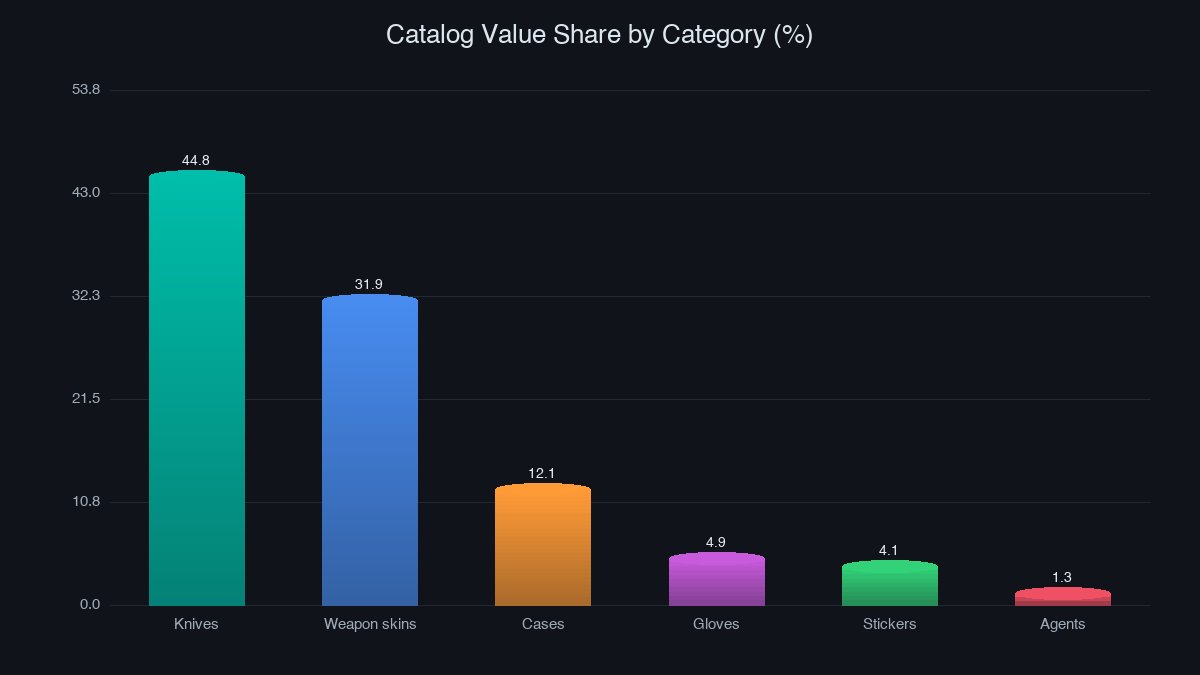
Knives alone account for 44.83% of catalogued value. Weapon skins are 31.94%, cases 12.13%, gloves 4.94%, stickers 4.12% and agents just 1.26%. Put differently: four out of every nine dollars in tracked inventory sits in one category, and that category is the one Valve permanently altered in October 2025 by making knives craftable.
There is one genuine bright spot in the data. The median StatTrak premium over the normal version of the same skin is +17.61%, measured across 3,189 matched skin pairs. StatTrak items are not manufactured from the same supply pool in the same proportions, and that scarcity is the one premium the market has not yet arbitraged away.
Cases are the other quiet corner. Retired cases have no new supply, and their unit economics are simple: a $0.09 Kilowatt Case and a $162 CS:GO Weapon Case both sit on the same shelf, and only one of them can be printed today.
The price distribution explains why the cooldown feels invisible to most players. Of all tracked items, 38.04% are worth less than $1, another 28.69% sit between $1 and $10, and only 0.99% are above $1,000. The median player's inventory is built almost entirely from the category that fell hardest, which is why the headline "market down" and personal experience rarely match.
There are exceptions worth noting, and they follow the same logic in reverse. The Glove Case climbed 14.7% in the same window that everything else drifted lower — a retired case whose supply is fixed and whose contents still have demand. When a fixed-supply item rises in a falling market, that is not noise. That is the market telling you where the floor is.
What a Cooling Market Actually Means for Buyers
A market where 98% of items are down is not a disaster if you are the one buying. It is the first buyer-friendly stretch of the CS2 era. Items that were $100 several years ago now trade in the $20 to $50 band, and the two-tier split gives you a clear map of where prices can still fall and where they probably cannot.
Three practical rules follow from the data:
- Ignore percentage leaderboards. A sticker "up 3,400%" on zero volume in seven days is not a trend, it is a single stale listing. Volume first, percentage second.
- Check listing depth before you buy into scarcity. Scarce legacy items hold value precisely because trading them is slow. If you cannot sell it next month, you do not own a position, you own a souvenir.
- Buy the item, not the trend. The skins still standing after seven months of decline are the ones people actually use in-game — which is where the real demand floor has been all along.
If you want to see where prices sit right now rather than reading about it, the live CS2 skin marketplace at SkinVS Shop lists current prices across every category — knives, gloves, rifles, cases and stickers — with real listings you can compare against the numbers above before the market moves again.
Data sources: CSDB.gg market trends (March 2 to October 2, 2026 snapshots), TradeUpAcademy weekly market report (September 27, 2026), Steam Dashboard skin investment data.