Why the CS2 Skin Market Just Fell Below Its Own Crash Bottom

Why the CS2 Skin Market Just Fell Below Its Own Crash Bottom
There is a number that CS2 traders have been treating as the floor for eleven months. In late October 2025, after Valve let players craft knives out of cheap red skins, PriceEmpire's market cap bottomed out at roughly $3.64 billion. That was the worst the market had ever been. Everything since — the recovery, the rallies, the "we're back" posts — was built on the assumption that number would hold.
It didn't. In mid-September 2026, PriceEmpire's live index reads about $3.40 billion. The market is now cheaper than it was at the bottom of its own historic crash.
A Floor That Wasn't A Floor
The chart below tells the whole story in four bars. A record peak, a violent break, a partial recovery — and then a long, quiet slide that gave all of it back.
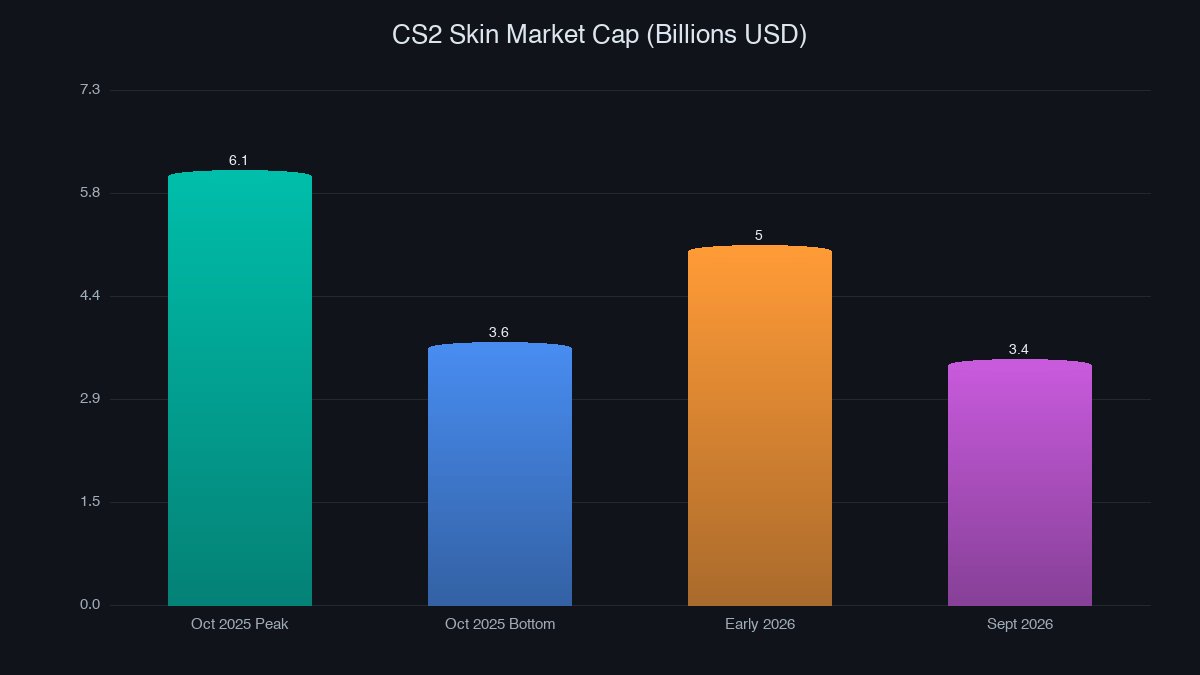
The peak was $6.06 billion on October 17, 2025. At the time the community was calling skins "more stable than crypto," and the market had just climbed 12.95% in ninety days. That confidence lasted less than a week.
On October 22–23, Valve shipped what it described as a small update. Players could now combine five Covert ("red") skins from a collection into a knife or a pair of gloves — instantly tradeable, no lock. Within 24 hours the market cap fell to $4.13 billion. Some trackers clocked the drop as high as $2 billion in under 30 hours, and individual knives lost as much as 70% of their value overnight.
It stabilised, briefly. By early 2026 the market had climbed back above $5 billion — roughly 75–80% of pre-crash levels — and the consensus narrative was that the trade-up panic had been overdone. Supply math supported that. FloatDB counted around 20 million eligible Covert skins in circulation against a pool of about 5.5 million knives and gloves. Even a total conversion of every red in existence would only double that supply. Painful, not fatal.
The floor held for a while. Then it stopped holding.
What Actually Broke
Look at the middle of the chart and you'll see the problem. This was not one dramatic crash. It was a slow grind with no single villain, which is much harder to write a headline about and much harder to argue your way out of.
Start with the bellwether everyone watches. ★ Butterfly Knife | Fade (Factory New) was a $2,400 knife at the start of September. It was trading near $1,800 days later — a 25% slide in a single month, on an item with 17,322 units in supply and roughly $38 million of total market capitalisation behind it. Butterfly knives are the most watched gold-tier item in the game. When the top of the market leaks, everything below it reprices.
The reason is structural. The October 2025 update didn't just lower knife prices — it turned red skins into a production input. Every player can now manufacture a gold item on demand. That means knife supply is no longer a function of case-opening luck; it's a function of how cheap reds are. As long as crafting stays economical, supply keeps dripping in.
And when supply is guaranteed, scarcity stops being a story you can sell to a buyer.
The Numbers Behind The Slide
SteamAnalyst's pricing data shows exactly how much of the old premium has been squeezed out of the gold tier. These are average prices across all wears and variants:
- ★ Butterfly Knife — average $1,384.76 across 171 skins
- ★ Karambit — average $1,246.16 across 151 skins
- ★ M9 Bayonet — average $962.70 across 160 skins
- ★ Sport Gloves — average $803.76 across 68 skins
- ★ Talon Knife — average $697.82 across 133 skins
Now compare those to the six-figure numbers traders were throwing around in 2024 and the picture is clear. The ultra-top of the market — the rare patterns, the low-float showpieces — still exists. Everything one tier down has been compressed toward the middle.
Case prices tell the same story from the other direction. Kilowatt Case — the cheapest container in the game, and the one that carries the Kukri Knife and the AK-47 | Inheritance — sits around $0.11 to $0.25 depending on where you look. Recoil Case trades around $0.25 to $0.50. Even the Clutch Case, a long-time stalwart, slid from about $1.30 to roughly $0.80 over the past year.
Part of that is by design. Valve has stopped shipping traditional cases almost entirely — the last regular container was the Fever Case back in March 2025, and the Dead Hand and Genesis terminals replaced the format with something that shows you the item before you buy it. When new supply comes from a shop instead of a lottery, the older containers lose their "next big case" premium.
Why Opening Cases Keeps Getting Worse
There's a metric in all of this that matters more to the average player than the market cap, and it's ugly. A CS2ROI study of all 42 cases put the best container in the game at a 79.5% return and the worst at 30.4%. Nothing pays for itself.
The mechanism is the key. It costs $2.49 regardless of what you open. On an Operation Hydra Case at $30, that's 8% of your cost. On a Kilowatt Case at $0.11, the key is 96% of your entire spend — which is why Kilowatt's ROI is 30.6% even though the items inside a single case are worth about seven times the case's own price. You aren't paying for skins. You're paying for the roll.
Which is exactly why the top of the case market still behaves differently. When a case costs more than the key, the maths changes, and legacy containers with frozen supply — Operation Wildfire at roughly $3.74, CS:GO Weapon Case at over $145 — keep climbing precisely because nobody can make more of them.
So What Now
Two things can be true at once. The market is below its 2025 floor, and it is still a market worth several billion dollars that has survived the single worst mechanical change in its history. The crash of October 2025 deleted value fast; what's happening in September 2026 is slower and less dramatic, but it has taken more.
The practical read for anyone holding skins is the same one that has worked all year: liquid, discontinued, unfarmable items held up best. Anything that can be crafted, opened in bulk, or replaced by a terminal has been drifting down and has not finished drifting.
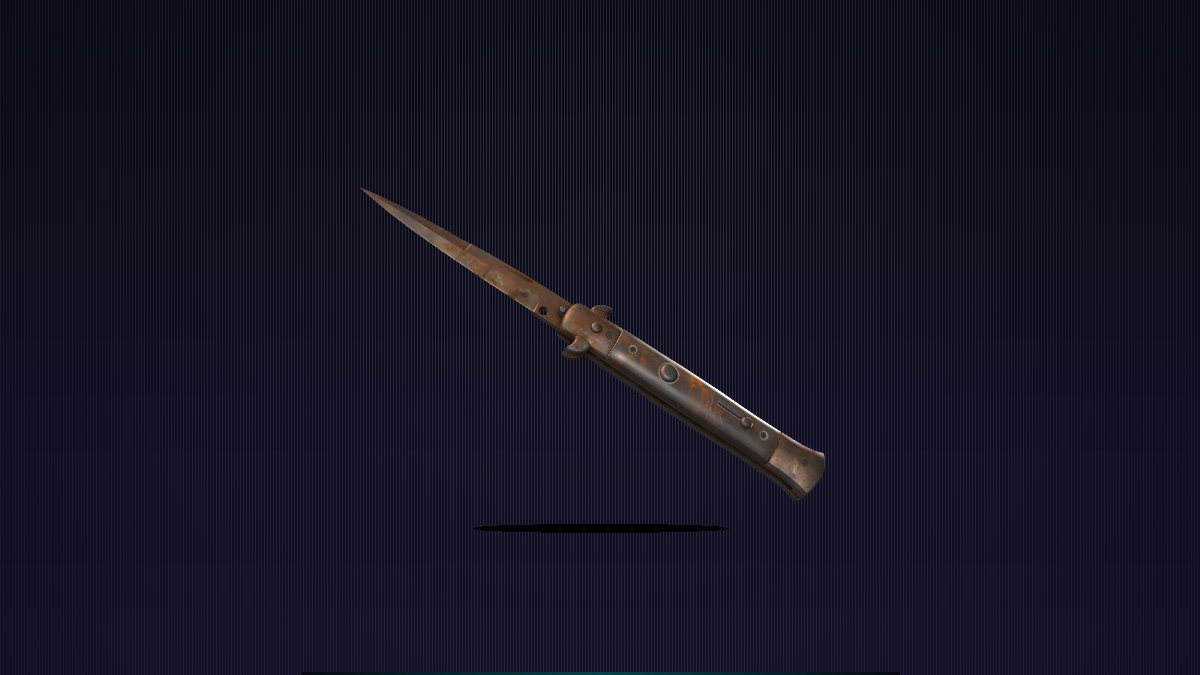
For anyone who just wants a knife in their inventory without betting on a recovery, the productive move is to buy a specific item rather than a lottery ticket — and if you do want the lottery, at least understand that the 0.26% gold rate means roughly one knife per 385 openings. The ★ Stiletto Knife | Rust Coat below is exactly what the bottom of that curve looks like: a real, tradeable knife with a real float value, and it costs less today than it did in 2024 for the same reason everything else does.
If you'd rather open your way to one, pick a container where the case price is a small fraction of your total spend and the special item pool is one you'd actually be happy to receive. The Phantom Cache fits that description better than most — and at these prices, the floor you're buying into is at least a real one.