CS2 Skin Bear Market Survival Guide: 5 Moves for a 50% Down Market
CS2 Skin Bear Market Survival Guide: 5 Moves for a 50% Down Market
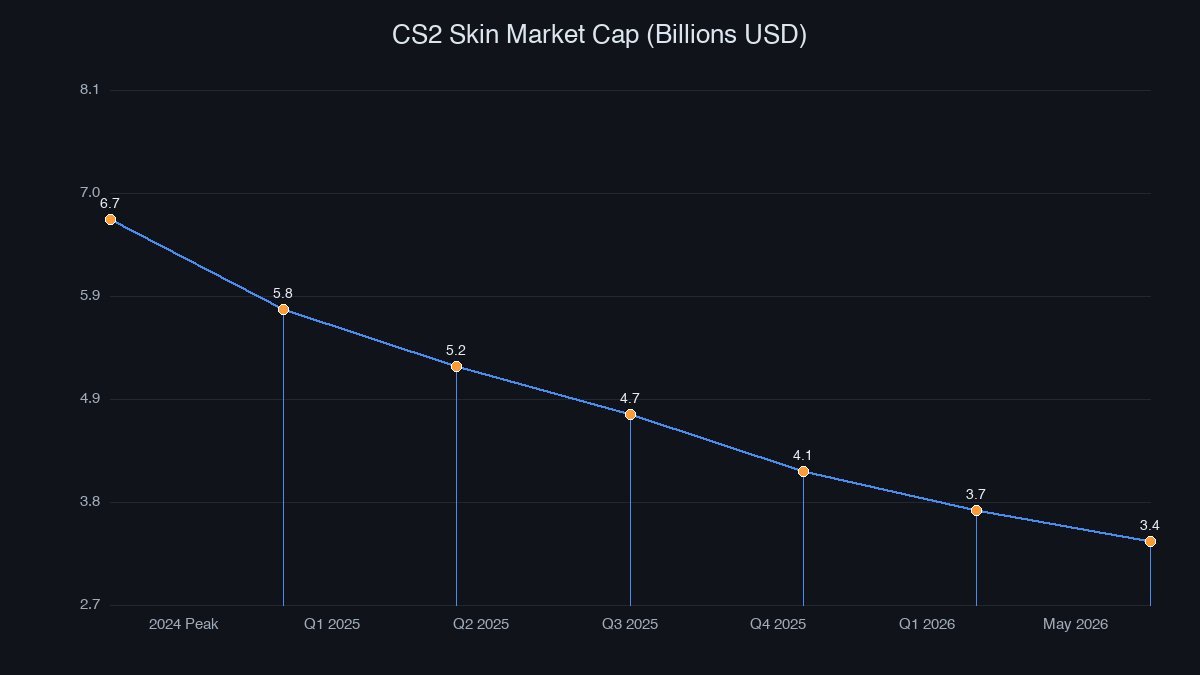
The CS2 skin market has shed half its value from the 2024 peak. A market that once topped $6.7 billion in total capitalization now sits at roughly $3.37 billion, according to community data aggregators. That's not a dip. That's a bear market — and it's testing everyone who holds CS2 skins as investments.
But here's what the panic headlines miss: bear markets are where the best positions are built. The question isn't whether the market will recover (history says yes — it's recovered from every decline since 2014). The question is whether you're positioned to benefit when it does.
Step 1: Understand Why the Market Is Down
Before you make any moves, you need to understand what you're navigating. The current decline isn't random — it has specific, identifiable causes:
The Armory fatigue. When Valve replaced the traditional Operation model with the Armory pass system, it flooded the market with new skins at an unprecedented rate. The Harlequin and Achroma collections dropped in early 2026, adding hundreds of new finishes just as the player base was absorbing the Dead Hand Collection's 17 weapon skins and 22 glove variants.
Philosophy shift at Valve. Community analysts at Skin.Club note a growing conversation about Valve "rejecting the old unboxing logic." The traditional case-and-key model created scarcity through randomness. The Armory system creates abundance through direct purchase. More supply, same demand, lower prices.
Macro cooling. The broader CS2 item economy is experiencing what analysts call "a broad cooling of the entire system" — not isolated weakness in specific categories, but a synchronized decline across skins, stickers, gloves, and knives.
Step 2: Identify What's Actually Holding Value
Not everything is down equally. In fact, some categories are showing remarkable resilience. The data from CSBOARD's 2026 market analysis points to a clear pattern: discontinued items outperform everything else.
Specifically, discontinued case reds (Covert rarity) in Minimal Wear and Field-Tested conditions are showing projected annual returns of 15-25%. These are skins like the AK-47 | Fire Serpent and AWP | Dragon Lore — items that can no longer be obtained through regular case openings and have a fixed, declining supply.
The logic is straightforward: new skins dilute the value of other new skins, but they can't touch items that are no longer being produced. When the market is flooded with Armory skins, the scarcity premium on discontinued items actually increases.
Step 3: Avoid the New-Release Trap
One of the most consistent patterns in CS2 skin economics: newly released case skins drop in price as supply increases, then stabilize. This is basic supply-demand mechanics, but it catches new investors every cycle.
The Dead Hand Collection gloves looked like a sure bet when they launched. Community-designed, high-quality finishes, rare special items. But within 60 days, the influx of Armory pass redemptions pushed prices down 30-40% from launch levels. The same pattern played out with Harlequin and Achroma — initial hype, aggressive opening, price compression.
The smart play during a bear market is to wait for the stabilization phase. Let the initial wave of openings pass. Let prices find their floor. Then evaluate whether the skin has genuine long-term appeal beyond the launch hype cycle.
Step 4: Build Positions in What You Understand
This sounds obvious, but bear markets test conviction. If you bought an AK-47 | Bloodsport at $120 and it's now trading at $85, the instinct is to sell and "cut losses." But if your original thesis was sound — the Bloodsport is one of the most iconic AK-47 finishes, from a discontinued case, with consistent demand — then a 30% drawdown during a market-wide decline doesn't invalidate the thesis.
The investors who built serious CS2 skin portfolios during the 2017-2019 cycle didn't do it by timing bottoms perfectly. They did it by accumulating positions in skins they understood, holding through volatility, and letting the market recovery do the work.
Practical framework for evaluating any skin in a bear market:
- Supply check: Is this skin still being generated? (Active case = ongoing supply pressure)
- Demand check: Does this skin have organic player demand beyond investors?
- Float check: Low-float and rare pattern variants historically hold value better
- Collection check: Is the collection itself respected in the community?
Step 5: Diversify Beyond Skins
One of the most interesting developments in the 2026 bear market is the relative strength of stickers and gloves. While weapon skins have been the primary target of Armory-driven dilution, stickers benefit from a different supply dynamic — they're tied to specific events (Majors, Operations) and have natural expiration dates.
The Cologne 2026 Major Shop's new price tracking features (7-day ranges, bookmarking, sticker showcase) are making sticker investing more accessible than ever. Meanwhile, gloves — especially the Dead Hand Collection's 22 new variants — have developed their own collector communities that operate somewhat independently from the broader skin market.
For investors concentrated in weapon skins, allocating even 15-20% of a portfolio to stickers and gloves can reduce correlation risk. The 2026 data suggests these categories are moving less in lockstep with weapon skins than they did in 2024-2025.
The Recovery Playbook
Market recoveries in CS2 tend to follow a pattern: tournament spikes first, discontinued items second, everything else third. The Cologne 2026 Major is already generating renewed interest — 30.8 million monthly players as of June 2026, a viewer pass system that's driving engagement, and a Pick'Em Challenge that keeps players checking prices daily.
If history rhymes, the recovery starts with the items closest to the action: Major stickers, tournament souvenirs, and the skins that pros use on stream. From there, it ripples outward to discontinued case items, then to the broader market.
Position accordingly. The players who come out of this bear market strongest won't be the ones who timed the exact bottom. They'll be the ones who understood what they owned, why they owned it, and had the patience to let the cycle play out.
Ready to start building your position? Browse real-time prices on the skinvs market — every listing includes float values, pattern data, and rarity tiers so you can make informed decisions, not hopeful guesses.
Sources: Skin.Club Community ("The CS2 Skin Market Keeps Crashing in 2026," May 27, 2026); CSBOARD Market Analysis 2026; Steam Market historical data.