Same Skin, 26% Apart: What CS2 Price Gaps Actually Cost You
Same Skin, 26% Apart: What CS2 Price Gaps Actually Cost You
On 21 October 2026, a G3SG1 | Chronos sat at $217.97 on Buff163 and $5,000 on CSFloat. Same skin. Same wear. Same day. That is a 2,194% gap, and it is not even the interesting part — extreme outliers like that are easy to spot and easy to dismiss.
The interesting part is the middle of the market. Across 1,086 skins priced at $5 or more with three or more quotes, the median gap between the cheapest and priciest marketplace was 26.1%, according to CSDB.gg's 21 October snapshot. One in four skins you buy is priced a quarter higher somewhere else, right now, with no difference in what you receive.
That number is the whole argument for shopping across marketplaces instead of buying from the first tab you open. Below is what the gap looks like when you stop treating it as an average and start treating it as a set of choices.
The Baseline Gap Is 26.1%, Not 5%
A lot of traders assume marketplace differences are rounding errors — a few percent, eaten by fees anyway. The snapshot says otherwise. The 26.1% figure is a median, which means half of all qualifying skins have a wider gap than that. Twenty-six percent on a $200 skin is $52, which is roughly the price of a second mid-tier skin.
Below the median things get tighter. On the cheap end of the catalog, spreads compress because there is no room for them — 35.54% of tracked items trade under $1, and a $0.40 case cannot have a $25 gap. The spread is a feature of expensive, thinly-traded items: fewer listings, fewer sellers watching each other, more room for one optimistic ask to sit there unanswered.
That is also why Steam is excluded from these comparisons. Steam's sticker price is gross of a fee the seller never receives, so quoting it against a cash marketplace price compares two different numbers. The gap we are measuring is cash-ask against cash-ask.
Buff163 vs Steam: Two Different Kinds of "Low"
The other half of the story is who actually holds the low price. On the same snapshot, Buff163 was cheapest on 37.31% of tracked items. Steam was cheapest on 15.63%. DMarket on 14.21%, Skinport on 10.81%, HaloSkins on 8.84%, SkinBaron on 6.81%.
Buff163's lead is not new, but its size is worth sitting with: more than one in three items is cheapest there. That does not mean it is the right place for every purchase — balance withdrawal, payment method, and trade locks all change the real cost — but it does mean a marketplace that never appears in your comparison is probably costing you money.
The week-over-week move shows how fast this shifts. DMarket's share of "cheapest price found here" fell from 26.7% to 14.21% between week 42 and week 43 — a 12.49 percentage-point drop in seven days, according to TradeUp Academy's archived week 43 report. Meanwhile Buff163 climbed 7.84 points, from 29.47% to 37.31%. If you built a buying habit on last month's data, it is already stale.
Where Spreads Stop Being Noise
Most of the largest gaps come from one outlying ask that nobody has undercut yet. That is exactly what you want to find as a seller, and exactly what you want to avoid paying as a buyer. The top of the list, all from the 21 October snapshot:
- G3SG1 | Chronos — 2,194% ($217.97 Buff163 vs $5,000 CSFloat, 3 markets)
- P250 | Digital Architect — 454% ($27.00 CSFloat vs $149.58 Youpin)
- G3SG1 | New Roots — 391% ($5.97 vs $29.29, 5 markets)
- CZ75-Auto | Emerald Quartz — 387% ($58.40 vs $284.51, 12 markets)
- Skeleton Knife | Doppler — 301% ($496.01 CSFloat vs $1,990 Tradeit.gg, 13 markets)
Read that list as a warning, not a shopping list. A 12-market skin with a 387% gap has a real liquid floor — the $58.40 is probably true. A 3-market skin with a 2,194% gap is a market with a missing seller, and the "cheap" copy may be gone before your trade confirms. Wide gaps on thin books are a data artefact; wide gaps on deep books are genuine arbitrage.
The deep-book examples matter more for normal buyers. ★ Karambit | Blue Steel (Field-Tested) showed a 74.9% spread between its priciest and cheapest variant in TradeUp Academy's week 43 data — on a knife that changes hands often enough to trust both quotes. That is the version of this trade that ordinary buyers can actually execute.
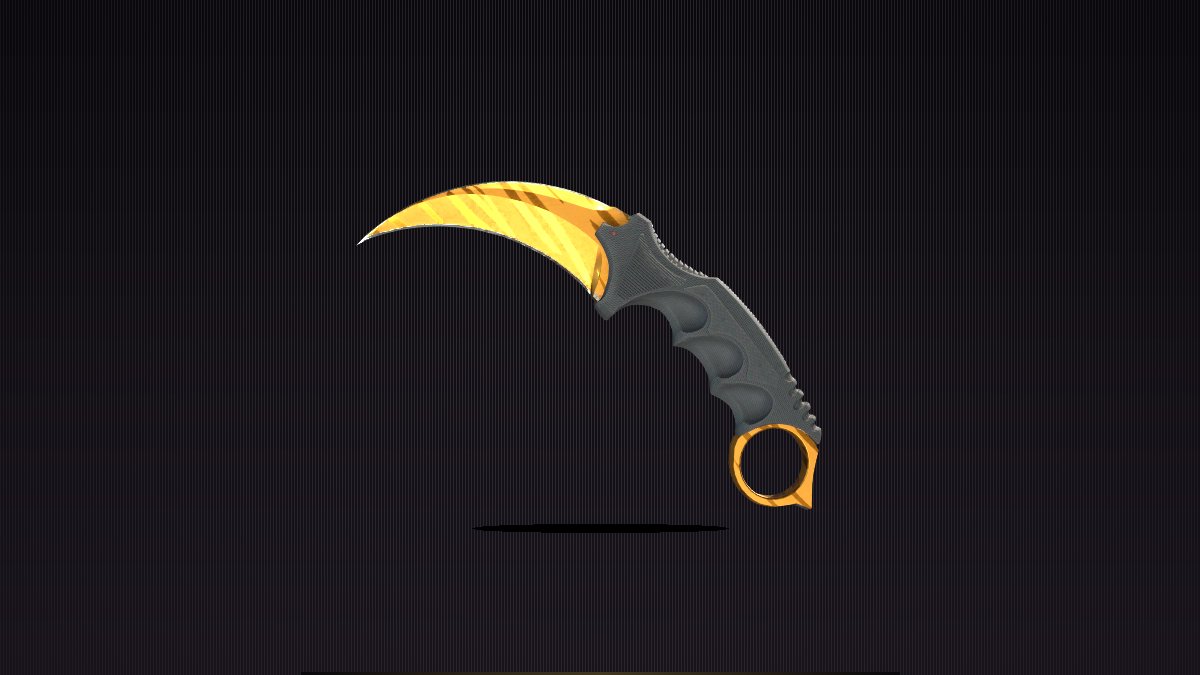
★ Karambit | Tiger Tooth (Factory New) is the cleaner example of what a deep book looks like when it is working correctly. It lists at $1,047.81 this week — a four-figure knife, traded often enough that no single seller controls the price. On a skin like that, a 26% gap is not an artefact or a typo, it is a real 26% you either capture or pay. Apply the median to a four-figure knife and the decision is worth about $270, which is more than a Fracture Case's entire weekly turnover per unit.
Contrast it with the Karambit | Doppler listings, where several Factory New copies sit in the catalog at $1,540, $1,627 and $2,170 on the same day. Same knife, same wear, same pattern family — a 41% spread between the cheapest and priciest listing. Nothing about the item changed except which copy and which seller you happened to open.
The StatTrak Tax Is Bigger Than the Market Gap
Here is the comparison most people never run. Across 3,125 matched skin pairs, the median StatTrak premium over the normal version was 29.63% — up from 21.24% the week before, an 8.39 percentage-point jump in seven days.
Put those two numbers side by side: shopping across marketplaces saves you a median 26.1%, while choosing StatTrak costs you a median 29.63%. They are the same order of magnitude. Which means the decision "do I want the kill counter" is worth roughly as much money as the decision "which marketplace do I open" — and almost everyone spends ten minutes on the second one and none on the first.
The premium also gets strange at the edges. ★ Bowie Knife | Ultraviolet (Factory New) listed at $188.15 normal and $2,064 in StatTrak — a 997% premium. Sawed-Off | Orange DDPAT (Factory New) went $58.91 to $647.68, or 999%. Those are not collector premiums in any rational sense; they are thin supply meeting one determined buyer.
What This Means for Your Next Purchase
The practical version of all this is unglamorous. Check three marketplaces before you buy anything over $50. Weight the check by depth — a quote on a 13-market skin means more than a quote on a 3-market skin. And run the StatTrak comparison as a separate decision, because the number attached to it is as large as the number attached to the marketplace hunt.
Then there is the part the spread data quietly argues for: buying from a venue where the item is already listed at a sane price, rather than chasing the single cheapest quote across twenty tabs. The catalog value being tracked across 28,107 items stood at $22.66M, up 2.03% week over week — the market is not in a panic, and prices are not moving fast enough to justify paying a 26% premium out of impatience.
If you want to see where the low end actually sits without running the comparison yourself, the SkinVS shop lists every item with its current ask, so the number you are comparing against is visible on the same screen as the number you are paying. Start from the cheapest ask, not the most familiar tab.