CS2 Legacy Cases Are Surging — Here's What the Numbers Actually Say

CS2 Legacy Cases Are Surging — Here's What the Numbers Actually Say
Two weeks ago, something shifted in the CS2 case market. After months of steady decline following Valve's trade-up update, prices for older cases started climbing. Not slowly — 2016 through 2019 cases are up roughly 33% since late May, according to community market trackers. The question isn't whether the recovery is happening. It's why, and whether it holds.
The Raw Numbers
Let's start with what changed. Through April and early May 2026, legacy case prices had been drifting downward — a predictable consequence of Valve's October 2025 trade-up contract overhaul, which wiped an estimated $2 billion from the skin market as reported by Bitdefender's security blog. Cases that had been climbing for years suddenly looked like depreciating assets.
Then the curve bent. Starting around May 25, the 2016–2019 case bracket — including the Gamma Case, Spectrum Case, and Horizon Case — began a sustained climb. By June 12, community price indices showed a 33% aggregate gain over the prior two-week period. The Clutch Case, a perennial market favorite, moved from roughly $1.80 to $2.40 in that window — a 33% increase on its own. The Revolver Case and Shadow Case posted similar numbers.
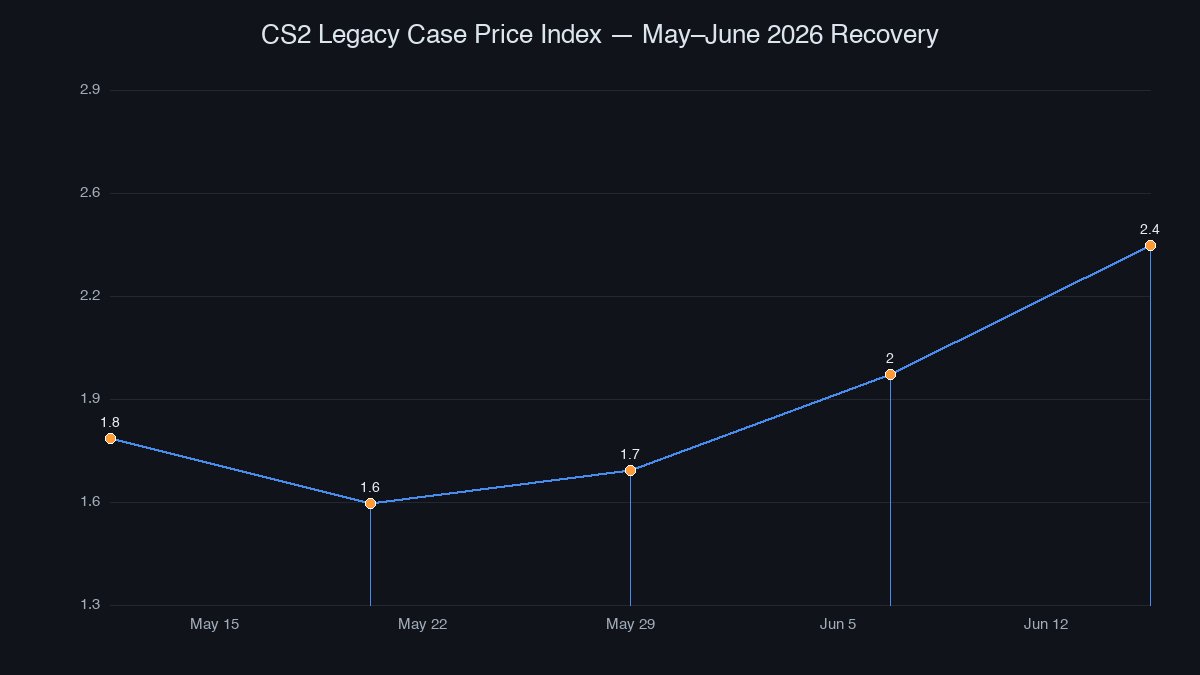
These aren't explosive, single-day spikes. They're methodical, sustained upticks that look more like accumulation than speculation — the kind of pattern you see when buyers are building positions, not chasing pumps.
What Changed in Late May
Three factors converged. The first and most structural is supply compression. In early 2026, community drop trackers recorded dozens of legacy cases falling to near-zero appearance frequency in the Weekly Care Package. Valve didn't announce this — the community found it by logging millions of drop events. When fresh supply stops, existing inventory thins through openings and hoarding. Prices don't jump immediately, but the floor rises.
The second factor is the Cologne 2026 Major sticker launch on May 21. Major events reliably redirect attention — and wallet share — toward stickers and souvenir packages. But they also pull players back into the game, which increases case opening volume. More cases opened means fewer cases in circulation. The Cologne Major ended in early June, and case prices kept climbing after it concluded — suggesting the demand wasn't just event-driven.
The third, and hardest to quantify, is sentiment recovery. The trade-up update in October 2025 broke confidence. Six months of sideways-to-down prices scared off speculators. But markets that survive a correction without collapsing often see the strongest subsequent recoveries — and the CS2 skin economy has weathered this one without a single major platform failure or scam wave. That resilience, however quiet, matters.
Which Cases Are Moving — and Which Aren't
Not every case is participating in this recovery. The 2016–2019 bracket is where the action lives. Cases from that era hold a specific appeal: they contain skins that have been out of the active drop pool long enough for supply to genuinely constrain, but they're recent enough that players recognize and want the contents. The Gamma Case's M4A4 | Desolate Space and Spectrum Case's AK-47 | Bloodsport are skins players actually use, not just collect.
By contrast, post-2020 cases — the Fracture Case, Recoil Case, and Snakebite Case — have barely moved. Supply remains abundant, and their most desirable skins are still actively traded in volume. The recovery hasn't reached them, and it may not for months.
The pre-2016 cases tell a different story entirely. Operation Bravo, Weapon Case 1, and the eSports 2013/2014 cases live in collector territory — their prices are driven by scarcity, not weekly opening demand. They've been expensive for years and haven't changed meaningfully through this cycle.
The Container Wildcard: Terminals
The introduction of Sealed Terminals — first the Genesis Terminal in September 2025, then the Dead Hand Terminal in March 2026 — adds a variable that didn't exist in previous case cycles. Terminals don't require keys, which makes them more accessible to casual openers. That accessibility could be pulling opening volume away from traditional cases, which would normally be bearish for case prices.
But community drop data suggests the Dead Hand Terminal appears in roughly 32% of Weekly Care Packages while each standard case appears around 17%. If terminals are absorbing some of the opening demand that would have gone to standard cases, the fact that standard case prices are still rising is even more noteworthy. It implies the underlying demand is strong enough to push prices up despite competition from a free-to-open alternative.
What the Pattern Suggests
Slow, sustained price increases on declining supply is the healthiest pattern a collectible market can show. It's not exciting — no 200% moonshots, no panic buying — but it's durable. The Clutch Case didn't go from $1.80 to $2.40 in a day. It took two weeks of consistent upward pressure.
That said, one data window doesn't make a trend. The 33% gain is real, but it's built on community-aggregated price indices with varying methodology. Valve publishes no official case price data, and third-party trackers can diverge by 5–10%. The signal is clear — prices are up — but the exact number has error bars.
The broader question is whether this recovery extends to the skin market beyond cases. Case prices recovering while skin prices stay flat would be unusual historically — cases and their contained skins tend to move together over medium timeframes. If case prices hold at these levels through late June, the contained skins will almost certainly follow.
For anyone watching the market right now, the next signal to track is simple: does the Clutch Case hold above $2.30 through the end of June? That single data point tells you more than any prediction. If it does, this isn't a bounce. It's a floor. And from a floor, you can build. If you want to see what today's numbers actually look like on the live market, the Phantom Cache case market has real-time pricing across every active case and skin — no estimates, no aggregation lag.