Knife Crafting Has Already Eaten 40% of CS2's Red Skins

Knife Crafting Has Already Eaten 40% of CS2's Red Skins
Roughly 8 million Covert-grade skins have been fed into CS2's Trade Up Contract since knife crafting arrived. Against a rough total pool of 22 million red skins, that is close to 40% of the entire Covert tier — not traded, not resold, but permanently consumed.
That number comes from a September 29 community study that spread fast through trading circles, and it reframes almost a year of knife crafting as something bigger than a market event. It is a supply event. Red skins used to be collectibles at the top of the weapon ladder. Now they are fuel.
The Number That Started the Argument
The estimate comes from reddit user VirtualTrust2048, who took a different route than most market observers: instead of tracking prices, he tracked outputs. Every knife produced in CS2 carries a Pattern ID, and crafted knives show up at a known value — Pattern ID 1000. Counting those, then working backwards through the five-to-one contract ratio, gives an estimate of how many Covert skins were consumed to produce them.
His conclusion: more than 8 million Covert skins went into knife contracts, out of roughly 22 million that have ever existed. Around 40% of the tier, gone.
That is a big claim, and it should be treated as an estimate rather than an audit. The method assumes a consistent relationship between crafted knives and their pattern signatures, and it cannot see items sitting in dormant or abandoned inventories. But the direction of travel has never really been in doubt — what is new here is the scale. Previously, the community argued about whether knife crafting was "draining" Covert supply. The study suggests the drain was closer to a flood.
How Five Red Skins Become a Knife
To understand why the numbers got this large, it helps to remember how simple Valve made the recipe. The October 22, 2025 update extended the Trade Up Contract to the top tier: five Covert-rarity items in, one rare special item out.
- 5 regular Covert skins → one regular knife or one pair of gloves.
- 5 StatTrak Covert skins → one StatTrak knife (gloves have no StatTrak version).
- Mixing StatTrak and normal inputs is not allowed, and mixing collections widens the output pool instead of narrowing it.
The five inputs decide which pools you roll into: the result comes from the collection of one of your skins, so five reds from the same case lock the outcome to that case's knife roster. Float matters too, since the wear of your inputs maps onto the wear of the output — which is why low-float reds carry a premium they never had before.
There is one more rule worth knowing: skins received through a trade carry a 7-day trade hold before they can be used in a contract, while items bought directly from the Steam Market can be crafted immediately. That single detail quietly decides who can mass-craft on day one of a price move and who has to wait.
The Cases That Got Gutted
The headline 40% is an average, and averages hide the interesting part. The same study breaks the damage down by case, and the disparity is enormous.
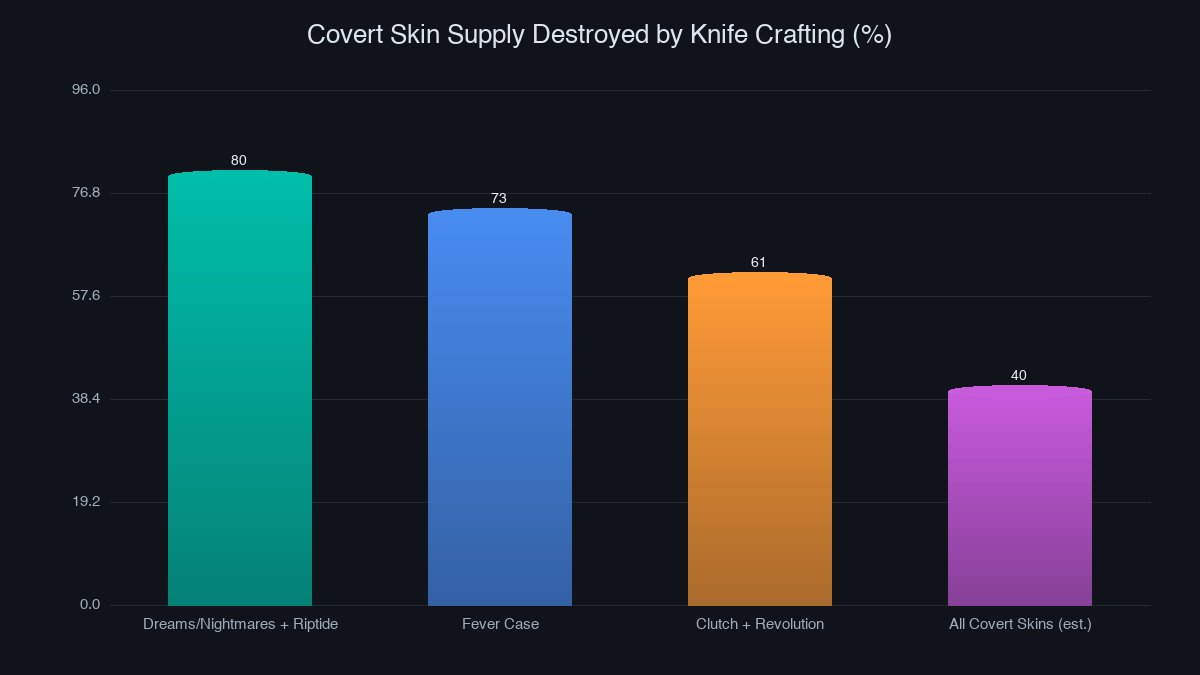
- Dreams & Nightmares and Operation Riptide: an estimated 80% drop, roughly 1.641 million items consumed. Both cases are famous for housing some of the most desirable knife finishes in the game, which makes them the natural first stop for crafters.
- Fever Case: down about 73%, or around 680,000 reds.
- Clutch and Revolution: down about 61%, approximately 1.626 million items between them.
Notice the pattern: the cases people craft from are not the cheapest ones. They are the ones with knife pools worth chasing. A cheap red from a case with an unremarkable knife roster is poor material, so it survives. A red from a case that can spit out a Butterfly or a Karambit gets bought up and destroyed, which means the cases with the best knife lines are losing their red skins fastest.
That is not a localised quirk in one corner of the market. It is a structural change across several of the most important sources of high-rarity items in the game at once.
Why Scarcity Cuts Both Ways
When supply of a consumable input collapses, the first thing that moves is the price of the input. Covert skins spiked hard within hours of the original update, and the study suggests that repricing has been sustained rather than a one-off spike, because the underlying material really did disappear.
The second thing that moves is the output. Knives and gloves flooded the market immediately after launch — total market capitalisation reportedly dropped by nearly $2 billion in the aftermath — because supply stopped being governed by case-opening odds alone. Years of accumulated exclusivity got diluted in weeks.
Trader TDM_Heyzeus has pointed at the combination that matters now: mass destruction of Covert supply on one side, and Valve's gradual move away from the case model on the other. If the raw material for crafting keeps shrinking while new items do not enter circulation any faster, scarcity starts working in favour of existing high-end positions again. That is the bull case for knives — and it is not a short-term story. It is a multi-month one.
The bear case is just as easy to state. Valve controls every lever that matters here. The company could tighten contract eligibility, add cooldowns, introduce material costs, or simply keep shipping new cases that refill the red tier from the top. Anyone who treats a supply estimate as a guaranteed price trajectory has confused a data point with a promise.
What It Means for Your Inventory
If you own Covert skins, the practical read is that you are holding something with industrial demand rather than pure collectible demand. That changes how you should think about them. A red skin's floor is no longer just what another collector will pay — it is what a crafter will pay for five of them, because that stack has a knife on the other side.
If you own knives, the interesting question is which ones depend on a shrinking input base. A knife whose only realistic entry route was ever case openings behaves differently from one you can now assemble from reds. And if you are the one doing the crafting, the maths is unforgiving: five inputs at inflated prices, plus fees, plus a random finish at the end of it. Win rates look great on highlights and terrible on spreadsheets.
The most useful habit right now is checking what the inputs actually cost before you get excited about an output. A Frost Vault opening and a five-Covert contract are two completely different bets, and only one of them lets you pick your odds. New CS2 and knife cases are listed with live prices and drop pools on our skin marketplace, which is the fastest way to price both sides of a contract before you commit — and to see whether the item you are about to burn as material is worth more intact than it is as fuel.
A Caveat Before You Buy Anything
Supply estimates like this one are most useful as a weather report, not a forecast. They tell you which way the wind has been blowing for eleven months. Right now it has been blowing red skins into the knife grinder, fastest in exactly the cases with the best knives inside them.
What happens next depends on Valve, on craft volumes, and on whether the community keeps treating Covert skins as material rather than as collectibles. Watch the input price, not the highlight reel. If five reds cost more than the average knife they can produce, the crusade is over for now — and the reds you are holding quietly become collectibles again.