CS2 Case ROI Compared: A $0.13 Case vs a $2.74 Case
CS2 Case ROI Compared: A $0.13 Case vs a $2.74 Case
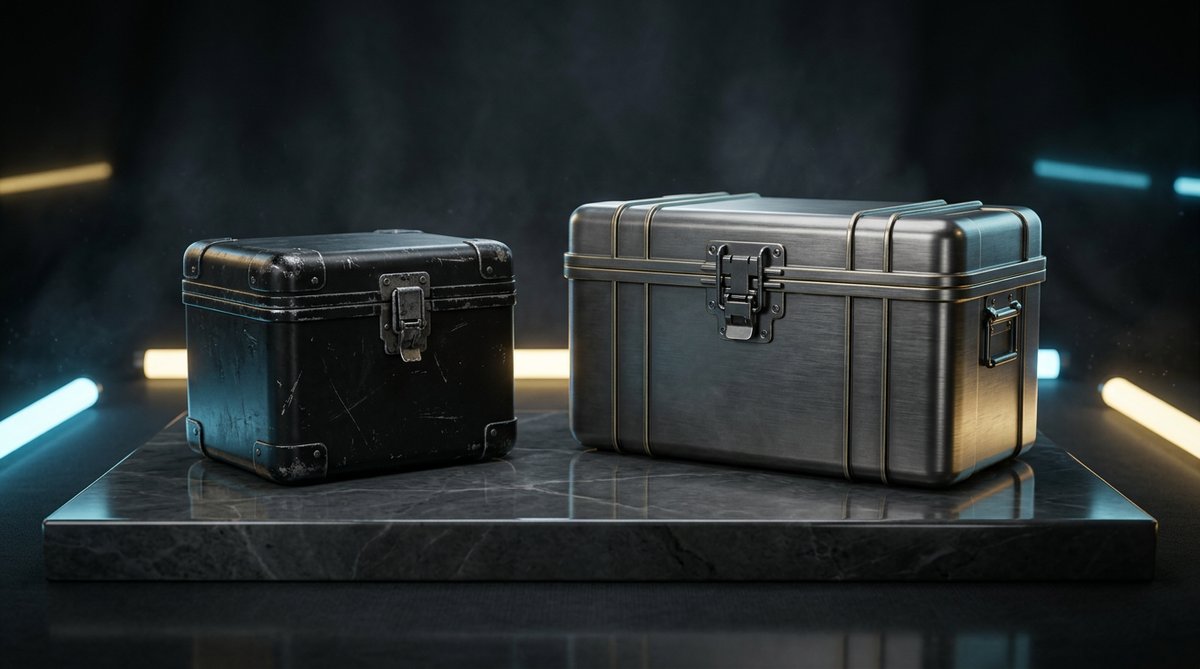
Same key. Same 0.26% shot at a knife. One sealed case costs thirteen cents; the other costs two dollars and seventy-four — and every ROI table on the internet ranks them in the same order while printing a different number for each.
So here is the comparison done properly. Kilowatt Case against Gamma 2 Case, round by round: what you hand over at the counter, what is actually inside the box, and what that 0.26% tier does to the math when you run it 267 times.
Round 1: What You Hand Over
Keys are not the variable. Valve sells them at a fixed price and never discounts them; the community tracks it at roughly $2.49 to $2.50. The case itself is the only part of the bill that moves, and that is where these two split apart.
- Kilowatt Case — about $0.12 to $0.15 on the lowest listing. Full cost per opening: roughly $2.63.
- Gamma 2 Case — about $2.73 to $2.74. Full cost per opening: roughly $5.19 to $5.24.
Twice the money out of your wallet for identical odds. On that alone the cheap case wins, and it is not close.
But there is a reason Kilowatt is nearly free, and it is the same reason Gamma 2 is not. Kilowatt is still in Valve's weekly drop pool, so supply keeps arriving and the sealed box stays a commodity. Gamma 2 rotated out years ago; no new copies enter the game, and every opening permanently destroys one. When supply stops, scarcity takes over. The Gallery Case is the live example — after it left the Armory rotation, its price roughly doubled from about $1 to about $2.
Round 2: What Is Actually Inside
Round 1 goes to Kilowatt. Round 2 is a different fight.
The tier odds are identical, because Valve published one table and applies it to every standard weapon case: 79.92% blue, 15.98% purple, 3.20% pink, 0.64% red, 0.26% gold. Roughly one opening in ten also rolls StatTrak on the non-gold tiers. Nothing you can do shifts those percentages, so the only thing separating the two cases is what each tier is worth.
That gap is wide. Kilowatt's contents are still being supplied by the same players opening it, which holds every tier down. Gamma 2's supply is frozen and shrinking, so its skins carry scarcity pricing. Expected value measures exactly that, and the trackers put Gamma 2's average return near $2.54 per opening against a $5.24 cost, with a gold-tier average around $415. Kilowatt recovers closer to 28 cents per dollar in the same snapshot.
Now look at the ceiling. A tracker that prices every case live puts the best performer — Chroma 3 — at about 80% of cost returned, and Kilowatt near the bottom of the field. Then remember the sale side: Steam takes around 15% when you sell what you unbox, which means a case needs roughly 118% raw recovery just to break even in cash. The best case in the game sits 38 points short of that line. Case opening is not a value strategy; it is a variance purchase, and both of these boxes are priced accordingly.
Round 3: The 0.26% Question
This is the round people actually care about, and the one the odds punish hardest. 0.26% is one opening in roughly 385. Stated the way you experience it, you need about 267 openings for a coin-flip chance at a gold — and the odds never carry over between attempts, so a hundred blue pulls in a row changes nothing about the hundred and first.
Run that against each case's cost and the practical difference finally lands. 267 openings of Kilowatt at $2.63 is about $702. The same run on Gamma 2 at $5.24 is about $1,399. Twice the money for the same coin flip.
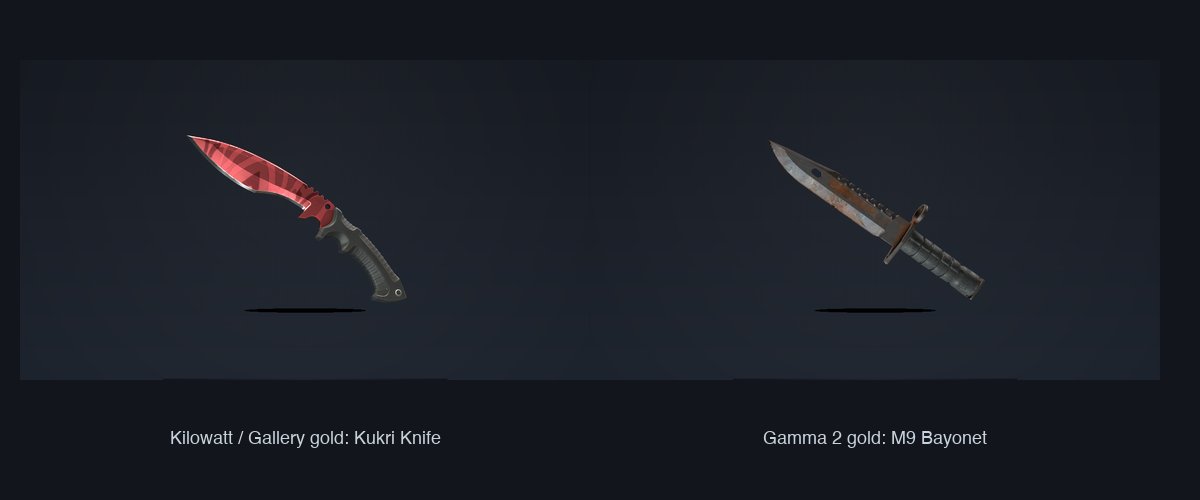
What you are flipping for is not the same, though. Kilowatt's gold pool is the Kukri Knife — the newest knife model in the game, and one you cannot pull from any legacy case. Gamma 2's pool is the classic generation, including the M9 Bayonet with the Gamma Doppler finishes at the top of it. If the knife you want only exists in one of those pools, the cheaper case is not cheaper. It is simply the wrong box, and no ROI percentage fixes that.
Why Four ROI Tables Give Four Answers
Gamma 2 shows up as 48.5% ROI on one tracker, as 61.6% of spend returned on a second, and as 65% recovery on a third. None of them are lying. They are answering slightly different questions.
- Key price. A $2.49 key versus a $2.50 key shifts the denominator far more on a thirteen-cent case than on a three-dollar one.
- StatTrak weighting. Counting the ~10% StatTrak roll as a premium, or leaving it out, moves the top of the table.
- Wear distribution. Whether Factory New and Battle-Scarred copies of the same skin are weighted by real drop frequency or averaged flat.
- The sale fee. Several tables quote raw market value and never subtract Steam's cut, which flatters every single row.
- Trade-up routing. Some drops are worth more fed into a contract than sold outright, and only some trackers count the better of the two outcomes.
One number survives all four methods: no case clears 100%. Across 40 priced cases the average modeled return lands near 39%, and the spread between the best and worst case in the game is wider than the spread between the two boxes in this article. That is worth sitting with — the argument over which case to open is a much smaller decision than the argument over whether to open one at all.
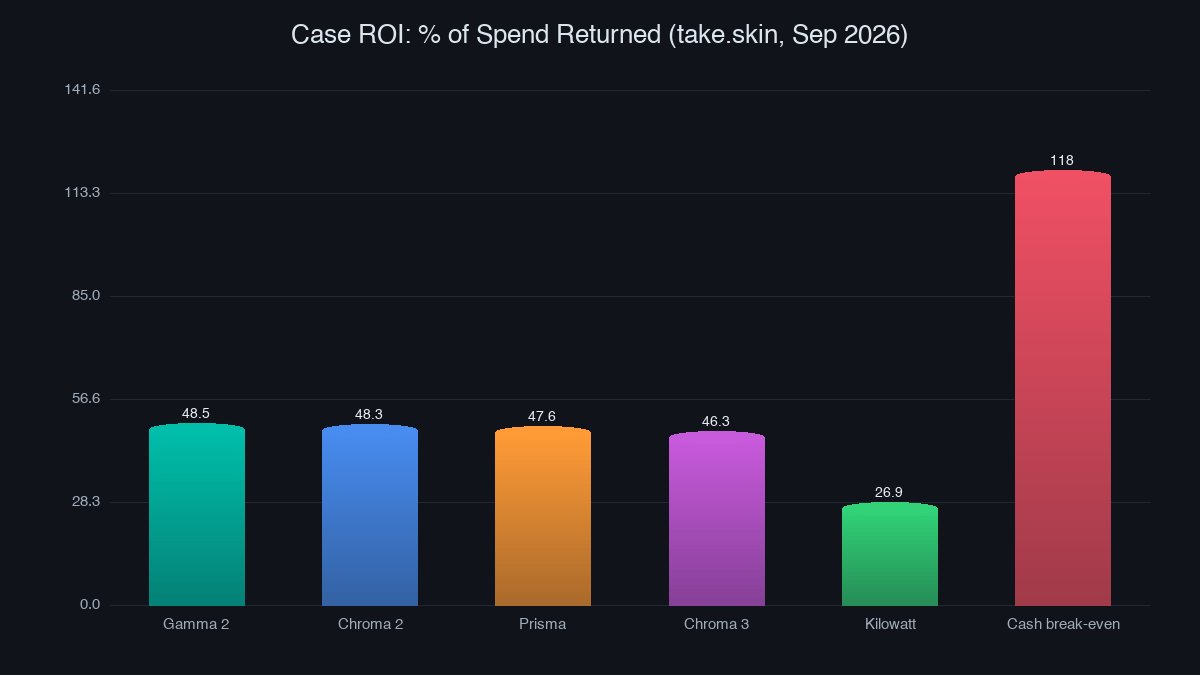
The chart above is the whole argument in one picture. Five of the most-recommended cases in the game, measured by the same methodology on the same day, all land between 26.9% and 48.5% of spend returned. The tall bar on the right is not another case — it is the 118% a case would need to return before Steam's sale fee stopped eating the proceeds. That gap is not a market inefficiency waiting to be corrected. It is the product.
So Which Box Do You Buy
If you are opening for the experience, the number that matters is cost per attempt, not the ROI percentage. Kilowatt lets you take twice as many swings for the same money, and on a 0.26% event, attempt count is the only lever you actually control.
If you are chasing one specific knife, work backwards from the gold pool instead of the price tag. Kilowatt and Gallery are the only two cases that can produce a Kukri Knife; Gamma 2 is your route into the older knife models and the Gamma Doppler finishes. Buying the wrong box cheaply is the most expensive mistake in case opening, and it is the one the ROI tables cannot warn you about because it is not a math error — it is a target error.
And if you want the skin rather than the gamble, the arithmetic is blunt: at these recovery rates you are paying somewhere between 1.6 and 3 times a skin's market price for the privilege of randomness. The players who come out ahead in this economy decide which exact item they want first, then go buy that item. Low-entry cases are still where most people start, though, and the Phantom Cache is a good first comparison point — its full reward pool is published, so you can price the box before you ever spend a key on it.