Cologne 2026's Sticker Market Split in Two: $1,468 vs $52 for the Same Logo

Cologne 2026's Sticker Market Split in Two: $1,468 vs $52 for the Same Logo
On July 28, Valve put a second version of every IEM Cologne 2026 sticker into the in-game shop. Same teams, same players, same tournament. The Team Falcons gold sticker already circulating was asking around $1,468. The new one, one tab over, cost $52.
That is not a discount. It is Valve repricing an entire collectible category overnight, and the original series has been bleeding ever since.
Round 1: What Each Series Actually Is
Cologne 2026 was already the strangest Major cosmetic cycle Counter-Strike has run. When the event shop opened on May 21, capsules were gone. Instead of buying a randomised capsule and hoping, players bought tokens — 100 tokens for about $0.99 — and spent them directly on the specific team logo or player autograph they wanted. Valve shipped 772 stickers into that system at launch.
The prices in that shop were dynamic. Valve moved them up and down with demand, and published nothing about how the algorithm worked, how much supply existed, or what triggered a jump.
Then came the correction. On July 28 Valve added a second, parallel set: the Ranked Series. Visually they are similar, with one difference that matters — a square border around the classic circular design, plus a small number in the corner showing where that team or player finished at the event. There are 579 of them.
The important difference is not the art. It is that Ranked Series prices are fixed.
Round 2: The Price Tag
Here is what dynamic pricing actually produced before the Ranked Series existed. Content creator Gabe Follower priced out the 100 most expensive Cologne stickers and found it would cost $19,447.37 to buy one of each. The single priciest item in Valve's own shop reached $1,522. At points, some stickers could not be bought in a single transaction at all because they exceeded the $2,000 balance limit on a Steam wallet.
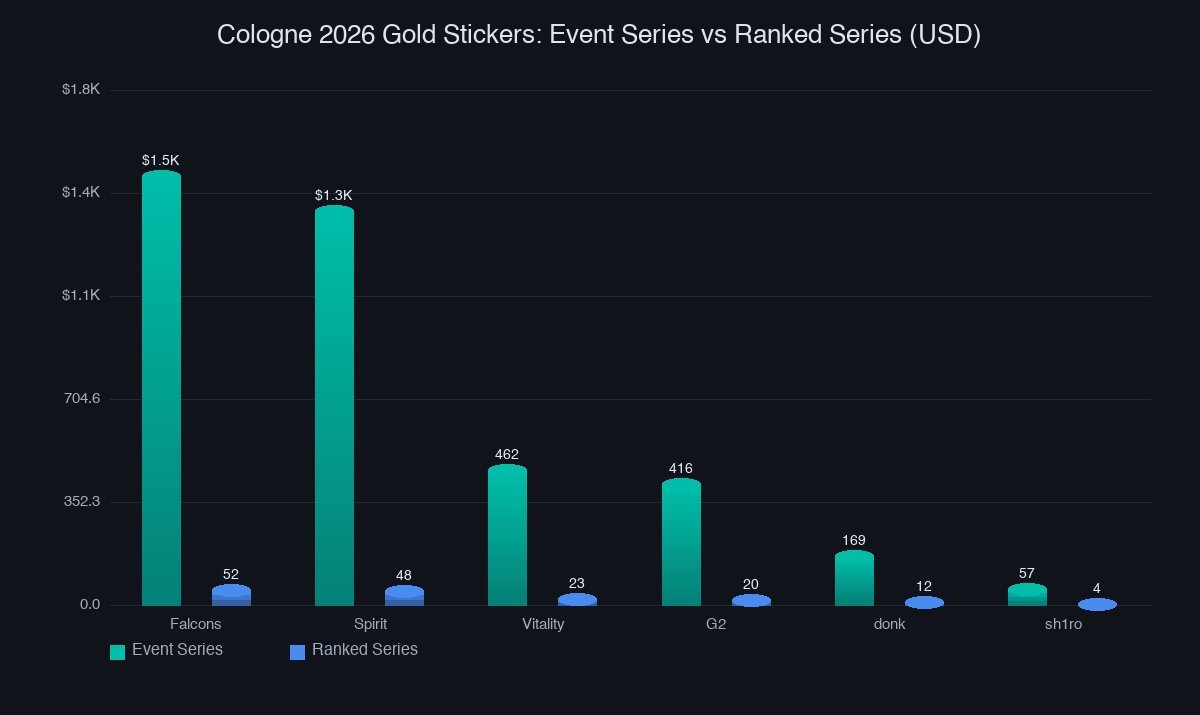
The Ranked Series caps out at roughly $60 — about 6,000 tokens. The gap is not a rounding error. For the same team and the same finish:
- Falcons Gold — Event Series ~$1,468, Ranked ~$52
- Spirit Gold — Event Series ~$1,348, Ranked ~$48
- Vitality Gold — Event Series ~$462, Ranked ~$23
- G2 Gold — Event Series ~$416, Ranked ~$20
- donk Gold — Event Series ~$169, Ranked ~$12
- sh1ro Gold — Event Series ~$57, Ranked ~$4
The token math tells the same story. In the same shop, a NiKo Champion sticker in the Ranked Series cost 4,011 tokens. The original Event Series version of that same autograph cost 98,773 tokens — roughly twenty-five times as much, for a sticker the game treats as functionally identical once it is on a gun.
Round 3: What Happened to Both Series
The obvious assumption is that the cheap copies crashed and the expensive originals held. The market did something more interesting: both sides slid.
The Ranked Series golds spiked almost immediately — scarcity of a brand new item, plus a shop that had only just opened — and then collapsed. The MAJ3R gold sticker hit an all-time high of $50.00 on August 10. It trades at $4.18 today, a 91.64% drop over 30 days. The gafolo gold peaked at $24.23 on August 6 and now sits at $1.65, down 90.73%. Even the holo tier is soft: the PR holo ranked sticker is off 24.78% in a week.
The Event Series, meanwhile, lost the thing that made it worth holding. Its entire premium rested on being the only version in existence. Once a fixed-price alternative shipped for every single team and player, "rare" stopped meaning anything. Anyone who bought a Falcons or Spirit gold as an investment watched the bulk of its perceived value evaporate in a single patch note.
Round 4: Why Valve Did It Anyway
Valve's own wording is unusually blunt. In shipping the Ranked Series, the developers acknowledged that the original dynamic pricing system "didn't produce reasonable prices." That admission followed reporting that several teams had seen Cologne sticker sales fall to as little as 20% of what an equivalent StarLadder Budapest Major capsule paid out.
The revenue split explains the pressure. Half of Major Shop and Viewer Pass revenue goes to the organiser, teams and players, divided by placement: the tournament organiser takes 5%, first place 2.85%, second 2.53%, third and fourth 2.25%, fifth through eighth 2.0% each, and the teams finishing 31st and 32nd collect roughly 0.72%. When the top of the market is priced so high that almost nobody buys, the money that was supposed to reach the lower-placed rosters never materialises.
Valve also bolted a circuit breaker onto the whole system: if a sticker's price falls by more than 25 tokens within 24 hours of your purchase, the difference is refunded to your token balance and you keep the sticker. A stable market does not need an emergency brake that trips inside a single day. This one does.
It is worth being precise about what the token shop replaced. Under the old capsule model, you bought a container for a fixed, low price and the Gold was a lottery ticket inside it. Most buyers ended up with a stack of Paper stickers for organisations they did not care about. The new model removes the lottery, which sounds friendlier, but it also removes the ceiling: every sticker has an individual price, so the popular ones can rise without limit until demand finally breaks. That is the mechanism that produced the $1,522 sticker, and it is the mechanism the Ranked Series now competes against.
The Verdict
If you want a Cologne 2026 sticker to actually put on a weapon, the Ranked Series is the only sane buy. You get the same team, the same autograph, the same finish, plus a placement number the original does not have, at a fraction of the cost. Buying the Event Series purely for the design is paying a twenty-five-times premium for a circular border.
The craft math makes the case on its own. Community estimates put a four-sticker holo craft at roughly $200 under the old Event Series pricing, a figure that would once have funded a full capsule spree at a previous Major. Built from Ranked Series stickers, the same four-slot craft costs a small fraction of that. If your goal is the look on the gun rather than a line in a portfolio tracker, there is no version of this where the expensive sticker wins.
If you are holding Event Series as an investment, the honest read is that you are now betting on Valve never doing this again — while Valve has said the token shop and dynamic pricing are built into future Majors, not a one-off experiment.
There is a hard deadline attached to all of it. The Cologne 2026 shop closes on September 29. After that date neither series can be bought in-game at any price, and any tokens you have not spent stop being redeemable for stickers. If you want to grab something before the door shuts, the last two weeks are the window.
The same logic that makes the cheap stickers the smart pick also applies to cases: pay attention to what a box actually returns rather than what its best pull looks like on a stream. Our Fan Favorite lists every pull and its real market value before you buy, and the full skin market lets you price any sticker or skin against live listings instead of taking an asking price at face value.