How to Buy Around the 7-Day Trade Lock Without Losing Money

How to Buy Around the 7-Day Trade Lock Without Losing Money
You spot a skin at 8% under every other listing. You pay. Then you notice the countdown: six days and eleven hours before you can touch it. Somewhere between a third and a half of the listings on any third-party marketplace at any given moment are in exactly that state, and the discount is not generosity — it is the price of waiting.
Learning to read that timer is one of the few edges in CS2 trading that costs nothing and requires no prediction about where prices go. Here is how to work it properly.
Step 1: Know Which Lock You're Looking At
There are three states an item can be in, and they behave nothing alike.
The first is a 7-day trade hold. Anything you buy on the Steam Community Market, unbox from a case, or take out of the in-game store or Armory arrives locked for seven days. You own it. You can equip it in a match. You cannot trade it or list it on Steam. Nothing shortens the timer, and there is no fee you can pay to skip it.
The second is Trade Protection, the yellow shield. Introduced in July 2025, this applies to items you receive in a trade. They are usable immediately, but for seven days the sender can have the trade reversed through Steam Support if their account turns out to be compromised. During that window you cannot re-trade it, list it, sell it on a third-party site, or move it into a storage unit — and you cannot open cases, apply stickers, or add name tags from that trade either.
The third is no lock at all: items from your weekly drop, or anything whose timer has already expired. These are the only listings a seller can actually hand you right now.
For buying, the distinction that matters most is hold-versus-protection. A held item's seller already owns it outright; they simply cannot deliver. A protected item has already changed hands once and can still snap back. Reputable marketplaces price these differently, and some quote two delivery estimates for the same skin for exactly this reason.
Step 2: Price the Discount Correctly
Locked copies of the same skin routinely list 5–10% cheaper than instantly deliverable ones. The instinct is to read that as free money. It is not — it is compensation for capital sitting still, and whether it is worth taking depends entirely on what you plan to do with the item.
If the skin is going straight into a loadout, the lock costs you nothing. You can equip it the moment it lands. Waiting seven days for a 7% discount on something you intend to keep is one of the cleanest trades in this market.
If you are buying to flip, the lock is a real cost, because your exit is also locked. You cannot sell before the timer clears, and by then the market may have moved. The honest way to size this: a discounted locked copy only beats the instant listing if the price holds or rises across your waiting window, and on the high-volume commodity end of the market it usually does not. Roughly 34% of all CS2 skins sit in the $0–$1 bracket and another 30% between $1 and $10, and those tiers churn constantly.
Then subtract the round trip. Fees decide whether a flip was ever profitable, and the break-even move is bigger than the headline number suggests:
- HaloSkins — 1% fee, needs +1.0% to break even
- CSFloat — 2%, needs +2.0%
- White.Market and CS.MONEY — 5%, needs +5.3%
- Waxpeer — 6%, needs +6.4%
- Skinport — 8%, needs +8.7%
- SkinBaron — 15%, needs +17.6%
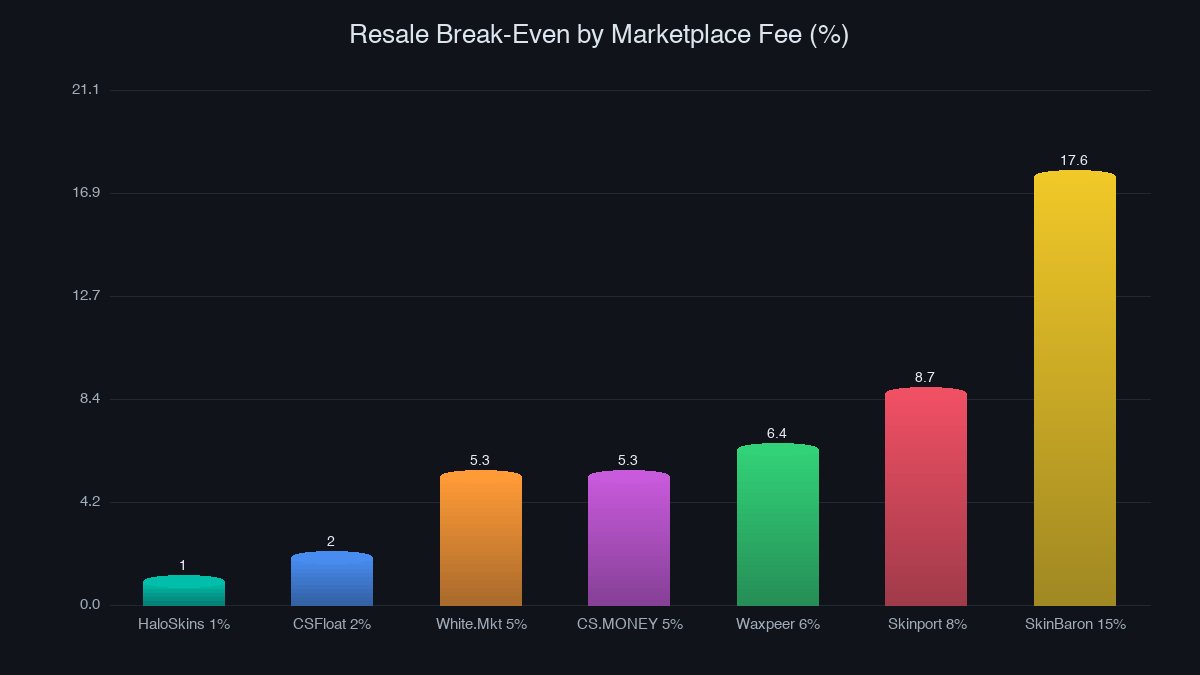
Against those numbers, a 7% lock discount on a 15% fee venue is already underwater before the skin moves at all. On a 2% venue it is roughly break-even with no margin for error. The discount and the fee have to be read together, never separately.
Step 3: Time the Unlock
This is where 2026 changed the game, and most guides have not caught up.
Older guidance was built on a shared daily reset: thousands of locked items all became tradable at the same fixed moment, so supply dumped onto the market in one wave and prices dipped right after. Buying into the dip and selling into the recovery was a real, repeatable pattern.
That wave no longer exists. Each item now unlocks exactly seven days after it entered the inventory, timed individually rather than on a shared schedule. The cooldown length did not change — only its precision. Thousands of simultaneous unlocks became a steady trickle spread across every hour of every day.
Practically, that kills lock-wave timing as a strategy and creates a smaller one: if you are selling, your unlock moment is now predictable to the minute, and so is the delivery deadline you are implicitly promising a buyer. If you are buying, the flat trickle means there is no rush — a locked listing that is 3% cheaper today will still be about 3% cheaper tomorrow, so you can take a week to decide without losing the edge.
The one time this matters a lot is right after a container release. New skins move fastest in their first days, and a seven-day hold means the people who unboxed early all reach tradability on a staggered but still dense schedule. First-week price drift is larger than most fee differences between marketplaces — that is the number worth pricing, not the last decimal of a commission.
Step 4: Pick the Venue That Survives the Round Trip
Steam remains the default and remains the worst deal for a seller: a 5% Steam fee plus a 10% CS2 fee means a $100 sale nets about $85, paid in Steam Wallet credit that cannot be withdrawn. There is also a $1,800 cap per listing and a $2,000 wallet ceiling, so the genuinely expensive items cannot even be listed there.
That is why cash-out venues exist, and why their fees span such a wide range. The practical rule is to match the venue to the job: the cheapest-fee platform for anything you plan to resell quickly, a P2P marketplace for float and pattern hunting, and Steam only when you want wallet funds you were going to spend inside Steam anyway.
One more mechanical detail that catches bulk buyers: since the April 2026 patch, a single trade offer involving CS2 inventory is capped at 1,000 items. Inventory transfers that used to clear in one trade now have to be split, which adds friction and time to exactly the kind of large-scale activity that trade locks already slow down.
Putting It Together
The rule set is short. Never buy a locked listing for a flip unless the discount exceeds the round-trip fee on the venue you will sell on. Always buy a locked listing for personal use when the discount is real, because waiting costs you nothing you were not already spending. And stop planning around synchronized unlock waves — 2026 retired them.
For anyone who would rather skip the timers entirely, the SkinVS shop lists skins with delivery terms shown up front, so you know before checkout whether you are buying now or buying a countdown. That single line of information is worth more than most people realise until they have been stuck waiting on a parcel for a week.
Timers and fee figures are current as of October 2026; Valve has changed lock behaviour more than once in the last eighteen months and can change it again without warning.